Review
. 2014 Aug 5:8:93.
doi: 10.3389/fncir.2014.00093. eCollection 2014.

Dopamine modulation of learning and memory in the prefrontal cortex: insights from studies in primates, rodents, and birds

Affiliations
Review

Dopamine modulation of learning and memory in the prefrontal cortex: insights from studies in primates, rodents, and birds

M Victoria Puig et al. Front Neural Circuits. .

Abstract

In this review, we provide a brief overview over the current knowledge about the role of dopamine transmission in the prefrontal cortex during learning and memory. We discuss work in humans, monkeys, rats, and birds in order to provide a basis for comparison across species that might help identify crucial features and constraints of the dopaminergic system in executive function. Computational models of dopamine function are introduced to provide a framework for such a comparison. We also provide a brief evolutionary perspective showing that the dopaminergic system is highly preserved across mammals. Even birds, following a largely independent evolution of higher cognitive abilities, have evolved a comparable dopaminergic system. Finally, we discuss the unique advantages and challenges of using different animal models for advancing our understanding of dopamine function in the healthy and diseased brain.

Keywords: dopamine receptors; evolution; executive function; learning and memory; neuromodulation; prefrontal cortex; working memory.


Figures
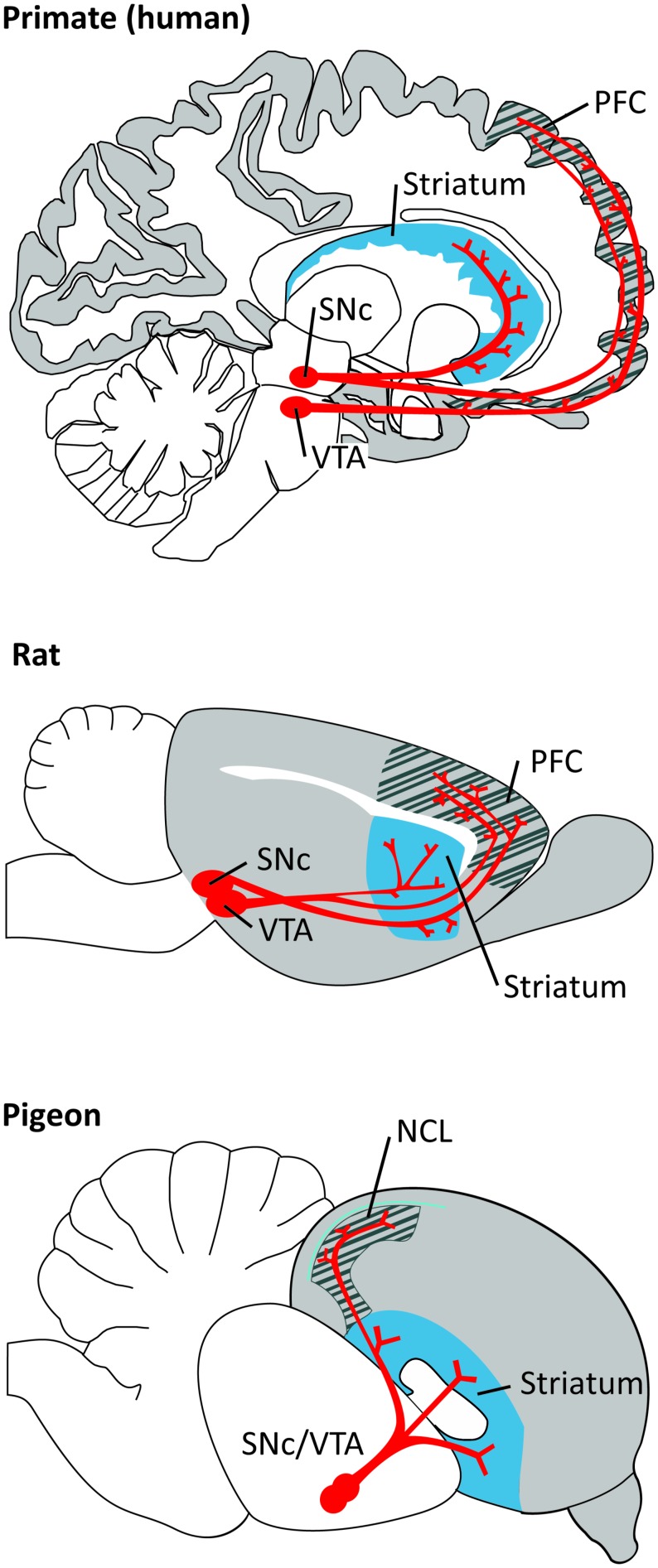
FIGURE 1
FIGURE 1
Dopaminergic projections (in red) from the ventral tegmental area (VTA) and substantia nigra pars compacta (SNc) to the PFC/NCL and striatum in the brain of a primate (human), a rat, and a pigeon. Pallial (cortical) areas across species are shaded in gray, the hatched area denotes the PFC/NCL, striatal areas are shaded in blue. Note that, in all species, DA neurons in both dopaminergic nuclei project to several subregions of the PFC/NCL and striatum.
FIGURE 2
FIGURE 2
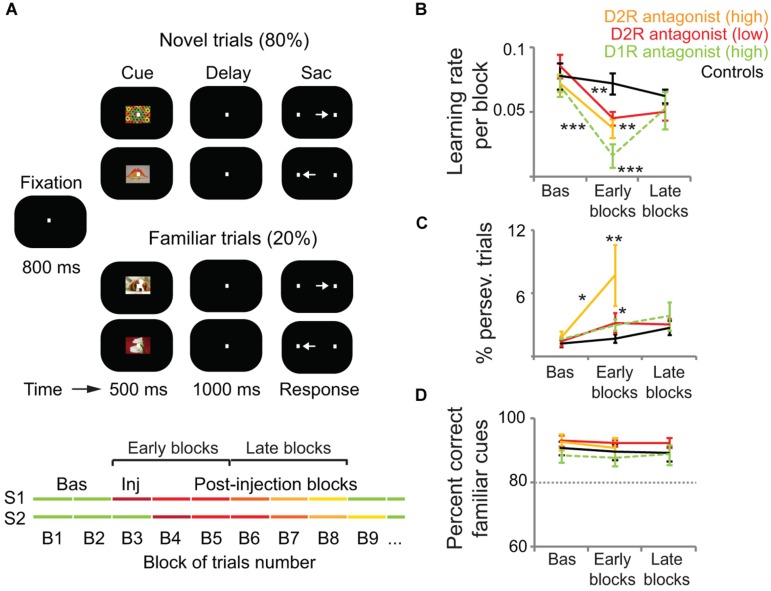
D1R and D2R in the monkey lateral PFC modulate associative learning but not highly familiar associations. (A) Delayed associative learning and memory task. Animals fixated to start a trial. A cue object was followed by a brief memory delay and presentation of two target dots. Saccade to the target associated with the cue was rewarded with juice drops. Trials were blocked in pairs of novel cues (80% of trials) and pairs of familiar cues (20% of trials). When performance on novel trials reached the learning criteria (80% correct and 30 correct trials per novel cue), novel cues were replaced and a new block of trials started. Monkeys first completed several Baseline blocks (Bas; first green lines). Then, 3 μl of either saline (controls; n = 20 sessions), a D1R antagonist (30 μg of SCH23390; n = 30 sessions), or a D2R antagonist (high concentration, 30 μg of eticlopride, n = 10 sessions; low concentration, 1 μg of eticlopride, n = 26 sessions) were pressure-injected in the left lateral PFC (Inj, injection block). Drugs were injected after different numbers of baseline blocks in different sessions (S1–S2) to account for any confounds generated by a systematic behavior of the monkeys. We classified blocks as baseline, “early” (injection block and first two postinjection blocks), or “late” (postinjection blocks 3–5). (B) Average learning rates across sessions. We measured the learning rate of each block of trials by fitting a sigmoid distribution to the performance of the monkeys on novel trials using a logistic regression model. Learning rates were the slopes of the fitted distributions. Learning rates decreased significantly after the injection of both D1R and D2R antagonists compared to baseline and post-saline blocks. The D2R antagonist reduced learning rates less than the D1R antagonist. (C) Average percent of perseverative errors (consecutive error trials of the same cue). Perseverative errors increased significantly after the injection of both D1R and D2R antagonists compared to baseline and post-saline blocks. The high concentration of the D2R antagonist elicited more perseveration than the other treatments. (D) Average percent correct of familiar trials during the baseline, early, and late blocks of trials. Dashed line depicts the 80% threshold used as part of the learning criteria. DA antagonists did not affect the performance of familiar associations. Shown are the mean and SEM. Two-way ANOVA for treatment and blocks as factors. *p < 0.05, **p < 0.01, ***p < 0.001, Tukey’s least significant difference post hoc test. Modified from Puig and Miller (2012, 2014).

References

    1. Abi-Dargham A. (2004). Do we still believe in the dopamine hypothesis? New data bring new evidence. Int. J. Neuropsychopharmacol. 7(Suppl. 1) S1–S5 10.1017/S1461145704004110 - DOI - PubMed
    1. Abi-Dargham A., Moore H. (2003). Prefrontal DA transmission at D1 receptors and the pathology of schizophrenia. Neuroscientist 9 404–416 10.1177/1073858403252674 - DOI - PubMed
    1. Albin R. L., Young A. B., Penney J. B. (1989). The functional anatomy of basal ganglia disorders. Trends Neurosci. 12 366–375 10.1016/0166-2236(89)90074-X - DOI - PubMed
    1. Alderson R. M., Kasper L. J., Hudec K. L., Patros C. H. G. (2013). Attention-deficit/hyperactivity disorder (ADHD) and working memory in adults: a meta-analytic review. Neuropsychology 27 287–302 10.1037/a0032371 - DOI - PubMed
    1. Alexander G. E., Crutcher M. D. (1990). Functional architecture of basal ganglia circuits: neural substrates of parallel processing. Trends Neurosci. 13 266–271 10.1016/0166-2236(90)90107-L - DOI - PubMed

Publication types