


The influence of race/ethnicity and place of service on breast reconstruction for Medicare beneficiaries with mastectomy
- PMID: 25140292
- PMCID: PMC4137047
- DOI: 10.1186/2193-1801-3-416
The influence of race/ethnicity and place of service on breast reconstruction for Medicare beneficiaries with mastectomy
Abstract
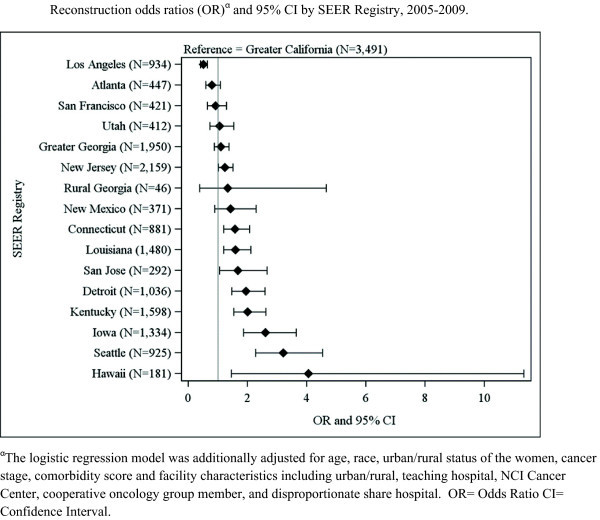
Racial disparities in breast reconstruction for breast cancer are documented. Place of service has contributed to disparities in cancer care; but the interaction of race/ethnicity and place of service has not been explicitly examined. We examined whether place of service modified the effect of race/ethnicity on receipt of reconstruction. We included women with a mastectomy for incident breast cancer in SEER-Medicare from 2005-2009. Using Medicare claims, we determined breast reconstruction within 6 months. Facility characteristics included: rural/urban location, teaching status, NCI Cancer Center designation, cooperative oncology group membership, Disproportionate Share Hospital (DSH) status, and breast surgery volume. Using multivariable logistic regression, we analyzed reconstruction in relation to minority status and facility characteristics. Of the 17,958 women, 14.2% were racial/ethnic women of color and a total of 9.3% had reconstruction. Caucasians disproportionately received care at non-teaching hospitals (53% v. 42%) and did not at Disproportionate Share Hospitals (77% v. 86%). Women of color had 55% lower odds of reconstruction than Caucasians (OR = 0.45; 95% CI 0.37-0.55). Those in lower median income areas had lower odds of receiving reconstruction, regardless of race/ethnicity. Odds of reconstruction reduced at rural, non-teaching and cooperative oncology group hospitals, and lower surgery volume facilities. Facility effects on odds of reconstruction were similar in analyses stratified by race/ethnicity status. Race/ethnicity and facility characteristics have independent effects on utilization of breast reconstruction, with no significant interaction. This suggests that, regardless of a woman's race/ethnicity, the place of service influences the likelihood of reconstruction.
Keywords: Breast cancer; Disparities; Mastectomy; Reconstruction.
Figures
References
-
- Alderman AK, Wei Y, Birkmeyer JD. Use of breast reconstruction after mastectomy following the Women's Health and Cancer Rights Act. JAMA. 2006;295(4):387–388. - PubMed
Grants and funding
LinkOut - more resources
Full Text Sources
Other Literature Sources
