


Persistently high estimates of late night, indoor exposure to malaria vectors despite high coverage of insecticide treated nets
- PMID: 25141761
- PMCID: PMC4261540
- DOI: 10.1186/1756-3305-7-380
Persistently high estimates of late night, indoor exposure to malaria vectors despite high coverage of insecticide treated nets
Abstract
Background: It has been speculated that widespread and sustained use of insecticide treated bed nets (ITNs) for over 10 years in Asembo, western Kenya, may have selected for changes in the location (indoor versus outdoor) and time (from late night to earlier in the evening) of biting of the predominant species of human malaria vectors (Anopheles funestus, Anopheles gambiae sensu stricto, and Anopheles arabiensis).
Methods: Mosquitoes were collected by human landing catches over a six week period in June and July, 2011, indoors and outdoors from 17 h to 07 h, in 75 villages in Asembo, western Kenya. Collections were separated by hour of the night, and mosquitoes were identified to species and tested for sporozoite infection with Plasmodium falciparum. A subset was dissected to determine parity. Human behavior (time going to bed and rising, time spent indoors and outdoors) was quantified by cross-sectional survey. Data from past studies of a similar design and in nearby settings, but conducted before the ITN scale up commenced in the early 2000s, were compared with those from the present study.
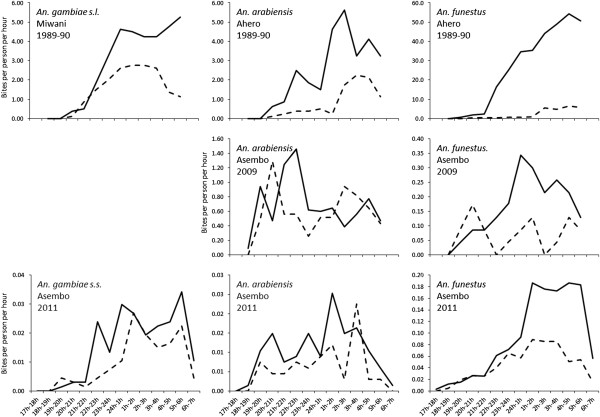
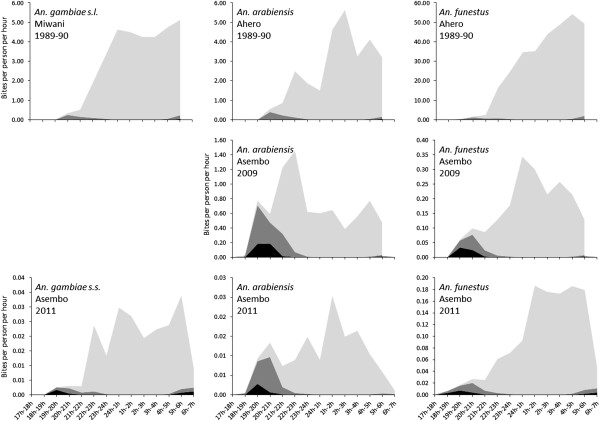
Results: Of 1,960 Anopheles mosquitoes collected in 2011, 1,267 (64.6%) were morphologically identified as An. funestus, 663 (33.8%) as An. gambiae sensu lato (An. gambiae s.s. and An. arabiensis combined), and 30 (1.5%) as other anophelines. Of the 663 An. gambiae s.l. collected, 385 were successfully tested by PCR among which 235 (61.0%) were identified as An. gambiae s.s. while 150 (39.0%) were identified as An. arabiensis. Compared with data collected before the scale-up of ITNs, daily entomological inoculation rates (EIRs) were consistently lower for An. gambiae s.l. (indoor EIR = 0.432 in 1985-1988, 0.458 in 1989-1990, 0.023 in 2011), and An. arabiensis specifically (indoor EIR = 0.532 in 1989-1990, 0.039 in 2009, 0.006 in 2011) but not An. funestus (indoor EIR = 0.029 in 1985-1988, 0.147 in 1989-1990, 0.010 in 2009 and 0.103 in 2011). Sporozoite rates were lowest in 2009 but rose again in 2011. Compared with data collected before the scale-up of ITNs, An. arabiensis and An. funestus were more likely to bite outdoors and/or early in the evening (p < 0.001 for all comparisons). However, when estimates of human exposure that would occur indoors (πi) or while asleep (πs) in the absence of an ITN were generated based on human behavioral patterns, the changes were modest with >90% of exposure of non-ITN users to mosquito bites occurring while people were indoors in all years. The proportion of bites occurring among non-ITN users while they were asleep was ≥90% for all species except for An. arabiensis. For this species, 97% of bites occurred while people were asleep in 1989-1990 while in 2009 and 2011, 80% and 84% of bites occurred while people were asleep for those not using ITNs. Assuming ITNs prevent a theoretical maximum of 93.7% of bites, it was estimated that 64-77% of bites would have occurred among persons using nets while they were asleep in 1989-1990, while 20-52% of bites would have occurred among persons using nets while they were asleep in 2009 and 2011.
Conclusions: This study found no evidence to support the contention that populations of Anopheles vectors of malaria in Asembo, western Kenya, are exhibiting departures from the well-known pattern of late night, indoor biting characteristic of these typically highly anthropophilic species. While outdoor, early evening transmission likely does occur in western Kenya, the majority of transmission still occurs indoors, late at night. Therefore, malaria control interventions such as ITNs that aim to reduce indoor biting by mosquitoes should continue to be prioritized.
Figures
References
-
- W.H.O . World Malaria Report 2012. Geneva, Switzerland: World Health Organization; 2012.
-
- Gatton ML, Chitnis N, Churcher T, Donnelly MJ, Ghani AC, Godfray HC, Gould F, Hastings I, Marshall J, Ranson H, Rowland M, Shaman J, Lindsay SW. The importance of mosquito behavioural adaptations to malaria control in Africa. Evolution. 2013;67:1218–1230. doi: 10.1111/evo.12063. - DOI - PMC - PubMed
Publication types
MeSH terms
Substances
LinkOut - more resources
Full Text Sources
Other Literature Sources
Medical
Miscellaneous
