. 2015 Apr;17(4):1338-50.
doi: 10.1111/1462-2920.12604. Epub 2014 Sep 15.

IroT/mavN, a new iron-regulated gene involved in Legionella pneumophila virulence against amoebae and macrophages

Affiliations

IroT/mavN, a new iron-regulated gene involved in Legionella pneumophila virulence against amoebae and macrophages

Emilie Portier et al. Environ Microbiol. 2015 Apr.

Abstract

Legionella pneumophila is a pathogenic bacterium commonly found in water. Eventually, it could be transmitted to humans via inhalation of contaminated aerosols. Iron is known as a key requirement for the growth of L. pneumophila in the environment and within its hosts. Many studies were performed to understand iron utilization by L. pneumophila but no global approaches were conducted. In this study, transcriptomic analyses were performed, comparing gene expression in L. pneumophila in standard versus iron restricted conditions. Among the regulated genes, a newly described one, lpp_2867, was highly induced in iron-restricted conditions. Mutants lacking this gene in L. pneumophila were not affected in siderophore synthesis or utilization. On the contrary, they were defective for growth on iron-depleted solid media and for ferrous iron uptake. A sequence analysis predicts that Lpp_2867 is a membrane protein, suggesting that it is involved in ferrous iron transport. We thus named it IroT, for iron transporter. Infection assays showed that the mutants are highly impaired in intracellular growth within their environmental host Acanthamoeba castellanii and human macrophages. Taken together, our results show that IroT is involved, directly or indirectly, in ferrous iron transport and is a key virulence factor for L. pneumophila.


Figures

Figure 1
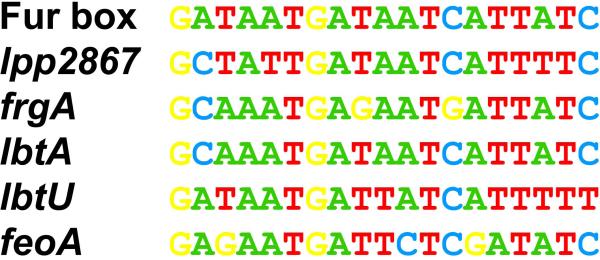
Figure 1. Potential lpp_2867 Fur box as compared to the consensus Fur box
Alignment of the putative Fur-boxes of all genes found to be iron-regulated are given. Conserved residues are coloured in the same way.
Figure 2
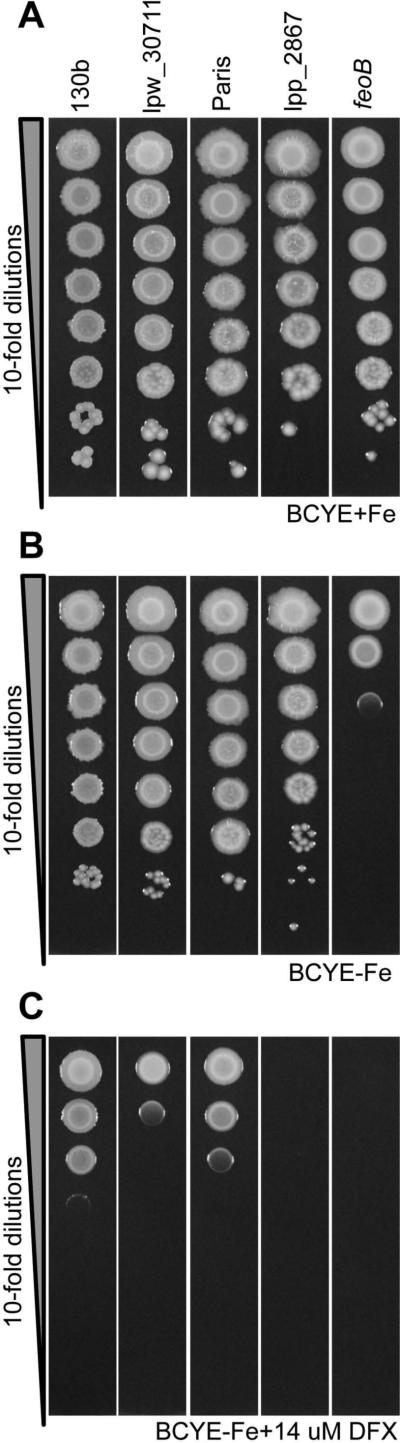
Figure 2. Growth of the lpw_30711 and lpp_2867 mutants is impaired on low iron BCYE plates
Growth of L. pneumophila strains on BCYE plates with various amount of iron (A) on standard BCYE plates, (B) on BCYE without iron supplementation, and (C) on BCYE without iron supplementation and with 14 μM DFX. Dilutions of wild type 130b and Paris strains, lpw_30771 and lpp_2867 mutants, or feoB mutant were spotted on each medium and incubated for growth. To avoid interference between different strains, a single column of each strain was spotted on one plate. The results are representative of three independent experiments.
Fig 3
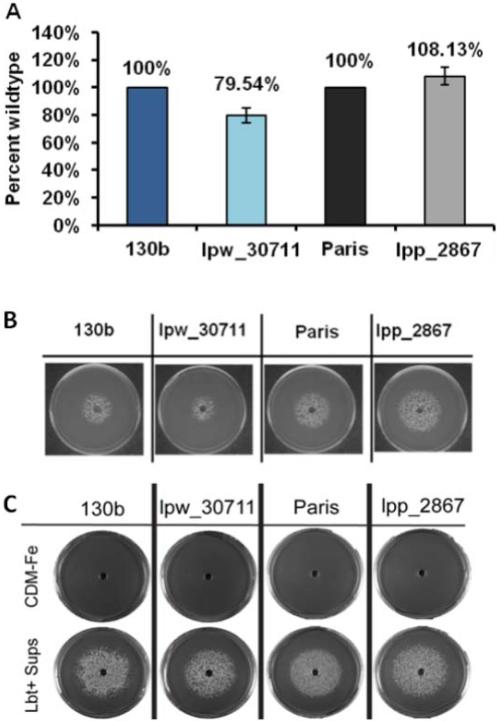
Fig 3. lpw_30711 and lpp_2867 mutants are not impaired in siderophore production or utilization
(A) CAS assay comparing wild type and mutant supernatants for levels of siderophore activity. Data represent the mean +/- SD of duplicate cultures. Siderophore activity of the mutants was not statistically different from that of its parental strains after three independent experiments. (B) Siderophore production: the bioassay was performed on both wild type strains and their respective mutants. Supernatants of each strain were tested for siderophore biological activity by examining their ability to promote the growth of the NU269 feoB mutant on non-iron supplemented BCYE agar. The results are representative of three independent experiments. (C) Siderophore utilization: wild type 130b and Paris strains and the corresponding lpw_30771 and lpp_2867 mutants were spread on BCYE agar without iron supplementation and containing 10 μM DFX. A well was made at the center of each plate and 75 μl of deferrated CDM (upper row) or legiobactin-containing supernatant (lower row) were added to each well. Growth was recorded after 6 days of incubation at 37°C. The results are representative of three independent experiments.
Figure 4
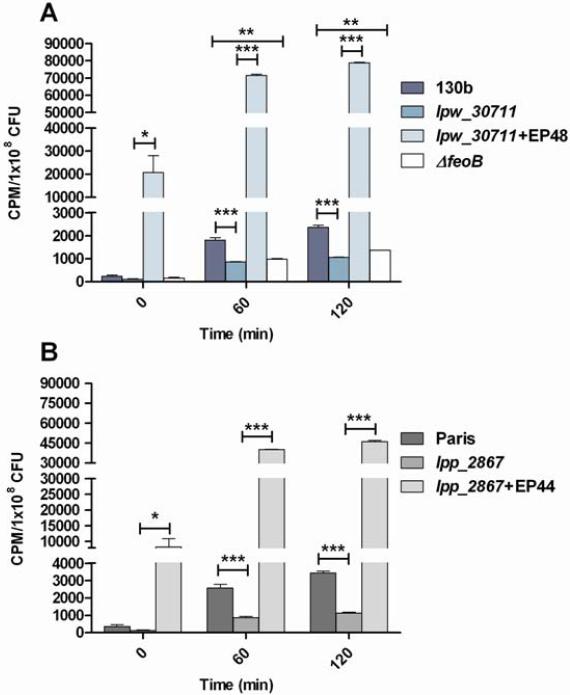
Figure 4. The lpw_30711 and lpp_2867 mutants are defective for ferrous iron uptake
Strains 130b (A) and Paris (B), their respective mutant strains lpw_30711 and lpp_2867 and the complemented strains with plasmids EP 48 or EP 44 were grown in deferrated CDM, and resuspended in buffer mixed with 55FeCl3. The feoB mutant was also used as a control. After 60 and 120 min of incubation, the levels of intracellular radiolabelled Fe2+ were determined. Data represent the mean +/− SEM from triplicate, and the results are representative of three independent experiments. (*** p < 0.001 (t-test)).
Figure 5
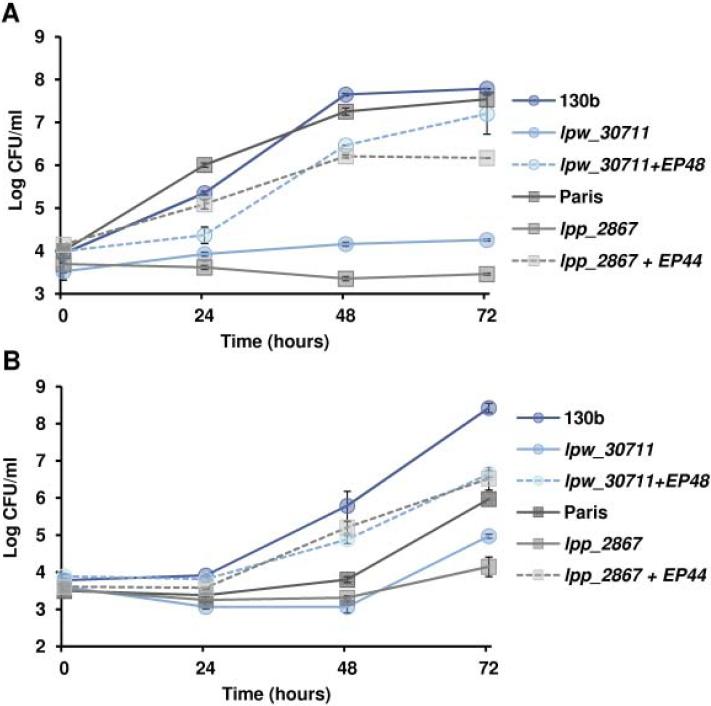
Figure 5. The lpw_30711 and lpp_2867 mutants are defective for intracellular growth
(A) Intra-macrophage (U937 cells) growth or (B) intra-amoebal (A. castellanii) growth of the wild-type strains 130b and Paris, their respective mutant strains lpw_30711 and lpp_2867 or the complemented strains with plasmids EP 48 or EP 44. Intracellular growth was monitored by CFU determination. Data represent the mean CFU +/− SEM from triplicate wells. The results are representative of three independent experiments (p < 0.05 at both the 24- 48- and 72-hour time points in (A) and 48- and 72-hour time points in (B) (t-test)).

References

    1. Aisen P. The binding and release of iron by transferrin. Birth Defects Orig Artic Ser. 1976;12:81–95. - PubMed
    1. Allard KA, Viswanathan VK, Cianciotto NP. lbtA and lbtB are required for production of the Legionella pneumophila siderophore legiobactin. J Bacteriol. 2006;188:1351–1363. - PMC - PubMed
    1. Allard KA, Dao J, Sanjeevaiah P, McCoy-Simandle K, Chatfield CH, Crumrine DS, et al. Purification of Legiobactin and importance of this siderophore in lung infection by Legionella pneumophila. Infect Immun. 2009;77:2887–2895. - PMC - PubMed
    1. Andrews SC. Making DNA without iron - induction of a manganese-dependent ribonucleotide reductase in response to iron starvation. Mol Microbiol. 2011;80:286–289. - PubMed
    1. Andrews SC, Robinson AK, Rodriguez-Quinones F. Bacterial iron homeostasis. FEMS Microbiol Rev. 2003;27:215–237. - PubMed

Publication types