


Physician-pharmacist collaborative management of asthma in primary care
- PMID: 25142870
- PMCID: PMC4188693
- DOI: 10.1002/phar.1468
Physician-pharmacist collaborative management of asthma in primary care
Abstract
Objective: To determine if asthma control improves in patients who receive physician-pharmacist collaborative management (PPCM) during visits to primary care medical offices.
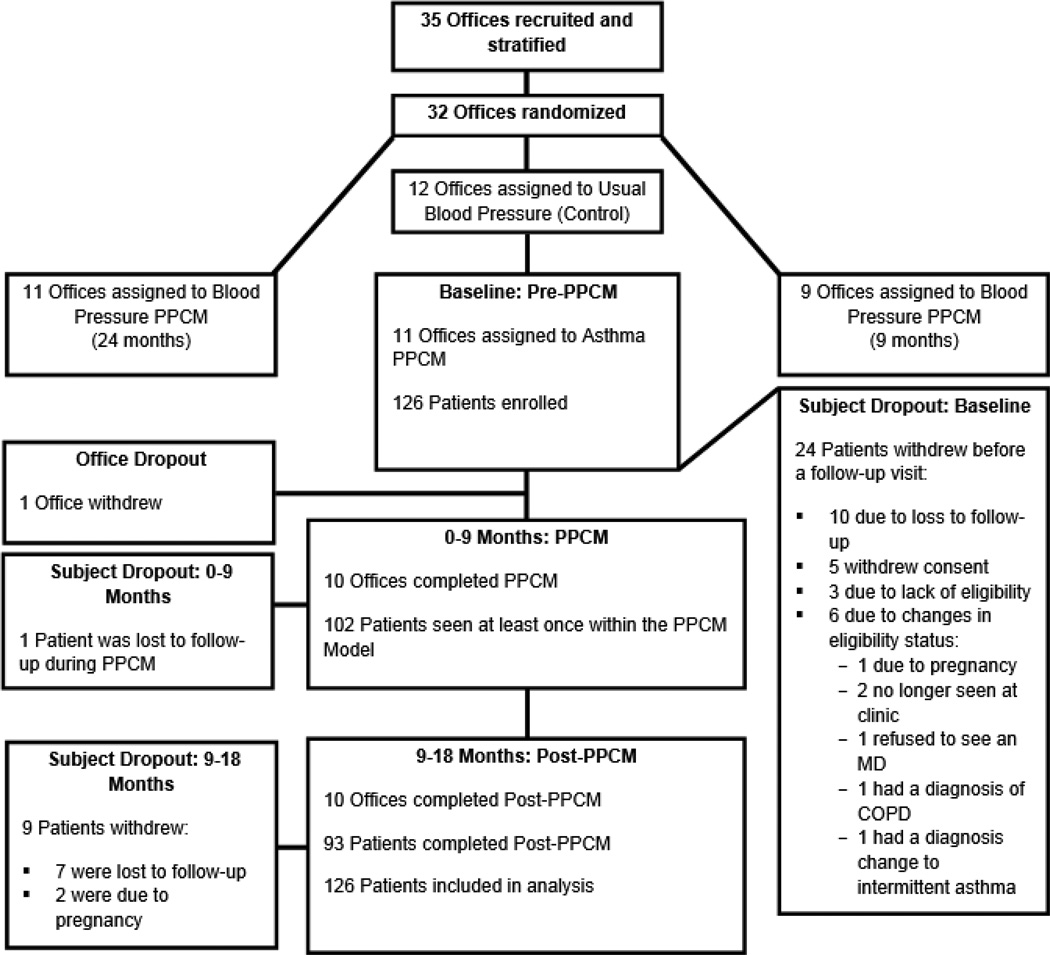
Design: Prospective pre-post study of patients who received the intervention in primary care offices for 9 months. The primary outcome was the sum of asthma-related emergency department (ED) visits and hospitalizations at 9 months before, 9 months during, and 9 months after the intervention. Events were analyzed using linear mixed-effects regression. Secondary analysis was conducted for patients with uncontrolled asthma (Asthma Control Test [ACT] less than 20). Additional secondary outcomes included the ACT, the Asthma Quality of Life Questionnaire by Marks (AQLQ-M) scores, and medication changes.
Intervention: Pharmacists provided patients with an asthma self-management plan and education and made pharmacotherapy recommendations to physicians when appropriate.
Results: Of 126 patients, the number of emergency department (ED) visits and/or hospitalizations decreased 30% during the intervention (p=0.052) and then returned to preenrollment levels after the intervention was discontinued (p=0.83). Secondary analysis of patients with uncontrolled asthma at baseline (ACT less than 20), showed 37 ED visits and hospitalizations before the intervention, 21 during the intervention, and 33 after the intervention was discontinued (p=0.019). ACT and AQLQ-M scores improved during the intervention (ACT mean absolute increase of 2.11, AQLQ-M mean absolute decrease of 4.86, p<0.0001) and sustained a stable effect after discontinuation of the intervention. Inhaled corticosteroid use increased during the intervention (p=0.024).
Conclusions: The PPCM care model reduced asthma-related ED visits and hospitalizations and improved asthma control and quality of life. However, the primary outcome was not statistically significant for all patients. There was a significant reduction in ED visits and hospitalizations during the intervention for patients with uncontrolled asthma at baseline. Our findings support the need for further studies to investigate asthma outcomes achievable with the PPCM model.
Keywords: asthma; collaboration; pharmacist; team-based care.
© 2014 Pharmacotherapy Publications, Inc.
Figures
References
-
- Centers for Disease Control and Prevention. Asthma facts—CDC’s national asthma control program grantees. Atlanta, GA: U.S. Department of Health and Human Services, Centers for Disease Control and Prevention; 2013.
-
- Centers for Disease Control and Prevention. Asthma's impact on the nation. [Accessed August 5, 2013]; Retrieved from: http://www.cdc.gov/asthma/impacts_nation.
-
- National Asthma, Education and Prevention Program (2007) Expert Panel Report 3 (EPR-3): Guidelines for the diagnosis and management of asthma-summary report 2007. J Allergy Clin Immunol. 2007;120:S94–S138. - PubMed
-
- Mehuys E, Van Bortel L, De Bolle L, Van Tongelen I, Annemans L, Remon JP, Brusselle G. Effectiveness of pharmacist intervention for asthma control improvement. Eur Respir. 2008;31:790–799. - PubMed
-
- Gillisen A. Patient's adherence in asthma. J Physiol Pharmacol. 2007;58:205–222. - PubMed
Publication types
MeSH terms
Grants and funding
LinkOut - more resources
Full Text Sources
Other Literature Sources
Medical
