Review
. 2014 Oct;146(4 Suppl):e61S-74S.
doi: 10.1378/chest.14-0736.

Triage: care of the critically ill and injured during pandemics and disasters: CHEST consensus statement

Collaborators
Review

Triage: care of the critically ill and injured during pandemics and disasters: CHEST consensus statement

Michael D Christian et al. Chest. 2014 Oct.

Abstract

Background: Pandemics and disasters can result in large numbers of critically ill or injured patients who may overwhelm available resources despite implementing surge-response strategies. If this occurs, critical care triage, which includes both prioritizing patients for care and rationing scarce resources, will be required. The suggestions in this chapter are important for all who are involved in large-scale pandemics or disasters with multiple critically ill or injured patients, including front-line clinicians, hospital administrators, and public health or government officials.

Methods: The Triage topic panel reviewed previous task force suggestions and the literature to identify 17 key questions for which specific literature searches were then conducted to identify studies upon which evidence-based recommendations could be made. No studies of sufficient quality were identified. Therefore, the panel developed expert opinion-based suggestions using a modified Delphi process. Suggestions from the previous task force that were not being updated were also included for validation by the expert panel.

Results: The suggestions from the task force outline the key principles upon which critical care triage should be based as well as a path for the development of the plans, processes, and infrastructure required. This article provides 11 suggestions regarding the principles upon which critical care triage should be based and policies to guide critical care triage.

Conclusions: Ethical and efficient critical care triage is a complex process that requires significant planning and preparation. At present, the prognostic tools required to produce an effective decision support system (triage protocol) as well as the infrastructure, processes, legal protections, and training are largely lacking in most jurisdictions. Therefore, critical care triage should be a last resort after mass critical care surge strategies.


Figures
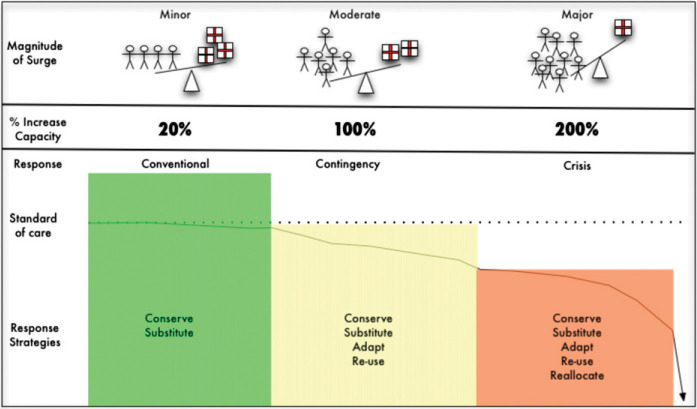
Figure 1
Figure 1
The spectrum of surge from minor to major. The magnitude of surge is illustrated by the alterations in the balance between demand (stick figures) and supply (medication boxes). As surge increases, the demand-supply imbalance worsens. Conventional, contingency, and crisis responses vary with magnitude of surge. Varying response strategies are associated with each level of response. As the magnitude of the surge increases, the response strategies used to cope gradually depart from the usual standard of care (default defining the standards of disaster care) until such point that even with crisis care, delivery of critical care is no longer possible.
Figure 2
Figure 2
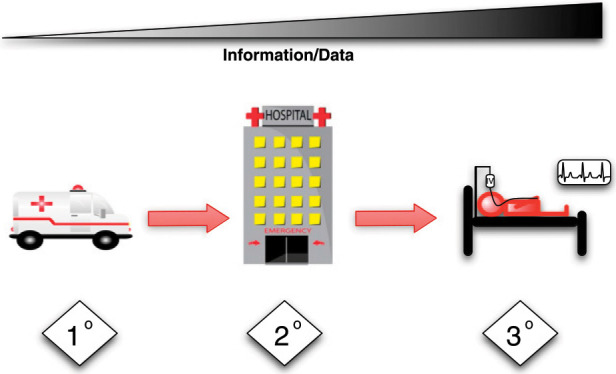
Primary triage (1°) involves decisions in the prehospital setting about the priority for treatment on the scene and evacuation to the hospital. Secondary triage (2°) involves decisions regarding the priority for assessment and initial treatment of patients when they first arrive at the hospital (usually the ED). Tertiary triage (3°) involves decisions regarding the priority for definitive care of patients in the ICU or operating room. The degree to which the decisions at each stage involve resource allocation (rationing) in addition to prioritization depends on the degree of imbalance between the demand for and supply of resources. As one progresses from primary through secondary and tertiary triage, the information and data available on which to base the triage decisions increase but so too does the complexity of the decisions. (Ambulance and hospital images courtesy of pamsclipart.com.)
Figure 3
Figure 3
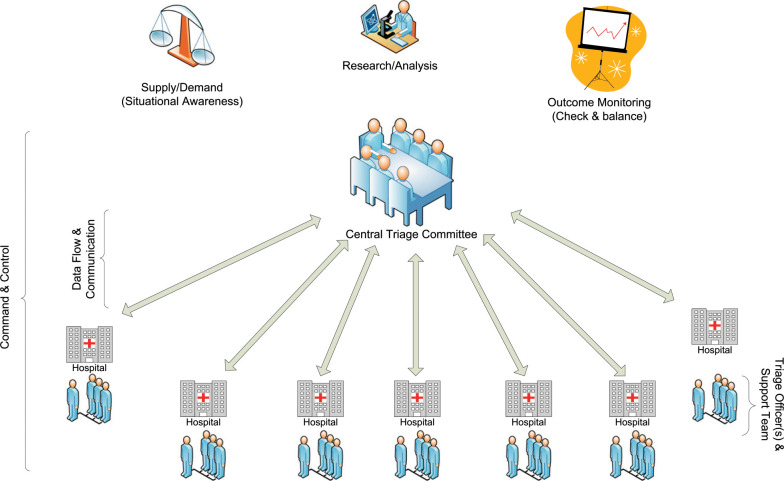
Triage infrastructure: the optimal relationship between the state or regional central triage committee and the triage officers at individual hospitals. The central triage committee must have situational awareness (knowledge of the resources supply and demand) and the capacity to conduct research in order to modify triage protocols and monitor triage outcomes. A bidirectional communication network between the central triage committee and hospitals is required to achieve situational awareness, monitor outcomes, and communicate modifications to the triage protocols. At the individual hospitals, the triage officers are supported by a staff or team.
Figure 4
Figure 4
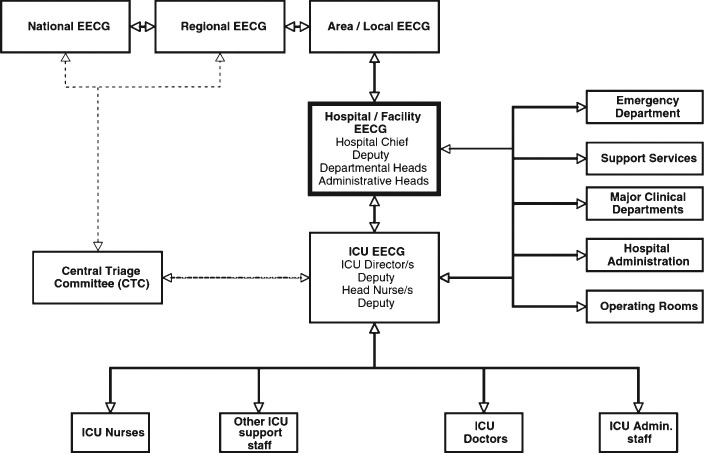
Schematic showing key lines of authority (command chain) and information flow (bidirectional) required for an effective response in a disaster, including performing triage. EECG = executive emergency control group. (Reprinted with permission from Joynt et al.16)
Figure 5
Figure 5
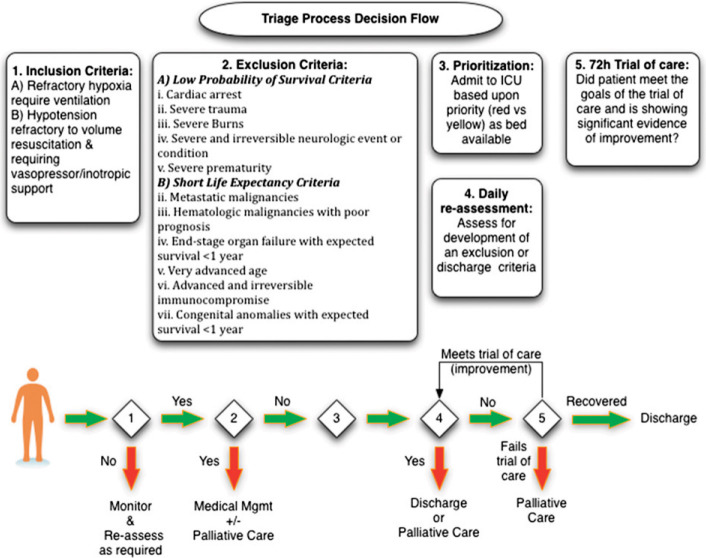
A conceptualized framework for how the critical care (tertiary) triage process and decisions would flow in a disaster or pandemic.

References

    1. Christian MD, Devereaux AV, Dichter JR, Geiling JA, Rubinson L. Definitive care for the critically ill during a disaster: current capabilities and limitations: from a Task Force for Mass Critical Care summit meeting, January 26-27, 2007, Chicago, IL. Chest. 2008;133(5_suppl):8S–17S. - PMC - PubMed
    1. Hick JL, Barbera JA, Kelen GD. Refining surge capacity: conventional, contingency, and crisis capacity. Disaster Med Public Health Prep. 2009;3(suppl 1):S59–S67. - PubMed
    1. Hick JL, Christian MD, Sprung CL. European Society of Intensive Care Medicine's Task Force for Intensive Care Unit Triage During an Influenza Epidemic or Mass Disaster. Chapter 2. Surge capacity and infrastructure considerations for mass critical care. Recommendations and standard operating procedures for intensive care unit and hospital preparations for an influenza epidemic or mass disaster. Intensive Care Med. 2010;36(suppl 1):S11–S20. - PubMed
    1. Hick JL, Hanfling D, Burstein JL. Health care facility and community strategies for patient care surge capacity. Ann Emerg Med. 2004;44(3):253–261. - PMC - PubMed
    1. Devereaux A, Christian MD, Dichter JR, Geiling JA, Rubinson L. Task Force for Mass Critical Care. Summary of suggestions from the Task Force for Mass Critical Care summit, January 26-27, 2007. Chest. 2008;133(5_suppl):1S–7S. - PMC - PubMed

Publication types