Determinants of influenza transmission in South East Asia: insights from a household cohort study in Vietnam
- PMID: 25144780
- PMCID: PMC4140851
- DOI: 10.1371/journal.ppat.1004310
Determinants of influenza transmission in South East Asia: insights from a household cohort study in Vietnam
Abstract
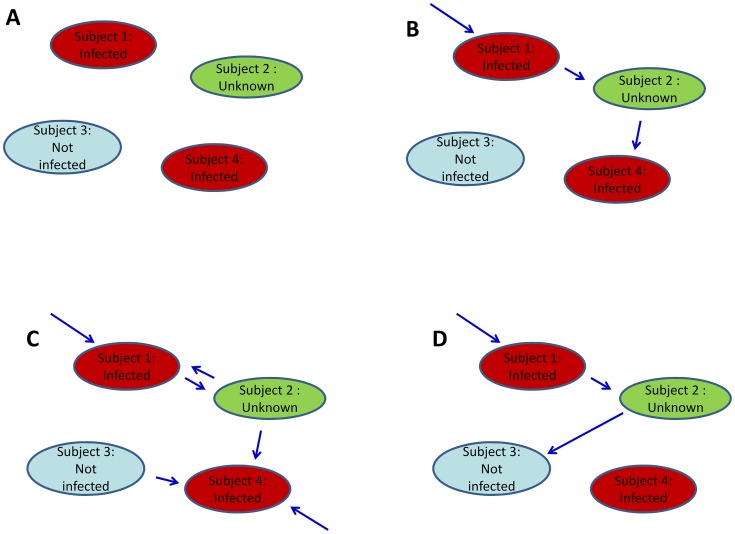
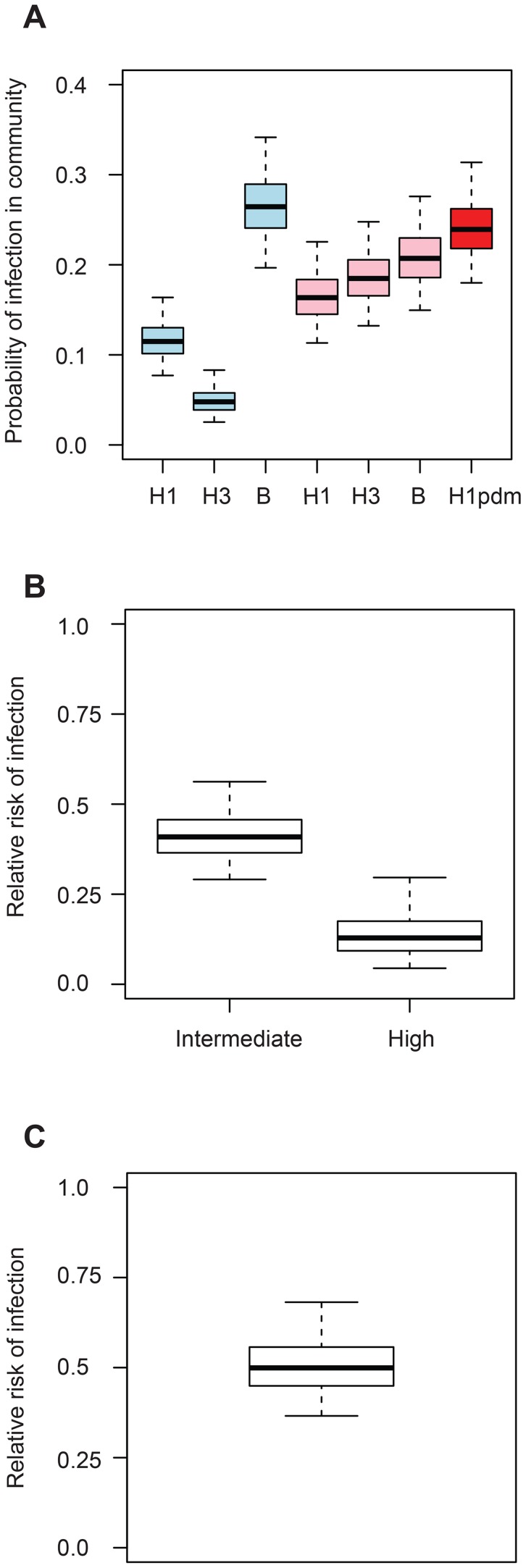
To guide control policies, it is important that the determinants of influenza transmission are fully characterized. Such assessment is complex because the risk of influenza infection is multifaceted and depends both on immunity acquired naturally or via vaccination and on the individual level of exposure to influenza in the community or in the household. Here, we analyse a large household cohort study conducted in 2007-2010 in Vietnam using innovative statistical methods to ascertain in an integrative framework the relative contribution of variables that influence the transmission of seasonal (H1N1, H3N2, B) and pandemic H1N1pdm09 influenza. Influenza infection was diagnosed by haemagglutination-inhibition (HI) antibody assay of paired serum samples. We used a Bayesian data augmentation Markov chain Monte Carlo strategy based on digraphs to reconstruct unobserved chains of transmission in households and estimate transmission parameters. The probability of transmission from an infected individual to another household member was 8% (95% CI, 6%, 10%) on average, and varied with pre-season titers, age and household size. Within households of size 3, the probability of transmission from an infected member to a child with low pre-season HI antibody titers was 27% (95% CI 21%-35%). High pre-season HI titers were protective against infection, with a reduction in the hazard of infection of 59% (95% CI, 44%-71%) and 87% (95% CI, 70%-96%) for intermediate (1∶20-1∶40) and high (≥1∶80) HI titers, respectively. Even after correcting for pre-season HI titers, adults had half the infection risk of children. Twenty six percent (95% CI: 21%, 30%) of infections may be attributed to household transmission. Our results highlight the importance of integrated analysis by influenza sub-type, age and pre-season HI titers in order to infer influenza transmission risks in and outside of the household.
Conflict of interest statement
SC received consulting fees from Sanofi Pasteur MSD for a project on the modelling of varicella zoster virus transmission. There are no other competing interests to declare. This does not alter our adherence to all PLOS policies on sharing data and materials.
Figures
References
-
- WHO Influenza (Seasonal). Available at www.who.int/mediacentre/factsheets/fs211/en/index.html. Accessed on 30 May 2012.
-
- Committee for Proprietary Medicinal Products (1997) Note for guidance on harmonisation of requirements for influenza vaccines. EMEA
-
- Wood JM, Levandowski RA (2003) The influenza vaccine licensing process. Vaccine 21: 1786–1788. - PubMed
Publication types
MeSH terms
Grants and funding
LinkOut - more resources
Full Text Sources
Other Literature Sources
Medical