. 2014 Nov 15;464(1):35-48.
doi: 10.1042/BJ20140530.

MondoA deficiency enhances sprint performance in mice

Affiliations

MondoA deficiency enhances sprint performance in mice

Minako Imamura et al. Biochem J. .

Abstract

MondoA is a basic helix-loop-helix (bHLH)/leucine zipper (ZIP) transcription factor that is expressed predominantly in skeletal muscle. Studies in vitro suggest that the Max-like protein X (MondoA:Mlx) heterodimer senses the intracellular energy status and directly targets the promoter region of thioredoxin interacting protein (Txnip) and possibly glycolytic enzymes. We generated MondoA-inactivated (MondoA-/-) mice by gene targeting. MondoA-/- mice had normal body weight at birth, exhibited normal growth and appeared to be healthy. However, they exhibited unique metabolic characteristics. MondoA-/- mice built up serum lactate and alanine levels and utilized fatty acids for fuel during exercise. Gene expression and promoter analysis suggested that MondoA functionally represses peroxisome-proliferator-activated receptor γ co-activator-1α (PGC-1α)-mediated activation of pyruvate dehydrogenase kinase 4 (PDK-4) transcription. PDK4 normally down-regulates the activity of pyruvate dehydrogenase, an enzyme complex that catalyses the decarboxylation of pyruvate to acetyl-CoA for entry into the Krebs cycle; in the absence of MondoA, pyruvate is diverted towards lactate and alanine, both products of glycolysis. Dynamic testing revealed that MondoA-/- mice excel in sprinting as their skeletal muscles display an enhanced glycolytic capacity. Our studies uncover a hitherto unappreciated function of MondoA in fuel selection in vivo. Lack of MondoA results in enhanced exercise capacity with sprinting.


Figures
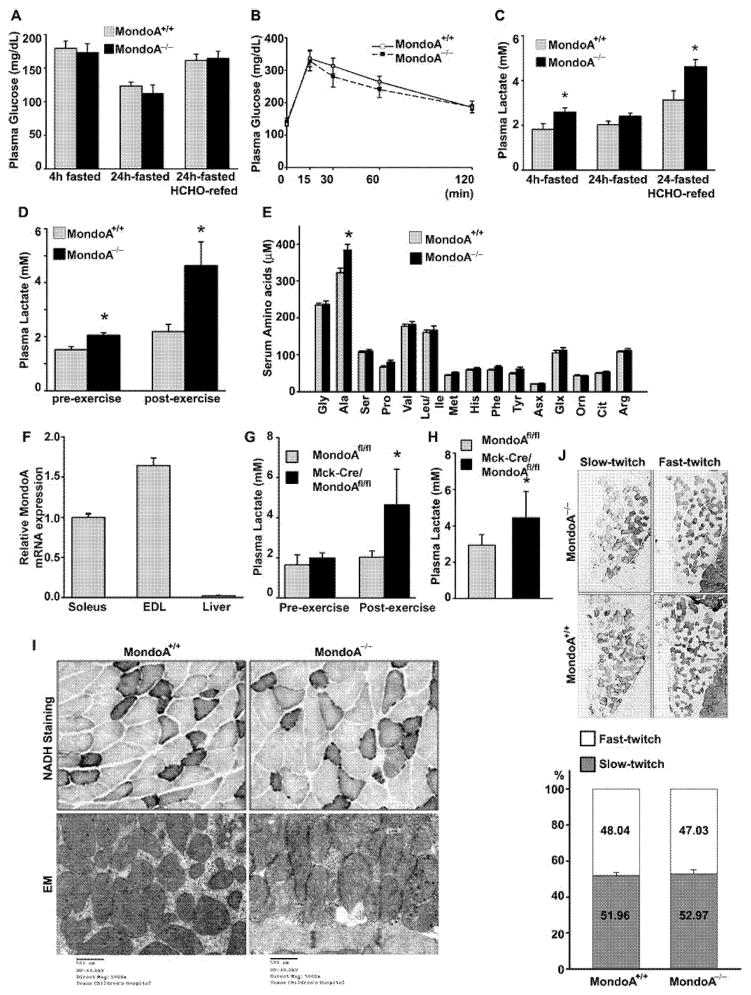
Figure 1
Figure 1. MondoA−/− mice exhibit higher levels of plasma lactate and alanine than MondoA+/+ mice
(A) Plasma glucose levels of MondoA−/− and MondoA+/+ mice measured at 4-h-, 24-h-fasted and 24-h-fasted followed by 18 h high sucrose fat-free (HCHO) diet re-feeding 12-week-old male mice (n = 6–7 each). (B) GTT of MondoA+/+ (n = 11) and MondoA−/− (n = 12) mice. Mice were fasted for 4 h before i.p. injection of D-glucose (2 g/kg of body weight). Blood glucose was measured at 0, 15, 30, 60 and 120 min after glucose challenge. (C) Plasma lactate was measured in 4-h-, 24-h-fasted without or with HCHO re-fed mice (n = 6–7 each). *P < 0.05 comparing MondoA+/+ and MondoA−/− mice. (D) Plasma lactate level of MondoA+/+ and MondoA−/− was measured before and after non-intensive treadmill exercise as described in the Materials and methods section (4-month-old male, n = 6 each). *P < 0.05 comparing MondoA+/+ and MondoA−/− mice. (E) Serum amino acids profile after non-intensive treadmill exercise. *P < 0.05 comparing MondoA+/+ and MondoA−/− 6-month-old male mice. (F) MondoA mRNA expression from skeletal muscle (soleus and EDL muscles) and liver was determined by qRT-PCR. MondoA mRNA expression was normalized to three house-keeping genes, B2m, Hmbs and Ppia, using GeNorm algorithm [42] and expressed as fold changes relative to the expression level in soleus muscle in eight-week-old female mice (n = 5–6 each) (G) Plasma lactate level of muscle-specific MondoA−/− KO mice (MCK-Cre MondoA−/−) and MondoA floxed control (MondoAflox/flox) mice measured before and after non-intensive treadmill exercise (n = 6). *P < 0.05 comparing muscle-specific MondoA−/− and floxed control 4-month-old mice. (H) Plasma lactate levels in HCHO re-fed MCK-Cre MondoA−/− (n = 7) and MondoAflox/flox mice (n = 6). *P < 0.05 comparing MondoAflox/flox and MCK-Cre MondoA−/− mice. (I) Evaluation of mitochondrial function in skeletal muscle isolated from 12-month-old female MondoA+/+and MondoA−/− mice. Upper panels, NADH staining (gastrocnemius); lower panels, EM (soleus). (J) Muscle fibre type identification. Type I (slow twitch) and type II (fast twitch) fibres of soleus muscle of MondoA+/+ and MondoA−/− 12-month-old female mice were determined by immunohistochemisty against fibre type-specific antibodies (upper panel) and the proportion of each fibre type determined (lower panel, MondoA+/+ n = 4, MondoA−/− n = 3). Data in (G) and (H) were expressed as means ± S.D.
Figure 2
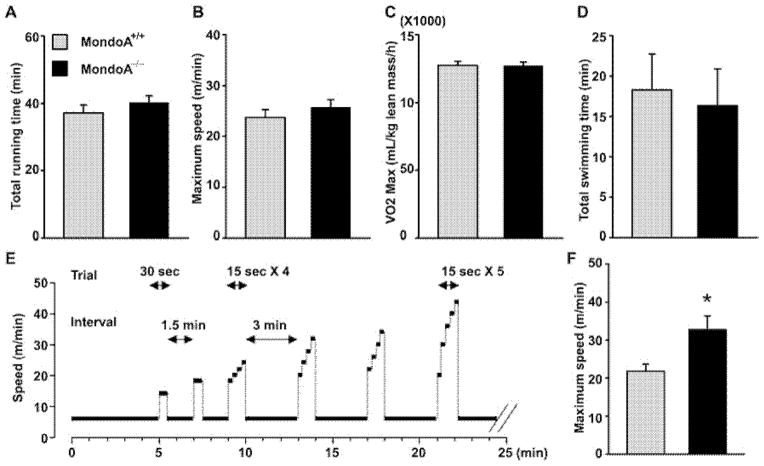
Figure 2. MondoA−/− mice preserve endurance capacity (A–E) while performing better at sprint running (F and G)
Four-month-old male MondoA+/+ (n = 8) and MondoA−/− mice (n = 8) were acclimated for treadmill running 5 min a day for 2 days. On the day of the trial, mice were committed to treadmill running and oxygen consumption was monitored during the running bout. Mice were forced to run until they were exhausted and stayed at the edge of grid with electric shock for 5 s. The figures indicate time period until exhaustion (A), running speed at exhaustion (B) and o2 max (C). All data were expressed as means ± S.E.M. For the swimming endurance test, 5-month-old male MondoA+/+ (n = 13) and MondoA−/− mice (n = 14) were acclimated for swimming 5 min a day for 2 days. On the day of test, mice were attached a weight (3% of body weight) and released into a water bucket. Mice were rescued when they showed signs of fatigue and failed to keep their noses above the water; the total time mice stayed in the water is recorded in (D). Sprinting exercise regime (E) and maximal sprinting speed (F) of 5-month-old MondoA+/+ mice (n = 17) and MondoA−/− mice (n = 14). *P < 0.05 comparing MondoA+/+ and MondoA−/− mice. See text for details.
Figure 3
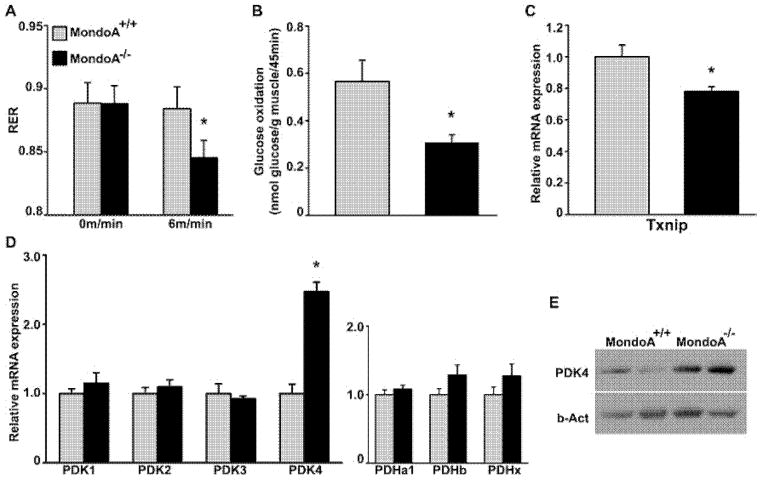
Figure 3. Reduced glucose oxidation and increased PDK4 expression in the muscles of MondoA−/− mice
(A) RER under mild exercise (6 m/min treadmill running) was measured. Four-month-old male mice were used (n = 8). *P < 0.05 comparing MondoA+/+ and MondoA−/− mice. (B) Ex vivo glucose oxidation rate of isolated EDL from MondoA+/+ and MondoA−/− 6-month-old female mice (n = 7). *P < 0.05 comparing MondoA+/+ and MondoA−/− mice. (C and D) Gene expression of representative glycolytic genes in skeletal muscle (EDL) was determined by qRT-PCR. Relative expression levels of gene of interest were normalized to Alas, Eef1g and Hmbs using GeNorm algorithm [42]. Eight-week-old female mice were used (n = 5–6). *P < 0.05 comparing MondoA+/+ and MondoA−/− mice. (E) Western blot analysis of PDK4 in skeletal muscle (soleus) isolated from 6-month-old female MondoA+/+ and MondoA−/− mice determined by immunoblotting.
Figure 4
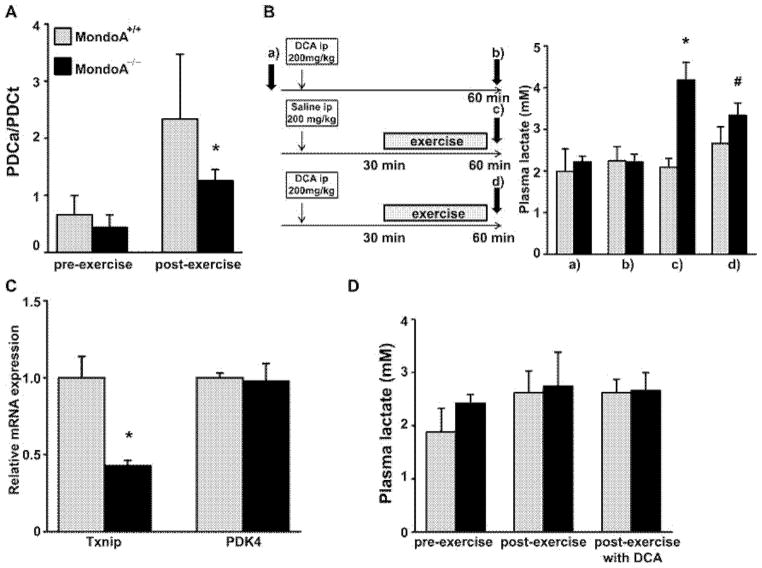
Figure 4. Impaired PDH activity is responsible for lactate build-up in MondoA−/− mice
(A) Down-regulation of PDH)activity in skeletal muscle of MondoA−/− mice (6-month-old males; n = 5–7). Actual (PDCa) and total (PDCt) PDH activity of skeletal muscle (soleus) was determined as described in the Materials and methods section. The ratio of actual:total PDH of skeletal muscle isolated before or after treadmill exercise is shown. (B) DCA ameliorates the elevation of lactate in MondoA−/− mice (n = 6–7; 5-month-old males). Plasma lactate was measured in MondoA+/+ and MondoA−/− mice before DCA injection (a), 60 min after DCA injection (b), 60 min after saline injection with a 30 min of exercise on treadmill (c) and 60 min after DCA injection and 30 min of exercise on treadmill (d). *P < 0.0001 comparing MondoA+/+ and MondoA−/− mice treated with saline and exercise [under (c)]. #P < 0.01 comparing MondoA−/− mice injected with saline and DCA [between (c) and (d)]. (C) PDK4 expression in EDL muscle isolated from 5-month-old male Txnip heterozygous mice (Txnip+/− was determined by qRT-PCR. Relative expression was normalized by Alas, β-actin and B2m using GeNorm algorithm [42] (n = 3). (D) Plasma lactate level of 4-month-old Txnip+/+ (n = 5) and Txnip+/− (n = 5) mice before exercise, after treadmill exercise with DCA administration. *P < 0.05 comparing Txnip+/+ and Txnip+/− mice.
Figure 5
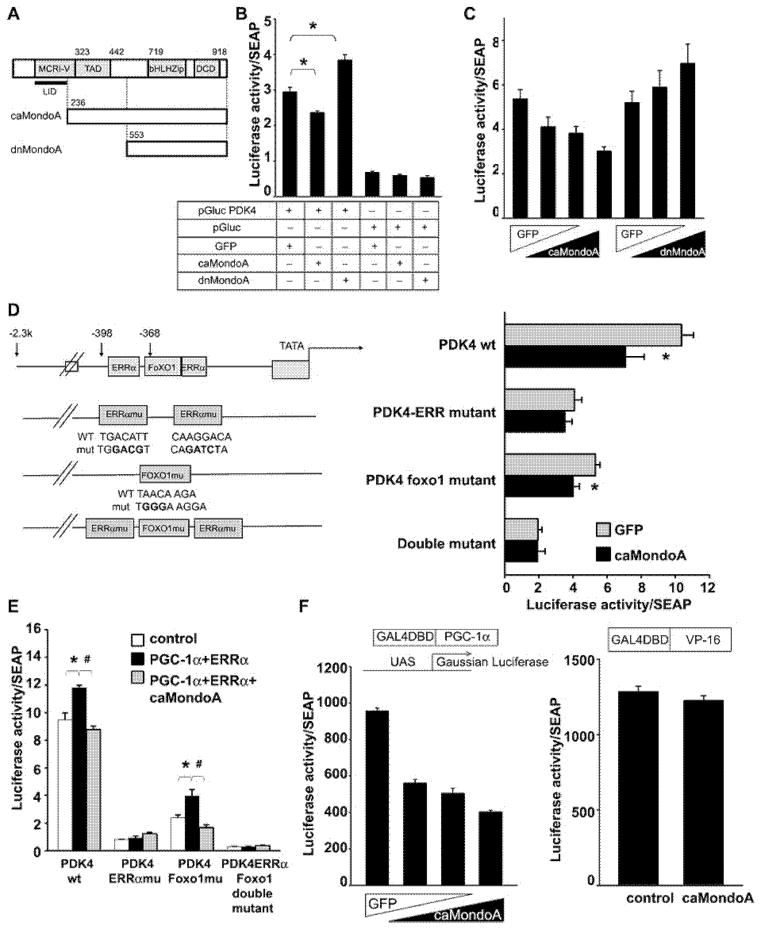
Figure 5. MondoA negatively regulates PDK4 promoter activity
(A) Schematic representation of the full-length as well as caMondoA and dnMondoA expression constructs. (B) Luciferase reporter plasmid (pGluc PDK4 or pGluc) and an internal control construct, pSRa-SEAP, which express secreted alkaline phosphatase were co-transfected with vector-expressing caMondoA or dnMondoA or GFP in C2C12 cells. Forty-eight hours after transfection, medium was collected and luciferase activity was analysed. *P < 0.05 between groups indicated by bracket. (C) pGluc PDK4 and pSRa-SEAP were co-transfected with increasing amount caMondoA or dnMondoA into BOSC23 cells. The total amounts of transfected DNA for each group were held the same by adding GFP expression vector. Forty-eight hours after transfection, medium was collected and luciferase activity was analysed. (D) Schematic representation of ERRα- and FOXO1-binding sites of PDK4 promoter and mutant constructs (left panel). pGluc PDK4 or pGluc PDK4 mutants and pSRa-SEAP were co-transfected with caMondoA or GFP control vector into BOSC23 cells. Forty-eight hours after transfection, medium was collected and luciferase activity was analysed. *P < 0.05 between GFP control and caMondoA transfected cells. (E) pGluc PDK4 or pGluc PDK4 mutants (as shown in D) and pSRa-SEAP were co-transfected with vectors expressing PGC-1α and ERRα with or without caMondoA into BOSC23 cells. The total amounts of transfected DNA for each group were held the same with either pcDNA3.1 empty vector or GFP expression vector. Forty-eight hours after transfection, medium was collected and luciferase activity was analysed. (F) Plasmids encoding either GAL4-PGC-1α (left panel) or GAL4 VP-16 (right panel) and pUAS-Gluc and pSEAP were co-transfected with indicated amount of vector-expressing caMondoA into BOSC23 cells. Twenty-four hours after transfection, medium was collected and luciferase activity was analysed.
Figure 6
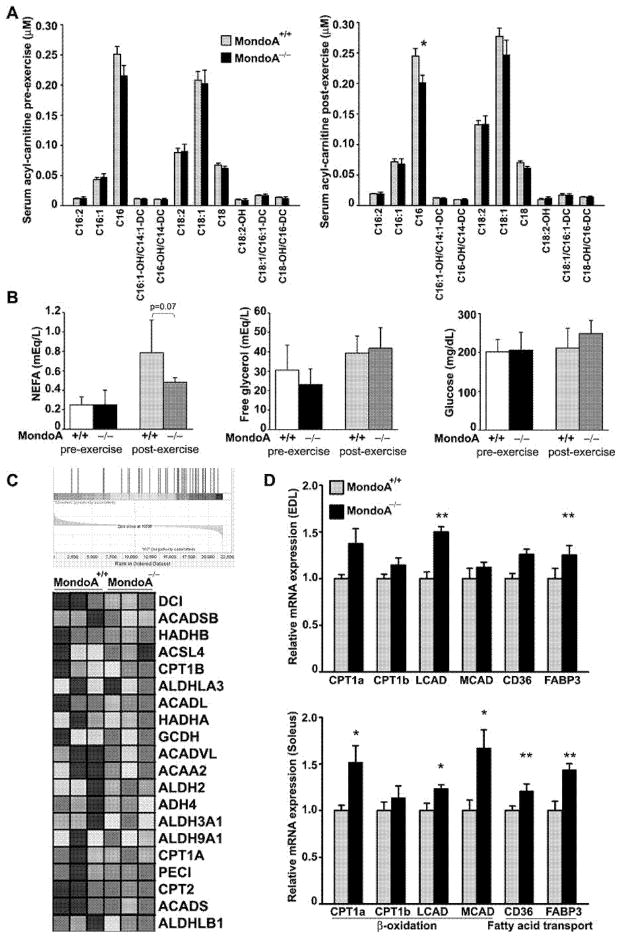
Figure 6. Metabolic shift from glucose oxidation to fatty acid oxidation in MondoA−/− mice
(A) Serum long-chain acylcarnitine profile. Serum harvested from 6-month-old male MondoA+/+ (n = 6) and MondoA−/− mice (n = 6), before and after treadmill exercise, were analysed. (B) Plasma glucose, NEFA and free glycerol before and after treadmill exercise. Four-month-old male (n = 6 each genotype). (C) Heat map of GSEA of fatty acid metabolism gene expressions in soleus muscles of 6-month-old male MondoA−/− and MondoA+/+ mice (n = 3 each). (D) qRT-PCR analysis of lipid-metabolism-associated gene-expression in skeletal muscle (EDL and soleus). Relative expression levels of gene of interest were normalized by Alas, Eef1g and Hmbs using GeNorm algorithm [42]. Eight-week-old female mice were used (n = 5–6). *P < 0.05, **P < 0.01 comparing MondoA+/+ and MondoA−/− mice.

References

    1. Girard J, Ferré P, Foufelle F. Mechanisms by which carbohydrates regulate expression of genes for glycolytic and lipogenic enzymes. Annu Rev Nutr. 1997;17:325–352. - PubMed
    1. Iizuka K, Bruick RK, Liang G, Horton JD, Uyeda K. Deficiency of carbohydrate response element-binding protein (ChREBP) reduces lipogenesis as well as glycolysis. Proc Natl Acad Sci USA. 2004;101:7281–7286. - PMC - PubMed
    1. Uyeda K, Yamashita H, Kawaguchi T. Carbohydrate responsive element-binding protein (ChREBP): a key regulator of glucose metabolism and fat storage. Biochem Pharmacol. 2002;63:2075–2080. - PubMed
    1. Billin AN, Eilers AL, Coulter KL, Logan JS, Ayer DE. MondoA, a novel basic helix–loop–helix–leucine zipper transcriptional activator that constitutes a positive branch of a max-like network. Mol Cell Biol. 2000;20:8845–8854. - PMC - PubMed
    1. Stoltzman CA, Peterson CW, Breen KT, Muoio DM, Billin AN, Ayer DE. Glucose sensing by MondoA:Mlx complexes: a role for hexokinases and direct regulation of thioredoxin-interacting protein expression. Proc Natl Acad Sci USA. 2008;105:6912–6917. - PMC - PubMed

Publication types

MeSH terms

Substances

LinkOut - more resources