


Advanced trauma life support training for hospital staff
- PMID: 25146524
- PMCID: PMC7184315
- DOI: 10.1002/14651858.CD004173.pub4
Advanced trauma life support training for hospital staff
Abstract
Background: Injury is responsible for an increasing global burden of death and disability. As a result, new models of trauma care have been developed. Many of these, though initially developed in high-income countries (HICs), are now being adopted in low and middle-income countries (LMICs). One such trauma care model is advanced trauma life support (ATLS) training in hospitals, which is being promoted in LMICs as a strategy for improving outcomes for victims of trauma. The impact of this health service intervention, however, has not been rigorously tested by means of a systematic review in either HIC or LMIC settings.
Objectives: To quantify the impact of ATLS training for hospital staff on injury mortality and morbidity in hospitals with and without such a training program.
Search methods: The search for studies was run on the 16th May 2014. We searched the Cochrane Injuries Group's Specialised Register, the Cochrane Central Register of Controlled Trials (CENTRAL, The Cochrane Library), Ovid MEDLINE(R), Ovid MEDLINE(R) In-Process & Other Non-Indexed Citations, Ovid MEDLINE(R) Daily and Ovid OLDMEDLINE(R), Embase Classic+Embase (Ovid), ISI WOS (SCI-EXPANDED, SSCI, CPCI-S & CPSI-SSH), CINAHL Plus (EBSCO), PubMed and screened reference lists.
Selection criteria: Randomised controlled trials, controlled trials and controlled before-and-after studies comparing the impact of ATLS-trained hospital staff versus non-ATLS trained hospital staff on injury mortality and morbidity.
Data collection and analysis: Three authors applied the eligibility criteria to trial reports for inclusion, and extracted data.
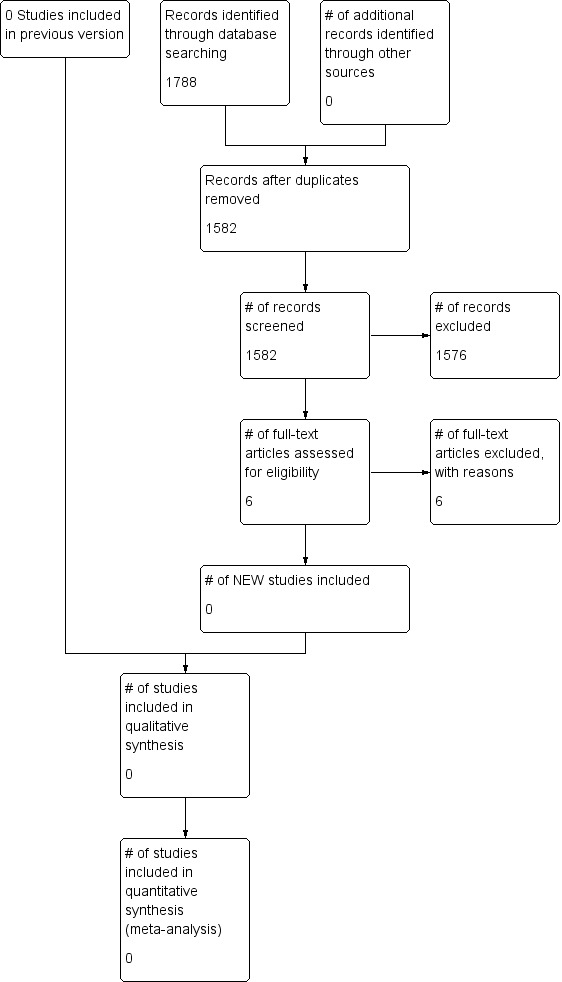
Main results: None of the studies identified by the search met the inclusion criteria for this review.
Authors' conclusions: There is no evidence from controlled trials that ATLS or similar programs impact the outcome for victims of injury, although there is some evidence that educational initiatives improve knowledge of hospital staff of available emergency interventions. Furthermore, there is no evidence that trauma management systems that incorporate ATLS training impact positively on outcome. Future research should concentrate on the evaluation of trauma systems incorporating ATLS, both within hospitals and at the health system level, by using more rigorous research designs.
Conflict of interest statement
SJ: None known.
DS: None known.
PC: None known.
RW: None known.
Update of
-
Advanced trauma life support training for hospital staff.Cochrane Database Syst Rev. 2009 Apr 15;(2):CD004173. doi: 10.1002/14651858.CD004173.pub3. Cochrane Database Syst Rev. 2009. Update in: Cochrane Database Syst Rev. 2014 Aug 22;(8):CD004173. doi: 10.1002/14651858.CD004173.pub4. PMID: 19370594 Updated.
References
References to studies excluded from this review
Aboutanos 2007 {published data only}
-
- Aboutanos M, Rodas B, Aboutanos E, Mora S, Wolfe F, Duane G, et al. Trauma Education and Care in the Jungle of Ecuador, Where There is no Advanced Trauma Life Support. The Journal of Trauma 2007;62(3):714‐9. - PubMed
Ali 1996 {published data only}
-
- Ali J, Cohen R, Adam R, Gana T, Pierre J, Bedaysie I, et al. Teaching effectiveness of the advanced trauma life support program as demonstrated by an objective structured clinical examination for practicing physicians. World Journal of Surgery 1996;20(8):1121‐5. - PubMed
Ali 1998 {published data only}
-
- Ali J, Cohen R, Gana J, Al‐Bedah T. Effect of the Advanced Trauma Life Support Program on Medical Students' Performance in Simulated Trauma Patient Management. The Journal of Trauma 1998;44(4):588‐91. - PubMed
Ali 2000 {published data only}
-
- Ali J, Gana T, Howard M. Trauma Mannequin Assessment of Management Skills of Surgical Residents after Advanced Trauma Life Support Training. Journal of Surgical Research 2000;93(1):197‐200. - PubMed
Drimousis 2011 {published data only}
-
- Drimousis PG, Theodorou D, Toutouzas K, Stergiopoulos S, Delicha EM, Giannopoulos P, et al. Advanced Trauma Life Support certified physicians in a non trauma system setting: is it enough?. Resuscitation 2011;82(2):180‐4. - PubMed
Hashmi 2013 {published data only}
-
- Hashmi ZG, Haider AH, Zafar SN, Kisat M, Moosa A, Siddiqui F, et al. Hospital‐based trauma quality improvement initiatives: first step toward improving trauma outcomes in the developing world. The Journal of Trauma and Acute Care Surgery 2013;75(1):60‐8. - PubMed
Hedges 2002 {published data only}
-
- Hedges JR, Adams AL, Gunnels MD. ATLS practices and survival at rural level III trauma hospital, 1995‐1999. Prehospital Emergency Care 2002;6(3):299‐305. - PubMed
Messick 1992 {published data only}
-
- Messick W, Rutledge R, Meyer A. The Association of Advanced Life Support Training and Decreased Per Capita Trauma Death Rates: An Analysis of 12,417 Trauma Deaths. Journal of trauma 1992;33(6):850‐5. - PubMed
Wang 2010 {published data only}
-
- Wang P, Li NP, Gu YF, Lu XB, Cong JN, Yang X, Ling Y. Comparison of severe trauma care effect before and after advanced trauma life support training. Chinese Journal of Traumatology 2010;13(6):341‐4. - PubMed
Additional references
Ali 1994
-
- Ali J, Adam R, Stedman M, Howard M, Williams JI. Advanced Trauma Life Support Program increases emergency room application of trauma resuscitative procedures in a developing country. Journal of Trauma 1994;36(3):391‐4. - PubMed
Berger 1996
-
- Berger LR, Mohan D. Injury control: a global view. Oxford: Oxford University Press, 1996.
Cales 1984
-
- Cales RH. Trauma mortality in Orange County: the effect of implementation of a regional trauma system. Annals of Emergency Medicine 1984;13(1):1‐8. - PubMed
Calicott 1980
-
- Calicott PE, Hughes I. Training in trauma advanced life support. Journal of the American Medical Association 1980;243(11):1156‐9.
Gwatkin 1997
Habibula 2002
-
- Shakiba S, Sethi D, Maree‐Kelly A. Advanced trauma life support training for hospital staff. Cochrane Database of Systematic Reviews 2002, Issue 4. [DOI: 10.1002/14651858.CD004173] - DOI
Higgins 2011
-
- Higgins JPT, Green S (editors). Cochrane Handbook for Systematic Reviews of Interventions Version 5.1.0 [updated March 2011]. The Cochrane Collaboration, 2011. Available from www.cochrane‐handbook.org.
Jayaraman 2014
Kelly 1994
-
- Kelly AM, Ardagh MW. Does learning emergency medicine equip medical students for ward emergencies?. Medical Education 1994;28(6):524‐7. - PubMed
Kirsch 1998
-
- Kirsch TD. Emergency medicine around the world. Annals of Emergency Medicine 1998;32(2):237‐8. - PubMed
Lecky 2000
-
- Lecky F, Woodford M, Yates DW. Trends in trauma care in England and Wales 1989‐97. Lancet 2000;355(9217):1771‐5. - PubMed
Lopez 2006
-
- Lopez A, Mathers D, Ezzati C, Jamison M, Murray D. Global and regional burden of disease and risk factors, 2001: systematic analysis of population health data. The Lancet 2006;367(9524):1747‐57. - PubMed
Mathers 2006
Murray 1997a
-
- Murray CJL, Lopez AD. Global mortality, disability, and the contribution of risk factors: Global Burden of Disease Study. Lancet 1997;349(9063):1269‐76. - PubMed
Murray 1997b
-
- Murray CJL, Lopez AD. Alternative projections of mortality and disability by cause 1990‐2020: Global Burden of Disease Study. Lancet 1997;349(9064):1498‐1504. - PubMed
Murray 1997c
-
- Murray CJL, Lopez AD. Mortality by cause for the eight regions of the world: Global Burden of Disease Study. Lancet 1997;349(9061):1436‐42. - PubMed
Reines 1988
-
- Reines HD, Bartlett RL, Chudy NE, Kiragu KR, McKnew MA. Is advanced life support appropriate for victims of motor vehicle accidents: the South Carolina highway trauma project. Journal of Trauma 1988;28(5):563‐70. - PubMed
Review Manager (RevMan) [Computer program]
-
- The Nordic Cochrane Centre. Review Manager (RevMan). Version 5.0. Copenhagen: The Cochrane Collaboration, 2008.
Roberts 1996
Sethi 2000
-
- Sethi D, Aljunid S, Sulong SB, Zwi A. Injury care in low and middle‐income countries: identifying potential for change. Injury Control and Safety Promotion 2000;7(3):153‐64.
Stiell 1999
-
- Stiell IG, Wells GA, Spaite DW, Nichol G, O'Brian B, Munkley DP. The Ontario Prehospital Advanced Life Support (OPALS) study Part II: Rationale and methodology for trauma and respiratory distress patients. OPALS Study Group. Annals of Emergency Medicine 1999;34(2):256‐62. - PubMed
WHO 2004
-
- WHO. World report on road traffic injury prevention. WHO 2004.
Publication types
MeSH terms
LinkOut - more resources
Full Text Sources
Other Literature Sources
Medical
Research Materials
Miscellaneous
