


Increased virulence of rabbit haemorrhagic disease virus associated with genetic resistance in wild Australian rabbits (Oryctolagus cuniculus)
- PMID: 25146599
- PMCID: PMC4598644
- DOI: 10.1016/j.virol.2014.06.037
Increased virulence of rabbit haemorrhagic disease virus associated with genetic resistance in wild Australian rabbits (Oryctolagus cuniculus)
Abstract
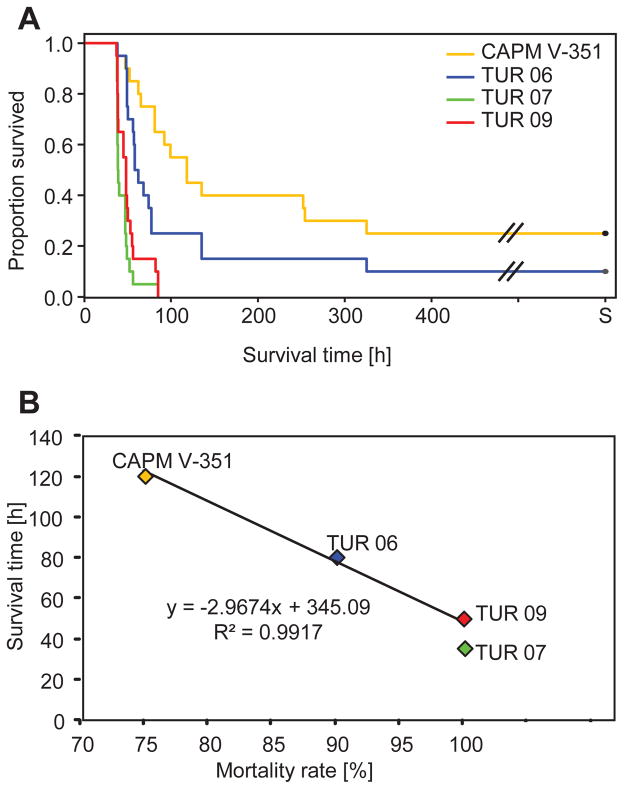
The release of myxoma virus (MYXV) and Rabbit Haemorrhagic Disease Virus (RHDV) in Australia with the aim of controlling overabundant rabbits has provided a unique opportunity to study the initial spread and establishment of emerging pathogens, as well as their co-evolution with their mammalian hosts. In contrast to MYXV, which attenuated shortly after its introduction, rapid attenuation of RHDV has not been observed. By studying the change in virulence of recent field isolates at a single field site we show, for the first time, that RHDV virulence has increased through time, likely because of selection to overcome developing genetic resistance in Australian wild rabbits. High virulence also appears to be favoured as rabbit carcasses, rather than diseased animals, are the likely source of mechanical insect transmission. These findings not only help elucidate the co-evolutionary interaction between rabbits and RHDV, but reveal some of the key factors shaping virulence evolution.
Keywords: Adaptive evolution; Biological control; Calicivirus; Emerging disease; Genetic resistance; Rabbit; Transmission; Virulence.
Copyright © 2014 Elsevier Inc. All rights reserved.
Conflict of interest statement
The authors declare they have no competing interests.
Figures


References
-
- Frank SA. Models of parasite virulence. Quart Rev Biol. 1996;71:37–78. - PubMed
-
- Richardson B. Calicivirus, myxoma virus and the wild rabbit in Australia: a tale of three invasions. In: Smith GLIW, McCauley J, Rowlands DJ, editors. New Challenges to Health: the Threat of Virus Infection. 60. Cambridge University Press; Cambridge, UK: 2001. pp. 67–87.
-
- Cooke B, Chudleigh P, Simpson S, Saunders G. The economic Benefits of the biological control of rabbits in Australia, 150–2011. Australian Econ Hist Rev. 2013;53:1–17.
-
- Cooke BD. Rabbits: manageable environmental pests or participants in new Australian ecosystems? Wildlife Res. 2012;39:279–289.
Publication types
MeSH terms
Grants and funding
LinkOut - more resources
Full Text Sources
Other Literature Sources
