Review
. 2015 Feb;22(2):225-36.
doi: 10.1038/cdd.2014.126. Epub 2014 Aug 22.

RIP kinases: key decision makers in cell death and innate immunity

Affiliations
Review

RIP kinases: key decision makers in cell death and innate immunity

F Humphries et al. Cell Death Differ. 2015 Feb.

Abstract

Innate immunity represents the first line of defence against invading pathogens. It consists of an initial inflammatory response that recruits white blood cells to the site of infection in an effort to destroy and eliminate the pathogen. Some pathogens replicate within host cells, and cell death by apoptosis is an important effector mechanism to remove the replication niche for such microbes. However, some microbes have evolved evasive strategies to block apoptosis, and in these cases host cells may employ further countermeasures, including an inflammatory form of cell death know as necroptosis. This review aims to highlight the importance of the RIP kinase family in controlling these various defence strategies. RIP1 is initially discussed as a key component of death receptor signalling and in the context of dictating whether a cell triggers a pathway of pro-inflammatory gene expression or cell death by apoptosis. The molecular and functional interplay of RIP1 and RIP3 is described, especially with respect to mediating necroptosis and as key mediators of inflammation. The function of RIP2, with particular emphasis on its role in NOD signalling, is also explored. Special attention is given to emphasizing the physiological and pathophysiological contexts for these various functions of RIP kinases.


Figures
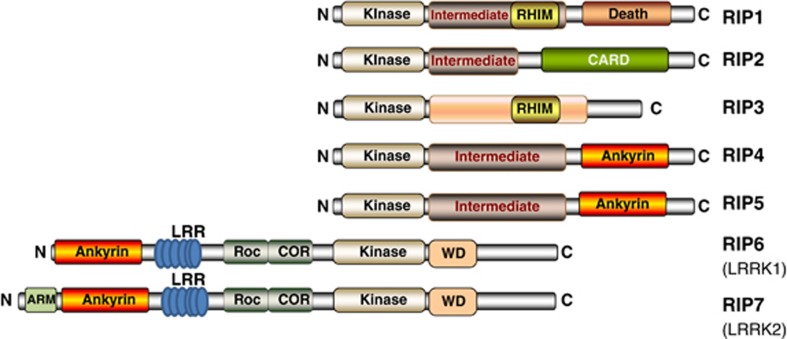
Figure 1
Figure 1
The RIP kinase family. The domain structures of members of the RIP kinase family are indicated. Roc, Ras of complex proteins; COR, C-terminal of Roc; WD, WD40 repeats; and ARM, Armadillo
Figure 2
Figure 2
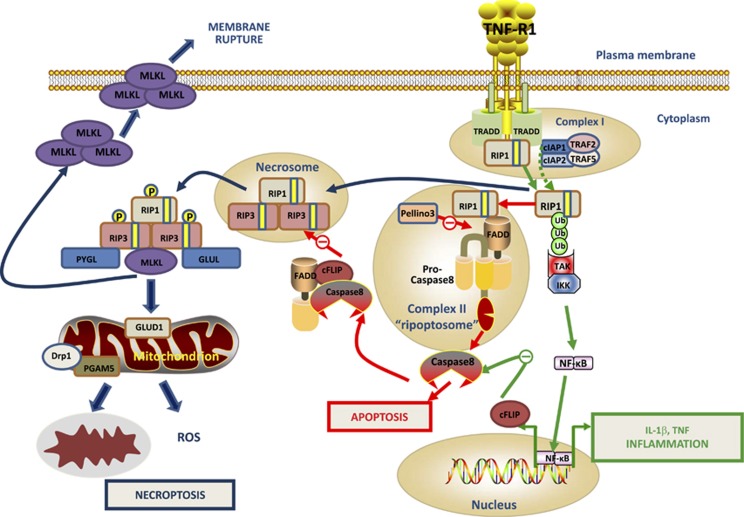
Regulatory roles of RIP1 and RIP3 in TNF signalling. Stimulation of cells with TNF leads to recruitment of TRADD and RIP1 to TNF-R1. RIP1 is ubiquitinated in a complex I containing TRAF2, TRAF5, cIAP1 and cIAP2 leading to TAK1/IKK-mediated activation of NFκB. The latter induces inflammation (by pro-inflammatory gene expression (e.g., IL-1β, TNF)) and anti-apoptotic proteins such as cFLIP. De-ubiquitination of RIP1 results in the formation of Complex II (or ‘ripoptosome' in the presence of IAP antagonists) with FADD and procaspase 8. Auto-processing of caspase 8 triggers a downstream caspase cascade and cell death by apoptosis. Pellino3 targets RIP1 to block formation of Complex II and apoptosis. Under the conditions of caspase 8 inhibition, RIP interacts with RIP3 (via their RHIM motifs, indicated in yellow) followed by RIP1/RIP3 phosphorylation (P) and formation of an amyloid filamentous structure known as the necrosome. RIP3 then interacts with MLKL, PYGEL, GLUL and GLUD1 resulting in mitochondrial ROS production. PGAM5 can also be stimulated to interact with the mitochondrial fission factor Drp1 leading to mitochondrial fragmentation and necroptosis, but this may be cell and species dependent. MLKL can also form oligomers that bind to membrane phospholipids resulting in membrane rupture. A FADD/cFLIP/caspase 8 complex can cleave RIP1 and RIP3 to prevent RIP1/RIP3-mediated necroptosis
Figure 3
Figure 3
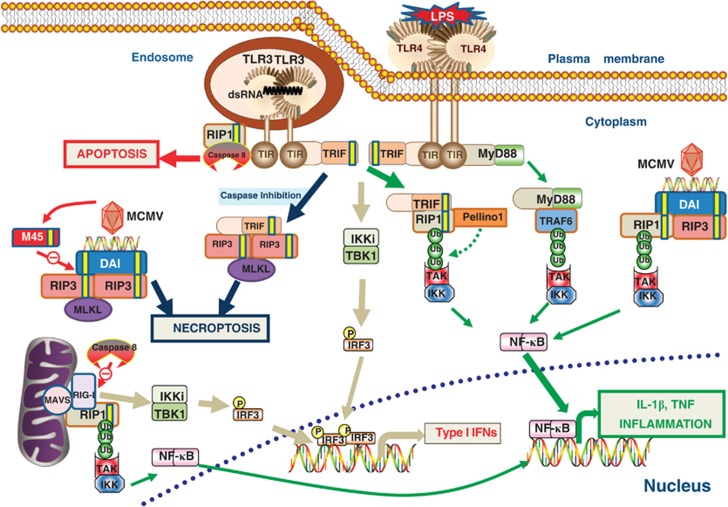
RIP1 and RIP3 in pattern recognition receptor signalling. LPS stimulates TLR4 to allow its Toll/IL-1 receptor (TIR) domain to interact with the TIR adaptor MyD88. This leads to ubiquitination of TRAF6, TAK1/IKK-mediated activation of NFκB and induction of pro-inflammatory genes such as IL-1β and TNF. The TIR domains of TLR3 and TLR4 can recruit another TIR adaptor TRIF, that contains a RHIM motif (in yellow), allowing TRIF to interact with RIP1. This is followed by Pellino1-mediated polyubiquitination of RIP1 allowing for TAK/IKK-induced activation of NFκB. TRIF (in a RIP1-independent manner) can also activate the TBK1/IKKi kinases to phosphorylate IRF3 and induce type I interferons (IFNs). Under conditions of caspase inhibition, the RHIM domain of TRIF can interact with the RHIM of RIP3 to trigger MLKL-mediated necroptosis. RIP1 can also facilitate the direct recruitment of caspase 8 to TLR3 leading to apoptosis. Murine cytomegalovirus (MCMV) can stimulate the DNA sensor DAI (containing two RHIMs) to interact with RIP1 and RIP3 to promote TAK/IKK-mediated activation of NFκB. DAI can also interact with RIP3 to promote MLKL-mediated necroptosis. The MCMV-encoded protein M45 contains a RHIM that allows it to target RIP3 and inhibit DAI- and RIP3-mediated necroptosis. The RNA helicase RIG-I is recruited to the mitochondria by MAVS followed by association with RIP1 and downstream activation of NFκB by TAK/IKK. RIG-1 also triggers TBK1/IKKi-mediated activation of IRF3 and induction of type I IFNs. RIP1 recruits caspase 8 to the RIG-1 complex resulting in RIP1 cleavage and termination of RIG-I signalling
Figure 4
Figure 4
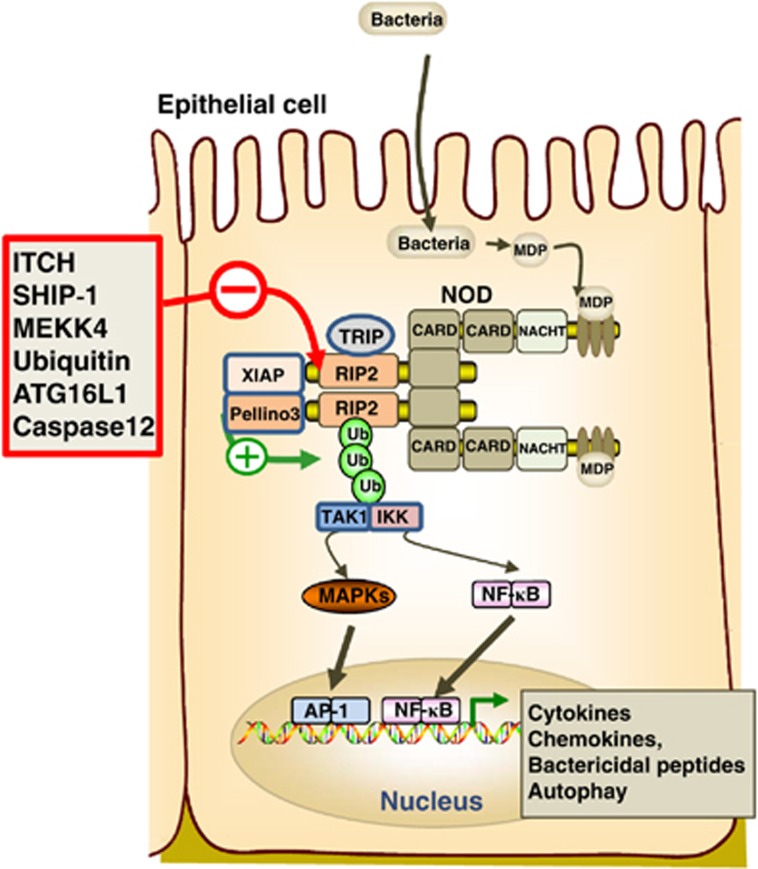
RIP2 and NOD signalling. Bacterial invasion of epithelial cells results in the stimulation of NOD proteins by peptidoglycan-derived peptides such as MDP. MDP binds to the leucine-rich repeat regions of NOD2 allowing for NACHT domains to mediate NOD oligomerization. The CARD domains of oligomerized NOD proteins interact with the CARD domains of RIP2 kinase molecules followed by binding of TRIP protein to RIP2 and XIAP and Pellino3-mediated polyubiquitination of RIP2. This facilitates recruitment of TAK1 and IKK complexes and downstream activation of NFκB, MAPKs and AP-1. The transcription factors drive expression of cytokines, chemokines and anti-bacterial peptides. NOD signalling can also result in cell autophagy. RIP2 is targeted by various negative regulatory proteins: ITCH catalyzes ubiquitination of RIP2 to inhibit NFκB activation; SHIP-1 disrupts the interaction between XIAP and RIP2; Free ubiquitin competes with RIP2 for the binding of NOD1; the autophagy protein ATG16L1 interferes with the polyubiquitination of RIP2 and the recruitment of RIP2 into NOD-signalling complexes; MEKK4 inhibits the basal interaction of RIP2 with NOD2; and Caspase 12 targets RIP2 and inhibits downstream signalling

Comment in

  • Targeting disease by immunomodulation.
    Kaufmann T, Simon HU. Kaufmann T, et al. Cell Death Differ. 2015 Feb;22(2):185-6. doi: 10.1038/cdd.2014.166. Cell Death Differ. 2015. PMID: 25578147 Free PMC article. No abstract available.

References

    1. O'Neill LA, Golenbock D, Bowie AG. The history of Toll-like receptors - redefining innate immunity. Nat Rev Immunol. 2013;13:453–460. - PubMed
    1. Chen G, Shaw MH, Kim YG, Nunez G. NOD-like receptors: role in innate immunity and inflammatory disease. Annu Rev Pathol. 2009;4:365–398. - PubMed
    1. Loo YM, Gale M., Jr Immune signaling by RIG-I-like receptors. Immunity. 2011;34:680–692. - PMC - PubMed
    1. Bhat N, Fitzgerald KA. Recognition of cytosolic DNA by cGAS and other STING-dependent sensors. Eur J Immunol. 2014;44:634–640. - PMC - PubMed
    1. Lamkanfi M, Dixit VM. Manipulation of host cell death pathways during microbial infections. Cell Host Microbe. 2010;8:44–54. - PubMed

Publication types

Substances