Effect of increasing dietary fiber on plasma levels of colon-derived solutes in hemodialysis patients
- PMID: 25147155
- PMCID: PMC4152802
- DOI: 10.2215/CJN.00490114
Effect of increasing dietary fiber on plasma levels of colon-derived solutes in hemodialysis patients
Abstract
Background and objectives: Numerous uremic solutes are derived from the action of colon microbes. Two such solutes, indoxyl sulfate and p-cresol sulfate, have been associated with adverse outcomes in renal failure. This study tested whether increasing dietary fiber in the form of resistant starch would lower the plasma levels of these solutes in patients on hemodialysis.
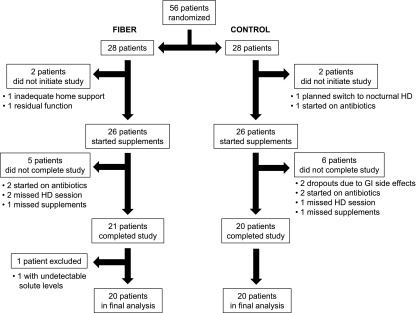
Design, setting, participants, & measurements: Fifty-six patients on maintenance hemodialysis were randomly assigned to receive supplements containing resistant starch (n=28) or control starch (n=28) daily for 6 weeks in a study conducted between October 2010 and May 2013. Of these, 40 patients (20 in each group) completed the study and were included in the final analysis. Plasma indoxyl sulfate and p-cresol sulfate levels were measured at baseline and week 6.
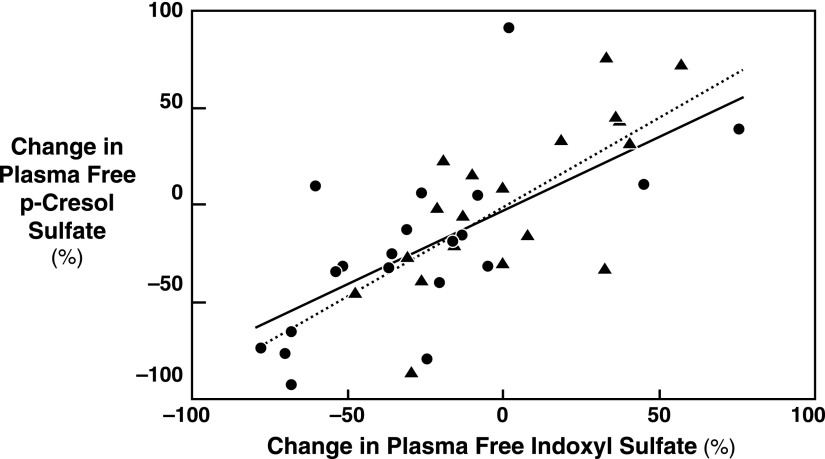
Results: Increasing dietary fiber for 6 weeks significantly reduced the unbound, free plasma level of indoxyl sulfate (median -29% [25th percentile, 75th percentile, -56, -12] for fiber versus -0.4% [-20, 34] for control, P=0.02). The reduction in free plasma levels of indoxyl sulfate was accompanied by a reduction in free plasma levels of p-cresol sulfate (r=0.81, P<0.001). However, the reduction of p-cresol sulfate levels was of lesser magnitude and did not achieve significance (median -28% [-46, 5] for fiber versus 4% [-28, 36] for control, P=0.05).
Conclusions: Increasing dietary fiber in hemodialysis patients may reduce the plasma levels of the colon-derived solutes indoxyl sulfate and possibly p-cresol sulfate without the need to intensify dialysis treatments. Further studies are required to determine whether such reduction provides clinical benefits.
Keywords: chronic hemodialysis; intestine; nutrition; uremia.
Copyright © 2014 by the American Society of Nephrology.
Figures
Comment in
-
Can oral therapy reduce uremic toxins?Clin J Am Soc Nephrol. 2014 Sep 5;9(9):1513-5. doi: 10.2215/CJN.07330714. Epub 2014 Aug 21. Clin J Am Soc Nephrol. 2014. PMID: 25147156 Free PMC article. No abstract available.
References
-
- Schepers E, Glorieux G, Vanholder R: The gut: The forgotten organ in uremia? Blood Purif 29: 130–136, 2010 - PubMed
-
- Evenepoel P, Meijers BK, Bammens BR, Verbeke K: Uremic toxins originating from colonic microbial metabolism. Kidney Int Suppl 114: S12–S19, 2009 - PubMed
-
- Meyer TW, Hostetter TH: Uremic solutes from colon microbes. Kidney Int 81: 949–954, 2012 - PubMed
Publication types
MeSH terms
Substances
Grants and funding
LinkOut - more resources
Full Text Sources
Other Literature Sources
Medical