


Comment
doi: 10.1182/blood-2014-07-581744.
How mutant HFE causes hereditary hemochromatosis
Affiliations
- PMID: 25147378
- PMCID: PMC4141508
- DOI: 10.1182/blood-2014-07-581744
Item in Clipboard
Comment
How mutant HFE causes hereditary hemochromatosis
Blood.
.
Abstract
In this issue of Blood, Wu et al describe the molecular function of HFE, the gene most commonly mutated in hereditary hemochromatosis (HH). HH is the most frequent genetic disorder of the Western world. The authors show that HFE prevents ubiquitination and proteasomal degradation of bone-morphogenetic protein (BMP) receptor type I (Alk3), thereby increasing expression of this receptor on the cell surface of hepatocytes. As a consequence, transcription of the iron-hormone hepcidin is activated.
Conflict of interest statement
Conflict-of-interest disclosure: M.U.M. received consulting fees from Novartis.
Figures
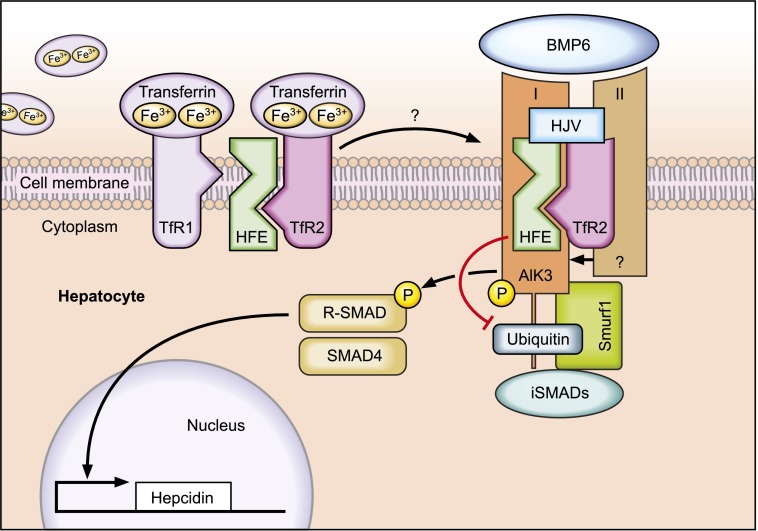
Regulated protein-protein interactions among HFE, TfR2, HJV (proteins mutated in HH), BMP receptors, and BMP ligands play a critical role in the “sensing” of transferrin-bound Fe to control hepcidin expression in hepatocytes. HFE binds to BMP receptor type I (Alk3) to prevent its ubiquitination and proteasomal degradation. As a result, expression of ALK3 is increased on the cell surface, activating BMP/SMAD signaling and hepcidin transcription. Professional illustration by Tom Webster, Lineworks, Inc.
Comment on
-
HFE interacts with the BMP type I receptor ALK3 to regulate hepcidin expression.Blood. 2014 Aug 21;124(8):1335-43. doi: 10.1182/blood-2014-01-552281. Epub 2014 Jun 5. Blood. 2014. PMID: 24904118 Free PMC article.
References
-
- Feder JN, Gnirke A, Thomas W, et al. A novel MHC class I-like gene is mutated in patients with hereditary haemochromatosis. Nat Genet. 1996;13(4):399–408. - PubMed
-
- Bridle KR, Frazer DM, Wilkins SJ, et al. Disrupted hepcidin regulation in HFE-associated haemochromatosis and the liver as a regulator of body iron homoeostasis. Lancet. 2003;361(9358):669–673. - PubMed
-
- Bennett MJ, Lebrón JA, Bjorkman PJ. Crystal structure of the hereditary haemochromatosis protein HFE complexed with transferrin receptor. Nature. 2000;403(6765):46–53. - PubMed
-
- Goswami T, Andrews NC. Hereditary hemochromatosis protein, HFE, interaction with transferrin receptor 2 suggests a molecular mechanism for mammalian iron sensing. J Biol Chem. 2006;281(39):28494–28498. - PubMed
Publication types
MeSH terms
Substances
LinkOut - more resources
Full Text Sources
Other Literature Sources
Research Materials
