


Antibacterial effect of silver nanoparticles against four foodborne pathogens
- PMID: 25147658
- PMCID: PMC4138668
- DOI: 10.5812/jjm.8720
Antibacterial effect of silver nanoparticles against four foodborne pathogens
Abstract
Background: There is increased demand for improved disinfection methods due to microorganisms resistant to multiple antimicrobial agents. Numerous types of disinfectants are available with different properties; but the proper disinfectant must be carefully selected for any specific application to obtain the desired antimicrobial effect.
Objectives: Antimicrobial effect of a commercial nanosilver product, NanoCid® L2000, against some foodborne pathogens was evaluated.
Materials and methods: Minimum inhibitory concentrations (MIC) were determined by monitoring the growth of bacteria at 600 nm, after 24 hours incubation at 35°C. Minimum bactericidal concentrations (MBC) were determined based on 3 log decrease in the viable population of the pathogens after incubation of nutrient agar plates at 35°C for 24 hours. The required exposure time for 3 log reduction in the viable population of the tested pathogens was determined as the minimum exposure time for efficient bactericidal activity.
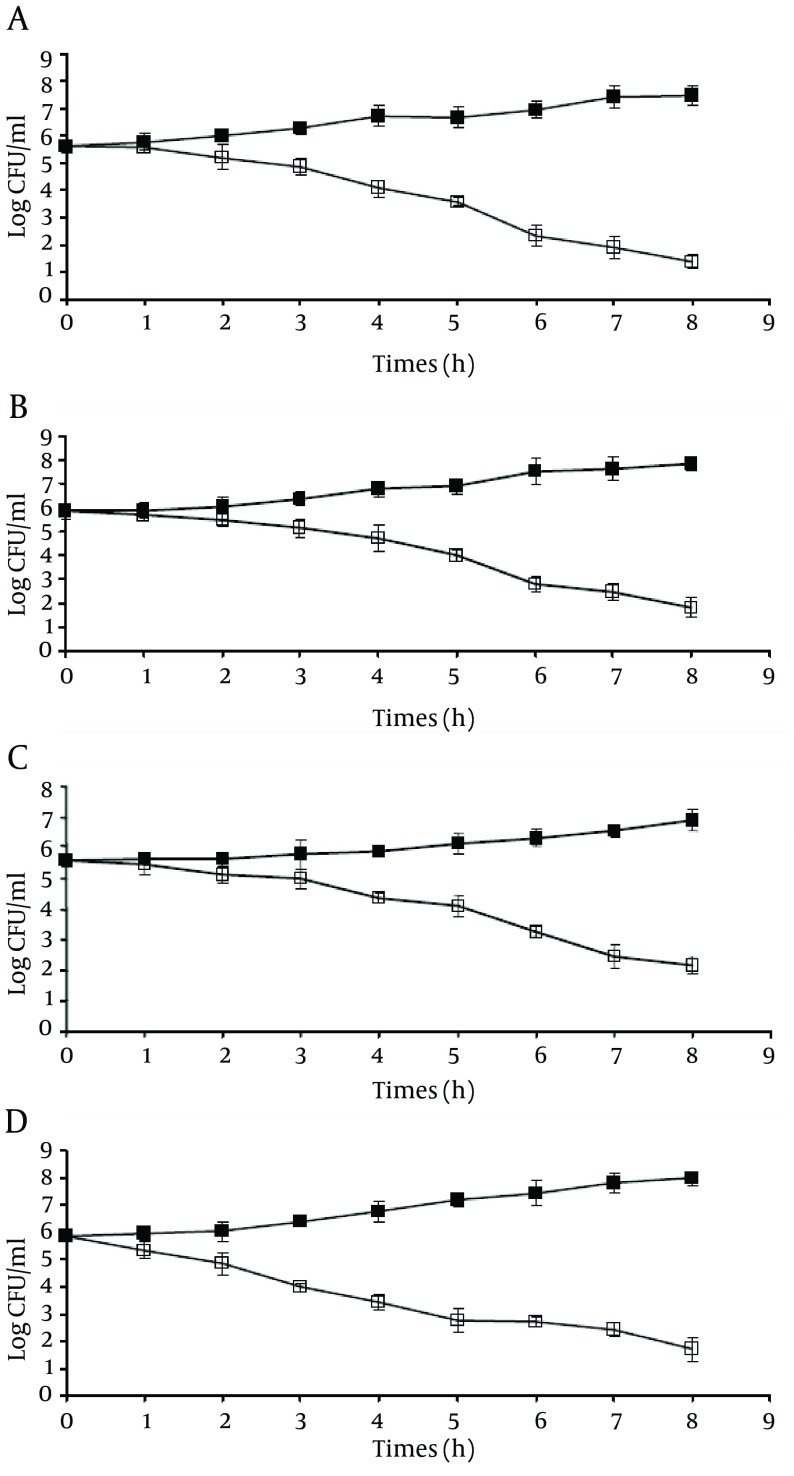
Results: The MIC values of Ag NPs against tested pathogens were in the range of 3.12-6.25 µg/mL. While Listeria monocytogenes showed the MIC value of 6.25 µg/mL, Escherichia coli O157:H7, Salmonella typhimurium and Vibrio parahaemolyticus all showed the MIC values of 3.12 µg/mL. However, all the pathogens showed the same MBC value of 6.25 µg/mL. To obtain an efficient bactericidal activity against E. coli O157:H7 and S. typhimurium, the exposure time should be at least ca. 6 hours., while this time was ca. 5 hours for V. parahaemolyticus and ca. 7 hours for L. monocytogenes.
Conclusions: Silver nanoparticles showed great antibacterial effectiveness on four important foodborne pathogens. Therefore, Ag NPs could be a good alternative for cleaning and disinfection of equipment and surfaces in food-related environments.
Keywords: Disinfection; Microbial Sensitivity Tests; Nanoparticles; Pathogen; Silver.
Figures
References
-
- Jay JM. Modern Food Microbiology. 6th ed. Singapore: Aspen Publishers; 2000. - DOI
-
- Armstrong GL, Hollingsworth J, Morris JG, Jr. Emerging foodborne pathogens: Escherichia coli O157:H7 as a model of entry of a new pathogen into the food supply of the developed world. Epidemiol Rev. 1996;18(1):29–51. - PubMed
-
- Griffin PM, Tauxe RV. The epidemiology of infections caused by Escherichia coli O157:H7, other enterohemorrhagic E. coli, and the associated hemolytic uremic syndrome. Epidemiol Rev. 1991;13:60–98. - PubMed
-
- Parihar VS, Barbuddhe SB, Danielsson-Tham ML, Tham W. Isolation and characterization of Listeria species from tropical seafoods. Food Cont. 2008;19(6):566–569. doi: 10.1016/j.foodcont.2007.06.009. - DOI
-
- Mani-Lopez E, Garcia HS, Lopez-Malo A. Organic acids as antimicrobials to control Salmonella in meat and poultry products. Food Res Int. 2012;45(2):713–721.
LinkOut - more resources
Full Text Sources
Other Literature Sources
Molecular Biology Databases