


The impact of donor viral replication at transplant on recipient infections posttransplant: a prospective study
- PMID: 25148381
- PMCID: PMC4336214
- DOI: 10.1097/TP.0000000000000354
The impact of donor viral replication at transplant on recipient infections posttransplant: a prospective study
Abstract
Background: Organ donors are often implicated as the source of posttransplant recipient infection. We prospectively studied kidney and liver donor-recipient pairs to determine if donor viral replication of cytomegalovirus (CMV), Epstein-Barr virus (EBV), and BK polyomavirus (BKV) at transplant was a risk factor for posttransplant recipient infection and disease.
Methods: Donors and recipients were studied for antibodies against CMV and EBV and for quantitative viral replication of CMV, EBV, and BKV in oral washes, urine, and whole blood pretransplant. Recipient testing continued every 3 months after transplantation. Demographic and clinical data on infections and graft and subject outcomes were obtained.
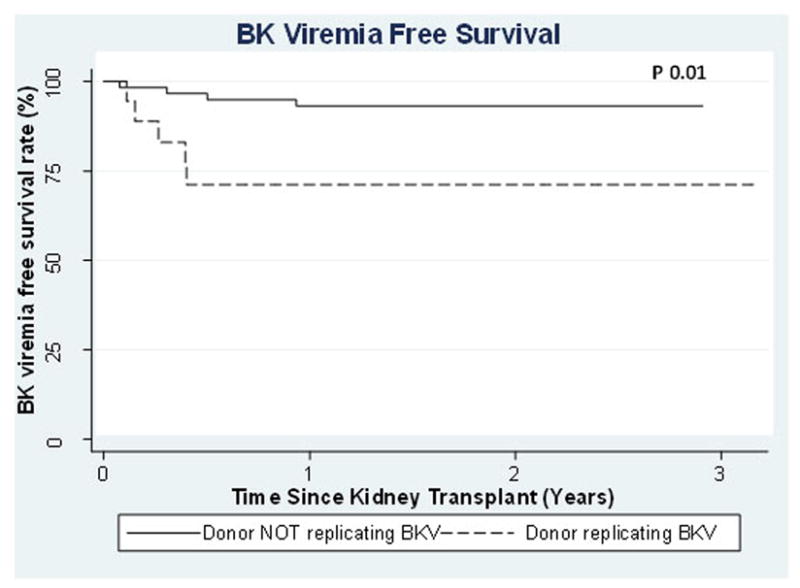
Results: The 98 donor-recipient pairs included 15 liver and 83 kidney transplants (18 of whom were children). No donor had detectable CMV replication; therefore, its impact on recipient CMV replication could not be analyzed. Donor EBV replication occurred in 22%, mostly in the oral wash and showed no impact on posttransplant recipient EBV replication (P=0.9) or EBV viremia (P=0.6) in kidney or liver recipients. Donor BKV replication occurred in 17%, mostly in the urine and although not associated with posttransplant recipient urinary BKV replication in recipients, it was associated with BKV viremia (P=0.02), and a significantly shorter time to BKV viremia (P=0.01) in kidney recipients.
Conclusion: Donor replication of CMV or EBV did not impact posttransplant recipient viral replication in kidney or liver transplants. Donor urinary BKV replication is associated with recipient BKV viremia in kidney transplants.
Conflict of interest statement
Conflict of interest: None by any authors
References
-
- Li L, Chaudhuri A, Weintraub LA, Hsieh F, Shah S, Alexander S, et al. Subclinical cytomegalovirus and Epstein-Barr virus viremia are associated with adverse outcomes in pediatric renal transplantation. Pediatr Transplant. 2007;11(2):187–95. - PubMed
-
- Bamoulid J, Courivaud C, Coaquette A, Chalopin JM, Gaiffe E, Saas P, et al. Subclinical Epstein-Barr virus viremia among adult renal transplant recipients: incidence and consequences. Am J Transplant. 2013;13(3):656–62. - PubMed
-
- Taylor AL, Marcus R, Bradley JA. Post-transplant lymphoproliferative disorders (PTLD) after solid organ transplantation. Crit Rev Oncol Hematol. 2005;56(1):155–67. - PubMed
-
- Kaden J, Zenker S, Eichler C, Groth J, May G, Strobelt V, et al. Risk of CMV infection and illness after kidney transplantation. Allerg Immunol (Leipz) 1991;37(1):47–58. - PubMed
Publication types
MeSH terms
Grants and funding
LinkOut - more resources
Full Text Sources
Medical
