Review
. 2015:77:407-30.
doi: 10.1146/annurev-physiol-021014-071937. Epub 2014 Aug 13.

Dynamics of lung defense in pneumonia: resistance, resilience, and remodeling

Affiliations
Review

Dynamics of lung defense in pneumonia: resistance, resilience, and remodeling

Lee J Quinton et al. Annu Rev Physiol. 2015.

Abstract

Pneumonia is initiated by microbes in the lung, but physiological processes integrating responses across diverse cell types and organ systems dictate the outcome of respiratory infection. Resistance, or actions of the host to eradicate living microbes, in the lungs involves a combination of innate and adaptive immune responses triggered by air-space infection. Resilience, or the ability of the host tissues to withstand the physiologically damaging effects of microbial and immune activities, is equally complex, precisely regulated, and determinative. Both immune resistance and tissue resilience are dynamic and change throughout the lifetime, but we are only beginning to understand such remodeling and how it contributes to the incidence of severe pneumonias, which diminishes as childhood progresses and then increases again among the elderly. Here, we review the concepts of resistance, resilience, and remodeling as they apply to pneumonia, highlighting recent advances and current significant knowledge gaps.

Keywords: NF-κB; STAT3; cytokines; innate immunity; lung; respiratory infection.


Figures
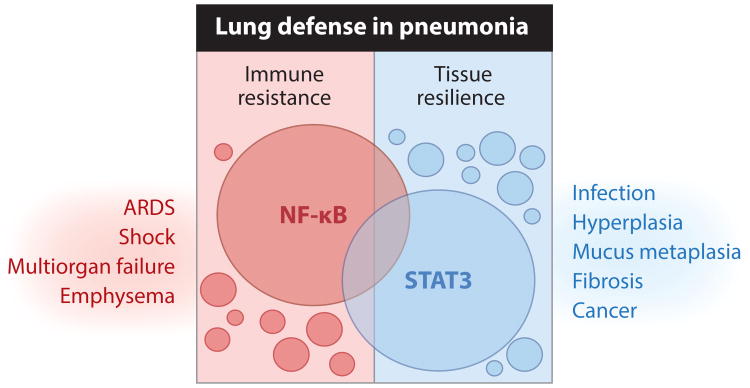
Figure 1
Figure 1
Lung defense requires a careful balance between immune resistance and tissue resilience pathways, shaped largely by NF-κB and STAT3, respectively. In response to lung infection, multiple signals are initiated to limit the number of living pathogens in the respiratory tract, some of which are more broadly applicable than others (small versus large circles). NF-κB represents a prominent signaling node for achieving such immune resistance, driving the expression of numerous factors eliciting innate immunity and antimicrobial defense. Correspondingly, pathways must be initiated that enable pneumonic lung tissue to tolerate the net pathological consequences of both the infection and the resulting immune response. Gene programs controlled by the STAT3 transcription factor promote such resilience by preserving tissue integrity and preventing excessive inflammation. Although the known functions of NF-κB and STAT3 are skewed toward resistance and resilience, respectively, these pathways are capable of functioning in an opposite manner through distinct and overlapping mechanisms, represented by intersections. Regardless of their dependence on NF-κB or STAT3, overexuberant resistance or resilience pathways are sufficient to drive lung diseases such as those indicated, demanding a controlled and balanced response. ARDS denotes acute respiratory distress syndrome.
Figure 2
Figure 2
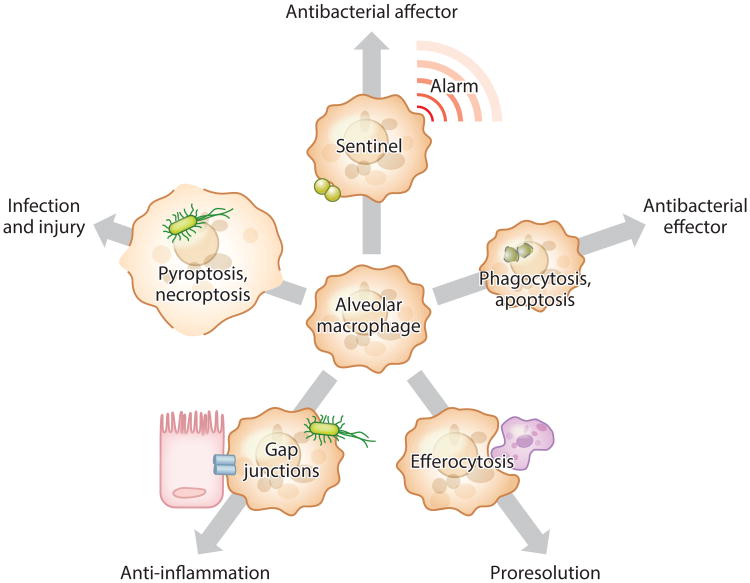
Roles of alveolar macrophages in resistance and resilience during pneumonia. As sentinel cells, alveolar macrophages sound the initial alarm and are essential to the rapid activation of other cells, the recruitment of neutrophils, and the killing of bacteria. In addition, alveolar macrophages are effectors of antibacterial resistance, capable of killing ingested bacteria, especially when undergoing apoptosis. The apoptosis of other cells in the lung stimulates alveolar macrophage efferocytosis, which eliminates dying leukocytes, prevents their release of danger signals in the lungs, and switches macrophage phenotypes to producing anti-inflammatory and proresolving signals. Select subsets of alveolar macrophages become nonmotile and adhere to the epithelium via gap junctions, through which these macrophages transmit Ca2+ waves that dampen inflammatory signaling. However, when nonapoptotic pathways of cell death are triggered by microbial virulence factors, alveolar macrophages become poor bacteria killers and release powerful proinflammatory signals that can exacerbate lung injury.
Figure 3
Figure 3
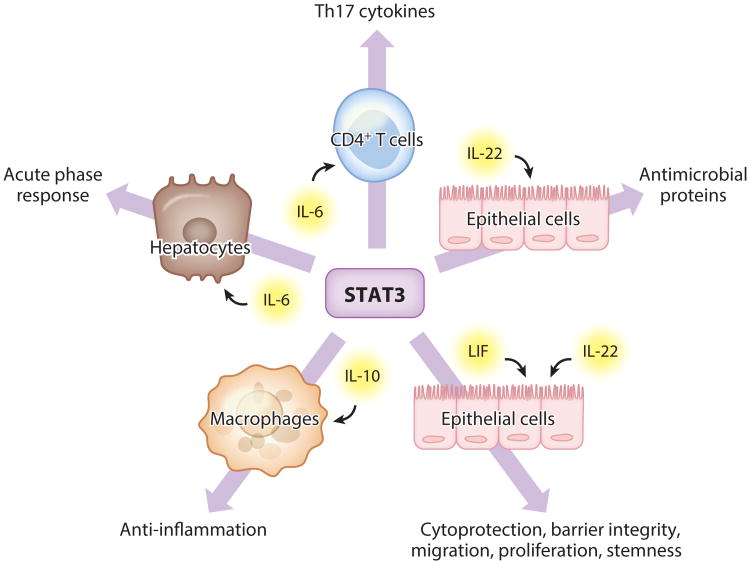
The STAT3 transcription factor facilitates diverse processes paramount to pneumonia biology both inside and outside of the lungs. The indicated outcomes represent consequences of STAT3 activity downstream of IL-6, leukemia inhibitory factor (LIF), IL-22, and IL-10 in select cell types during pneumonia. These outcomes are critical determinants of immune resistance (antimicrobial proteins, acute phase response, Th17 cytokines), tissue resilience (anti-inflammatory signals, epithelial preservation, acute phase response), and immune remodeling (Th17 cytokines). Pathways shown are those highlighted in the review and reflect only a fraction of the known roles of STAT3 that may be relevant to pneumonia.
Figure 4
Figure 4
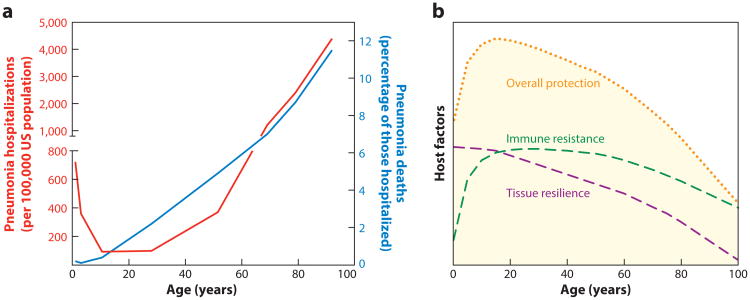
Remodeling responses to pneumonia throughout the lifetime. (a) Effect of age on pneumonia in the United States, from 2007 to 2009. The red line shows age-stratified hospitalizations for pneumonia of any cause per 100,000 US population, reflecting a U-shaped curve between birth and retirement ages, followed by a steeper incline to far greater hospitalization rates among the elderly (note break in y-axis at left). The blue line shows rates of in-hospital death related to pneumonia from any cause, reflecting a steady increase beginning in early childhood and continuing throughout the ensuing years. The graph was constructed from data communicated by Griffin et al. (155), with ages plotted as the midpoint of each age range reported. (b) Conceptual framework portraying how changes in resistance and resilience may be responsible for the effects of age on pneumonia (as in panel a). We propose that immune resistance increases dramatically in childhood due to the development of heterotypic adaptive immunity and lung-resident memory against respiratory pathogens, which together protect younger adults but (we predict) wane in the elder years. We propose that tissue resilience declines throughout the lifetime, increasing pneumonia death rates even among those with strong resistance and then synergizing with the decreasing resistance in the elder years to render pneumonia incidence and severity especially elevated at those ages. Overall protection against pneumonia, plotted here as a simple sum of resistance plus resilience, plummets when both parameters of lung defense simultaneously decrease. Panel b does not reflect actual data but rather reflects a conceptual framework that we constructed to communicate the paradigms spotlighted in this review.

References

    1. Vos T, Flaxman AD, Naghavi M, Lozano R, Michaud C, et al. Years lived with disability (YLDs) for 1160 sequelae of 289 diseases and injuries 1990–2010: a systematic analysis for the Global Burden of Disease Study 2010. Lancet. 2012;380:2163–96. - PMC - PubMed
    1. Armstrong GL, Conn LA, Pinner RW. Trends in infectious disease mortality in the United States during the 20th century. JAMA. 1999;281:61–66. - PubMed
    1. Liu L, Johnson HL, Cousens S, Perin J, Scott S, et al. Global, regional, and national causes of child mortality: an updated systematic analysis for 2010 with time trends since 2000. Lancet. 2012;379:2151–61. - PubMed
    1. Mizgerd JP. Respiratory infection and the impact of pulmonary immunity on lung health and disease. Am J Respir Crit Care Med. 2012;186:824–29. - PMC - PubMed
    1. Curns AT, Holman RC, Sejvar JJ, Owings MF, Schonberger LB. Infectious disease hospitalizations among older adults in the United States from 1990 through 2002. Arch Intern Med. 2005;165:2514–20. - PubMed

Publication types

MeSH terms