


Temporal trends of nonalcoholic fatty liver disease-related hepatocellular carcinoma in the veteran affairs population
- PMID: 25148760
- PMCID: PMC4333060
- DOI: 10.1016/j.cgh.2014.08.013
Temporal trends of nonalcoholic fatty liver disease-related hepatocellular carcinoma in the veteran affairs population
Abstract
Background & aims: Nonalcoholic fatty liver disease (NAFLD) is a risk factor for hepatocellular carcinoma (HCC). However, no systemic studies from the United States have examined temporal trends, HCC surveillance practices, and outcomes of NAFLD-related HCC.
Methods: We identified a national cohort of 1500 patients who developed HCC from 2005 through 2010 from Veterans Administration (VA) hospitals. We reviewed patients' full VA medical records; NAFLD was diagnosed based on histologic evidence for, or the presence of, the metabolic syndrome in the absence of hepatitis C virus (HCV) infection, hepatitis B, or alcoholic liver disease. We compared annual prevalence values for the main risk factors (NAFLD, alcohol abuse, and HCV), as well a HCC surveillance and outcomes, among HCC patients.
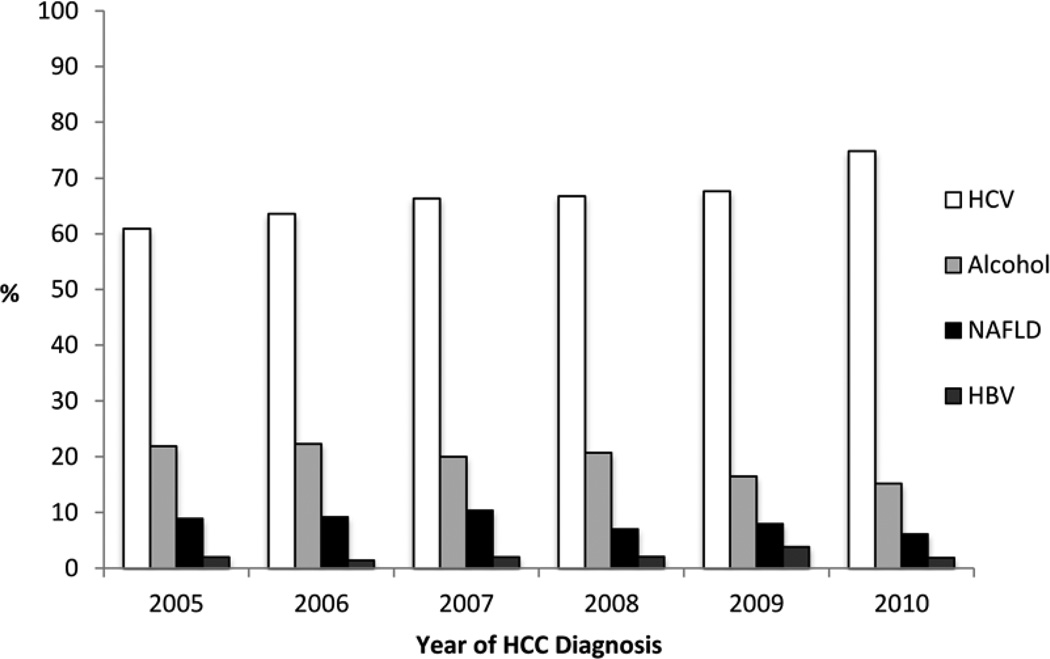
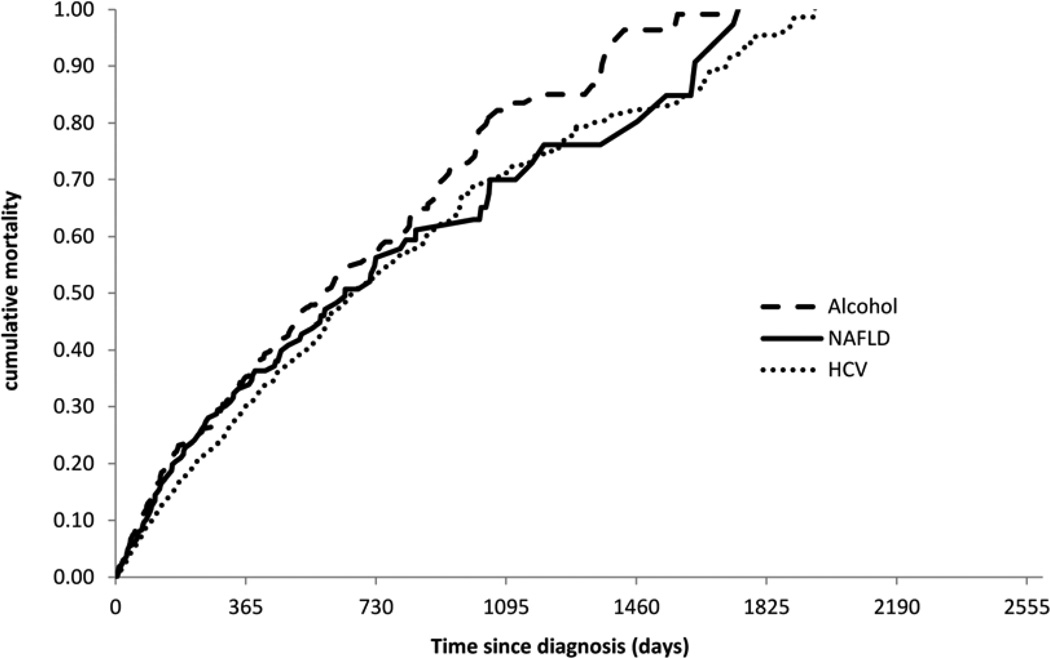
Results: NAFLD was the underlying risk factor for HCC in 120 patients (8.0%); the annual proportion of NAFLD-related HCC remained relatively stable (7.5%-12.0%). In contrast, the proportion of HCC cases associated with HCV increased from 61.0% in 2005 (95% confidence interval, 53.1%-68.9%) to 74.9% in 2010 (95% confidence interval, 69.0%-80.7%). The proportion of HCC cases associated with only alcohol abuse decreased from 21.9% in 2005 to 15.7% in 2010, and the annual proportion of HCC cases associated with hepatitis B remained relatively stable (1.4%-3.5%). A significantly lower proportion of patients with NAFLD-related HCC had cirrhosis (58.3%) compared with patients with alcohol- or HCV-related HCC (72.4% and 85.6%, respectively; P < .05). A significantly higher percentage of patients with NAFLD-related HCC did not receive HCC surveillance in the 3 years before their HCC diagnosis, compared with patients with alcohol- or HCV-associated HCC. A lower proportion of patients with NAFLD-related HCC received HCC-specific treatment (61.5%) than patients with HCV-related HCC (77.5%; P < .01). However, the 1-year survival rate did not differ among patients with HCC related to different risk factors.
Conclusions: NAFLD is the third most common risk factor for HCC in the VA population. The proportion of NAFLD-related HCC was relatively stable from 2005 through 2010. Although patients with NAFLD-related HCC received less HCC surveillance and treatment, a similar proportion survive for 1 year, compared with patients with alcohol-related or HCV-related HCC.
Keywords: Incidence; Liver Cancer; NASH; Time.
Copyright © 2015 AGA Institute. Published by Elsevier Inc. All rights reserved.
Conflict of interest statement
Figures
References
-
- El-Serag HB, Davila JA, Petersen NJ, McGlynn KA. The continuing increase in the incidence of hepatocellular carcinoma in the United States: an update. Ann Intern Med. 2003;139:817–823. - PubMed
-
- McGlynn KA, Tarone RE, El-Serag HB. A comparison of trends in the incidence of hepatocellular carcinoma and intrahepatic cholangiocarcinoma in the United States. Cancer Epidemiol Biomarkers Prev. 2006;15:1198–1203. - PubMed
-
- Davila JA, Morgan RO, Shaib Y, et al. Hepatitis C infection and the increasing incidence of hepatocellular carcinoma: a population-based study. Gastroenterology. 2004;127:1372–1380. - PubMed
-
- Adams LA, Lindor KD. Nonalcoholic fatty liver disease. Ann Epidemiol. 2007;17:863–869. - PubMed
-
- Williams CD, Stengel J, Asike MI, et al. Prevalence of nonalcoholic fatty liver disease and nonalcoholic steatohepatitis among a largely middle-aged population utilizing ultrasound and liver biopsy: a prospective study. Gastroenterology. 2011;140:124–131. - PubMed
Publication types
MeSH terms
Grants and funding
LinkOut - more resources
Full Text Sources
Other Literature Sources
Medical
