


Microglial Aβ receptors in Alzheimer's disease
- PMID: 25149075
- PMCID: PMC11486233
- DOI: 10.1007/s10571-014-0101-6
Microglial Aβ receptors in Alzheimer's disease
Abstract
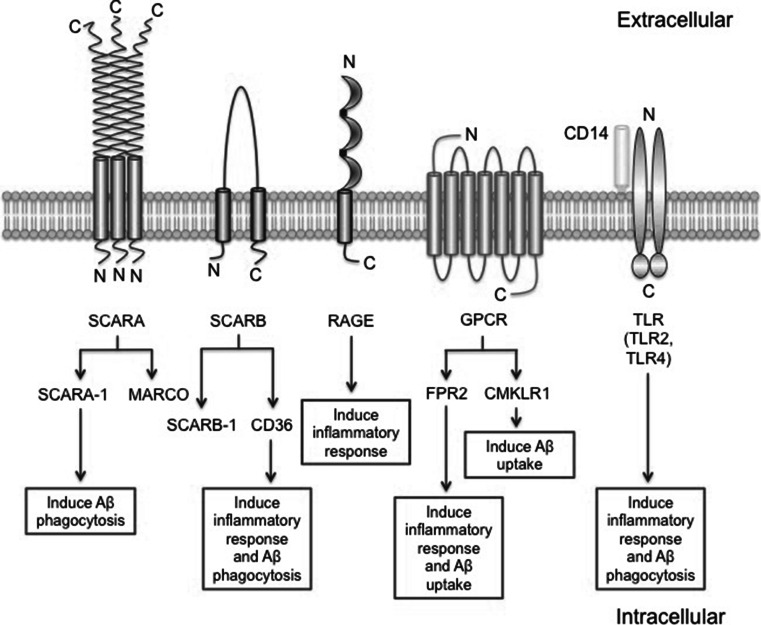
Amyloid β (Aβ) plays a pivotal role in the progression of Alzheimer's disease (AD) through its neurotoxic and inflammatory effects. On one hand, Aβ binds to microglia and activates them to produce inflammatory mediators. On the other hand, Aβ is cleared by microglia through receptor-mediated phagocytosis and degradation. This review focuses on microglial membrane receptors that bind Aβ and contribute to microglial activation and/or Aβ phagocytosis and clearance. These receptors can be categorized into several groups. The scavenger receptors (SRs) include scavenger receptor A-1 (SCARA-1), MARCO, scavenger receptor B-1 (SCARB-1), CD36 and the receptor for advanced glycation end product (RAGE). The G protein-coupled receptors (GPCRs) are formyl peptide receptor 2 (FPR2) and chemokine-like receptor 1 (CMKLR1). There are also toll-like receptors (TLRs) including TLR2, TLR4, and the co-receptor CD14. Functionally, SCARA-1 and CMKLR1 are involved in the uptake of Aβ, and RAGE is responsible for the activation of microglia and production of proinflammatory mediators following Aβ binding. CD36, CD36/CD47/α6β1-intergrin, CD14/TLR2/TLR4, and FPR2 display both functions. Additionally, MARCO and SCARB-1 also exhibit the ability to bind Aβ and may be involved in the progression of AD. Here, we focus on the expression and distribution of these receptors in microglia and their roles in microglia interaction with Aβ. Finally, we discuss the potential therapeutic value of these receptors in AD.
Figures
References
-
- Akiyama H, Barger S, Barnum S, Bradt B, Bauer J, Cole GM, Cooper NR, Eikelenboom P, Emmerling M, Fiebich BL, Finch CE, Frautschy S, Griffin WS, Hampel H, Hull M, Landreth G, Lue L, Mrak R, Mackenzie IR, McGeer PL, O’Banion MK, Pachter J, Pasinetti G, Plata-Salaman C, Rogers J, Rydel R, Shen Y, Streit W, Strohmeyer R, Tooyoma I, Van Muiswinkel FL, Veerhuis R, Walker D, Webster S, Wegrzyniak B, Wenk G, Wyss-Coray T (2000) Inflammation and Alzheimer’s disease. Neurobiol Aging 21(3):383–421 - PMC - PubMed
-
- Alarcon R, Fuenzalida C, Santibanez M, von Bernhardi R (2005) Expression of scavenger receptors in glial cells. Comparing the adhesion of astrocytes and microglia from neonatal rats to surface-bound beta-amyloid. J Biol Chem 280(34):30406–30415. doi:10.1074/jbc.M414686200 - PubMed
-
- Arita M, Ohira T, Sun YP, Elangovan S, Chiang N, Serhan CN (2007) Resolvin E1 selectively interacts with leukotriene B4 receptor BLT1 and ChemR23 to regulate inflammation. J Immunol 178(6):3912–3917 - PubMed
-
- Bachstetter AD, Xing B, de Almeida L, Dimayuga ER, Watterson DM, Van Eldik LJ (2011) Microglial p38alpha MAPK is a key regulator of proinflammatory cytokine up-regulation induced by toll-like receptor (TLR) ligands or beta-amyloid (Abeta). J Neuroinflammation 8:79. doi:10.1186/1742-2094-8-79 - PMC - PubMed
Publication types
MeSH terms
Substances
LinkOut - more resources
Full Text Sources
Other Literature Sources
Medical
Research Materials
Miscellaneous
