. 2014 Nov;80(22):6870-8.
doi: 10.1128/AEM.02072-14. Epub 2014 Aug 22.

Newly identified thermostable esterase from Sulfobacillus acidophilus: properties and performance in phthalate ester degradation

Affiliations

Newly identified thermostable esterase from Sulfobacillus acidophilus: properties and performance in phthalate ester degradation

Xiao-Yan Zhang et al. Appl Environ Microbiol. 2014 Nov.

Abstract

EstS1, a newly identified thermostable esterase from Sulfobacillus acidophilus DSM10332, was heterologously expressed in Escherichia coli and shown to enzymatically degrade phthalate esters (PAEs) to their corresponding monoalkyl PAEs. The optimal pH and temperature of the esterase were found to be 8.0 and 70°C, respectively. The half-life of EstS1 at 60°C was 15 h, indicating that the enzyme had good thermostability. The specificity constant (kcat/Km) of the enzyme for p-nitrophenyl butyrate was as high as 6,770 mM(-1) s(-1). The potential value of EstS1 was demonstrated by its ability to effectively hydrolyze 35 to 82% of PAEs (10 mM) within 2 min at 37°C, with all substrates being completely degraded within 24 h. At 60°C, the time required for complete hydrolysis of most PAEs was reduced by half. To our knowledge, this enzyme is a new esterase identified from thermophiles that is able to degrade various PAEs at high temperatures.


Figures

FIG 1
FIG 1
Multiple-sequence alignment of esterases from S. solfataricus P1 (SsoP1) (22), P. calidifontis (PCa) (BAC06606.1), Acinetobacter sp. M673 (M673) (AFK31309.1), and S. acidophilus (SAc) (AEW03609.1; referred to as EstS1 in this study). The catalytic triad Ser154, Asp248, and His278 in the S. acidophilus esterase EstS1, as deduced from the alignment, is indicated by black bullets. The consensus sequence Gly-X-Ser-X-Gly around the active-site Ser154 is boxed. An asterisk indicates a position which has a single, fully conserved residue; a colon indicates conservation between groups of strongly similar properties (scoring >0.5 in the Gonnet PAM 250 matrix); a period indicates conservation between groups of weakly similar properties (scoring ≤0.5 in the Gonnet PAM 250 matrix).
FIG 2
FIG 2
Analysis of recombinant EstS1 on 12% SDS-PAGE. (A) Analysis of expression and purity of recombinant EstS1. Lane M, molecular mass marker; lane 1, total protein before induction; lane 2, total protein of induced bacteria; lane 3, supernatant of induced bacterial lysate; lane 4, purified recombinant EstS1. (B) Digestion of His-tagged EstS1 with thrombin. Lane M, molecular mass marker; lane 1, EstS1 without a His tag; lane 2, His-tagged EstS1.
FIG 3
FIG 3
Physicochemical properties of EstS1. (A) Effect of pH on the enzyme activity of recombinant EstS1. The substrate mixture, containing different buffers, was preincubated prior to enzyme addition. (B) Temperature profile of recombinant EstS1. The substrate mixture, containing 1 mM p-nitrophenyl butyrate, was preincubated prior to enzyme addition. (C and D) Effect of temperature on the stability of recombinant EstS1. The thermostability of recombinant EstS1 was determined by preincubating the enzyme in pH 8.0 buffer at different temperatures (50, 60, 65, and 70°C) for various time intervals. All data were obtained from three independent experiments and corrected for autohydrolysis of the substrate. The error bars indicate standard deviations.
FIG 4
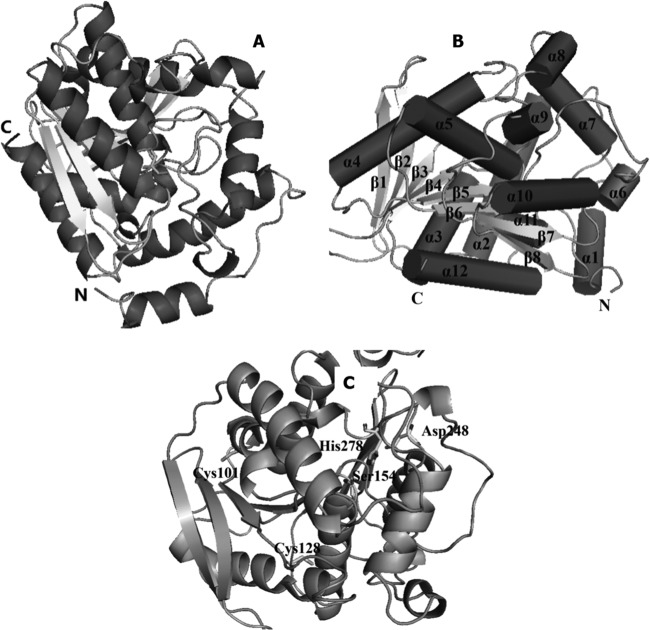
FIG 4
Structural analysis of EstS1. (A) Ribbon diagram showing the overall structure of the EstS1 model. The N and C termini are labeled. (B) EstS1 model with alpha helices and beta strands labeled. (C) Ribbon diagrams of the active site and two cysteines. The proposed active-site residues Ser154-Asp248-His 278 and two important cysteines (Cys101 and Cys128) are shown as stick representations.
FIG 5
FIG 5
Thin-layer chromatographic analysis of PAE reaction products. PAEs (10 μmol each) dissolved in 0.05 ml DMSO in 1-ml reaction volumes were treated with EstS1 (30 U) for 24 h at 37°C.
FIG 6
FIG 6
Time courses of PAE degradation at different temperatures. Substrates (10 μmol each) dissolved in 0.05 ml DMSO in 1-ml reaction volumes were treated with EstS1 (30 U) at 37 or 60°C. The percentage of residual PAE in the reaction mixture at each time point was determined by high-performance liquid chromatography. The results are presented as average values ± standard deviations (n = 3).

References

    1. Abdel daiem MM, Rivera-Utrilla J, Ocampo-Perez R, Mendez-Diaz JD, Sanchez-Polo M. 2012. Environmental impact of phthalic acid esters and their removal from water and sediments by different technologies–a review. J. Environ. Manage. 109:164–178. 10.1016/j.jenvman.2012.05.014. - DOI - PubMed
    1. Vamsee-Krishna C, Phale PS. 2008. Bacterial degradation of phthalate isomers and their esters. Indian J. Microbiol. 48:19–34. 10.1007/s12088-008-0003-8. - DOI - PMC - PubMed
    1. Gu JD, Li J, Wang Y. 2005. Biochemical pathway and degradation of phthalate ester isomers by bacteria. Water Sci. Technol. 52:241–248. - PubMed
    1. Nakai M, Tabira Y, Asai D, Yakabe Y, Shimyozu T, Noguchi M, Takatsuki M, Shimohigashi Y. 1999. Binding characteristics of dialkyl phthalates for the estrogen receptor. Biochem. Biophys. Res. Commun. 254:311–314. 10.1006/bbrc.1998.9928. - DOI - PubMed
    1. Asai D, Tahara Y, Nakai M, Yakabe Y, Takatsuki M, Nose T, Shinmyozu T, Shimohigashi Y. 2000. Structural essentials of xenoestrogen dialkyl phthalates to bind to the estrogen receptors. Toxicol. Lett. 118:1–8. 10.1016/S0378-4274(00)00253-8. - DOI - PubMed

Publication types

MeSH terms

Associated data

LinkOut - more resources