


Predictors of resolution and persistence of renal laboratory abnormalities in pediatric HIV infection
- PMID: 25149850
- PMCID: PMC4301405
- DOI: 10.1007/s00467-014-2909-1
Predictors of resolution and persistence of renal laboratory abnormalities in pediatric HIV infection
Abstract
Background: Among human immunodeficiency virus (HIV)-infected youth, the role of renal disease (RD) and its management has become increasingly important as these children/adolescents mature into young adults. The identification of predictors of abnormal renal laboratory events (RLE) may be helpful in the management of their HIV infection and its associated renal complications.
Methods: Data collected from HIV-infected youth followed for ≥ 48 months were analyzed to identify predictors of resolution versus persistence of RLE and determine the utility of RLE to predict the onset of RD. Analysis included descriptive and inferential methods using a multivariable extended Cox proportional hazards model.
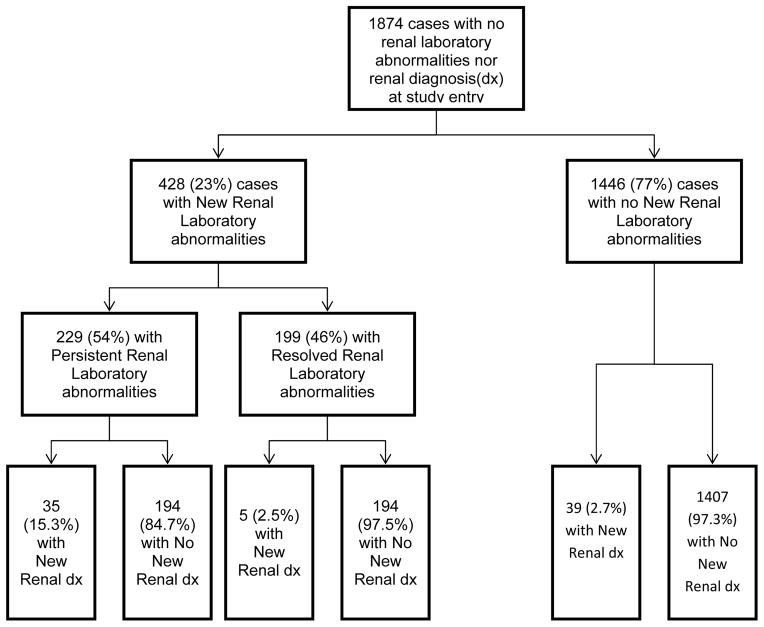
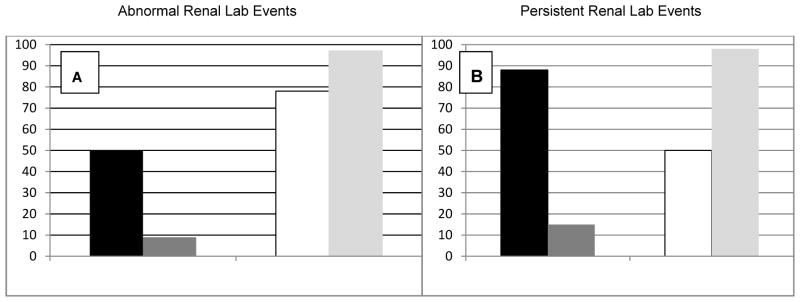
Results: Of the 1,874 at-risk children enrolled in the study, 428 (23 %) developed RLE, which persisted in 229 of these (54 %). CD4 percentages of <25 % [hazard ratio (HR) 0.63, p < 0.002) and an HIV viral load of >100,000 copies/ml (HR 0.31, p < 0.01) were associated with reduced rates of resolution, while in most cases exposure to highly active antiretroviral therapy (HAART)/nephrotoxic HAART prior to or subsequent to RLE were not. Persistence of RLE was 88 % sensitive for identifying new RD. Negative predictive values for RD were >95 % for both the at-risk cohort and those with RLE.
Conclusions: Advanced HIV disease predicted persistence of RLE in HIV-infected youth. Persistent RLE were useful for identifying RD.
Figures
References
Publication types
MeSH terms
Grants and funding
- U01 AI068632/AI/NIAID NIH HHS/United States
- UM1 AI068632/AI/NIAID NIH HHS/United States
- UM1 AI069415/AI/NIAID NIH HHS/United States
- UM1 AI069477/AI/NIAID NIH HHS/United States
- U01 AI068616/AI/NIAID NIH HHS/United States
- U01 AI041110/AI/NIAID NIH HHS/United States
- UM1 AI068616/AI/NIAID NIH HHS/United States
- AI068632/AI/NIAID NIH HHS/United States
- P30 AI045008/AI/NIAID NIH HHS/United States
- M01 RR016587/RR/NCRR NIH HHS/United States
- U01AI068632/AI/NIAID NIH HHS/United States
- UL1 TR001082/TR/NCATS NIH HHS/United States
- 1 U01 AI068616/AI/NIAID NIH HHS/United States
- 5 U01 AI41110/AI/NIAID NIH HHS/United States
LinkOut - more resources
Full Text Sources
Other Literature Sources
Medical
Research Materials
Miscellaneous
