


Drugs with narrow therapeutic index as indicators in the risk management of hospitalised patients
- PMID: 25152793
- PMCID: PMC4140577
- DOI: 10.4321/s1886-36552010000100006
Drugs with narrow therapeutic index as indicators in the risk management of hospitalised patients
Abstract
Drugs with narrow therapeutic index (NTI-drugs) are drugs with small differences between therapeutic and toxic doses. The pattern of drug-related problems (DRPs) associated with these drugs has not been explored.
Objective: To investigate how, and to what extent drugs, with a narrow therapeutic index (NTI-drugs), as compared with other drugs, relate to different types of drug-related problems (DRPs) in hospitalised patients.
Methods: Patients from internal medicine and rheumatology departments in five Norwegian hospitals were prospectively included in 2002. Clinical pharmacists recorded demographic data, drugs used, medical history and laboratory data. Patients who used NTI-drugs (aminoglycosides, ciclosporin, carbamazepine, digoxin, digitoxin, flecainide, lithium, phenytoin, phenobarbital, rifampicin, theophylline, warfarin) were compared with patients not using NTI-drugs. Occurrences of eight different types of DRPs were registered after reviews of medical records and assessment by multidisciplinary hospital teams. The drug risk ratio, defined as number of DRPs divided by number of times the drug was used, was calculated for the various drugs.
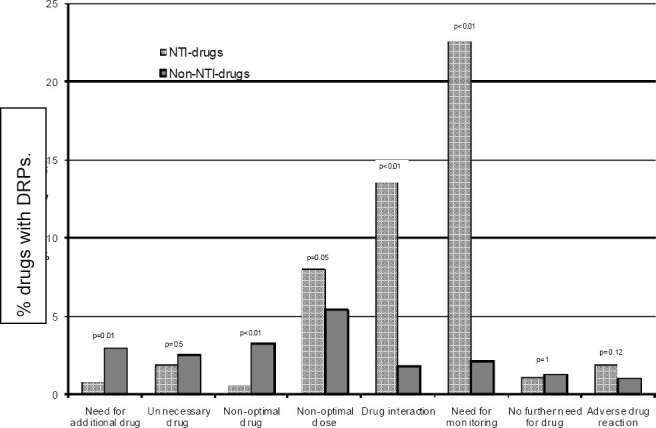
Results: Of the 827 patients included, 292 patients (35%) used NTI-drugs. The NTI-drugs were significantly more often associated with DRPs than the non-NTI-drugs, 40% versus 19% of the times they were used. The drug risk ratio was 0.50 for NTI-drugs and 0.20 for non-NTI-drugs. Three categories of DRPs were significantly more frequently found for NTI-drugs: non-optimal dose, drug interaction, and need for monitoring.
Conclusion: DRPs were more frequently associated with NTI-drugs than with non-NTI-drugs, but the excess occurrence was solely related to three of the eight DRP categories recorded. The drug risk ratio is a well-suited tool for characterising the risk attributed to various drugs.
Keywords: Clinical Pharmacy Information Systems; Drug Toxicity; Inpatients; Norway.
Conflict of interest statement
None to declare.
The study was carried out at the University of Oslo and partly funded by The Norwegian Community Pharmacy Foundation and The Norwegian Pharmacy Associations’ Foundation. Both are nonprofit organisations.
Figures

References
-
- Ernst FR, Grizzle AJ. Drug-related morbidity and mortality: updating the cost-of-illness model. J Am Pharm Assoc. 2001;41:192–199. - PubMed
-
- Winterstein AG, Sauer BC, Hepler CD, Poole C. Preventable drug-related hospital admissions. Ann Pharmacother. 2002;36:1238–1248. - PubMed
-
- Patel P, Zed PJ. Drug-related visits to the emergency department: how big is the problem? Pharmacotherapy. 2002;22:915–923. - PubMed
-
- Goodman, Gilman's . Pharmacokinetics and Pharmacodynamics. 11. Ed. Chapter 1. The McGraw-Hill Companies, Inc; 2005. The Pharmacological Basis of Therapeutics. ISBN:0-07-142280-3.
-
- Budnitz DS, Shehab N, Kegler SR, Richards CL. Medication use leading to emergency department visits for adverse drug events in older adults. Ann Intern Med. 2007;147:755–765. - PubMed
LinkOut - more resources
Full Text Sources