


Review
doi: 10.3390/toxins6082541.
Engineering venom's toxin-neutralizing antibody fragments and its therapeutic potential
Affiliations
- PMID: 25153256
- PMCID: PMC4147596
- DOI: 10.3390/toxins6082541
Item in Clipboard
Review
Engineering venom's toxin-neutralizing antibody fragments and its therapeutic potential
Toxins (Basel).
.
Abstract
Serum therapy remains the only specific treatment against envenoming, but anti-venoms are still prepared by fragmentation of polyclonal antibodies isolated from hyper-immunized horse serum. Most of these anti-venoms are considered to be efficient, but their production is tedious, and their use may be associated with adverse effects. Recombinant antibodies and smaller functional units are now emerging as credible alternatives and constitute a source of still unexploited biomolecules capable of neutralizing venoms. This review will be a walk through the technologies that have recently been applied leading to novel antibody formats with better properties in terms of homogeneity, specific activity and possible safety.
Figures
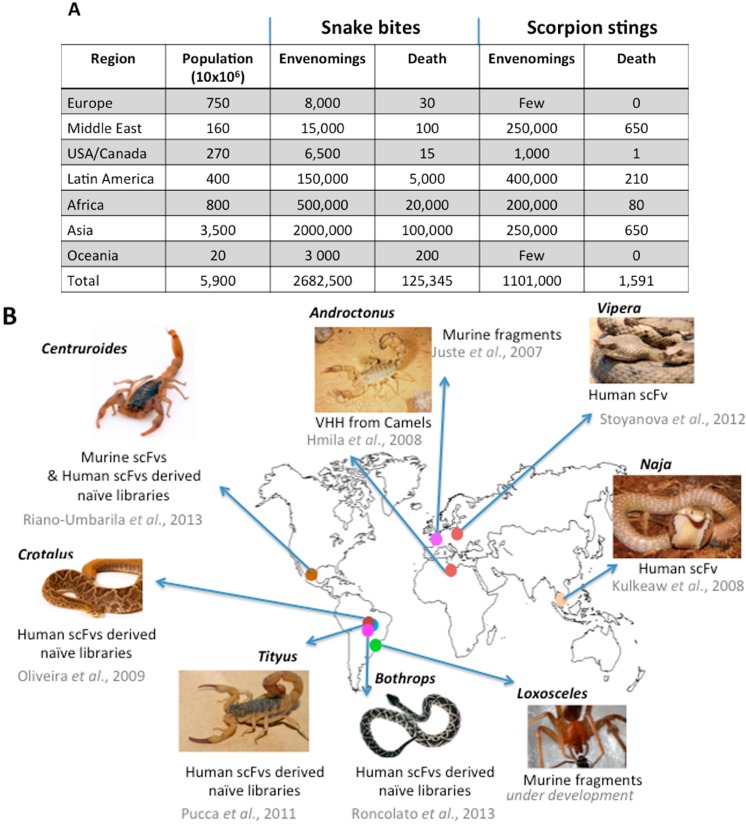
Snake bites and scorpion stings around the world. (A) World incidence and mortality adapted from [14,15]); (B) research carried out on recombinant antibody fragments with the potential for neutralizing venoms.
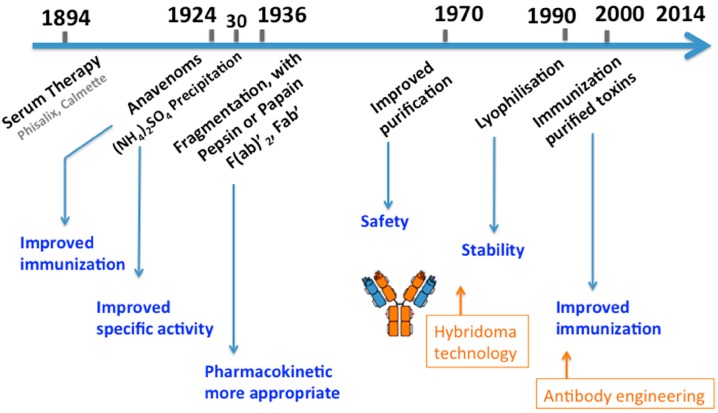
A timeline of polyclonal antivenom development. Antivenom production has taken advantage of several technological improvements in antibody fragmentation, protein purification and preservation, but no breakthrough innovation has yet taken place despite the discovery of hybridoma and antibody engineering technologies. Adapted from [20].
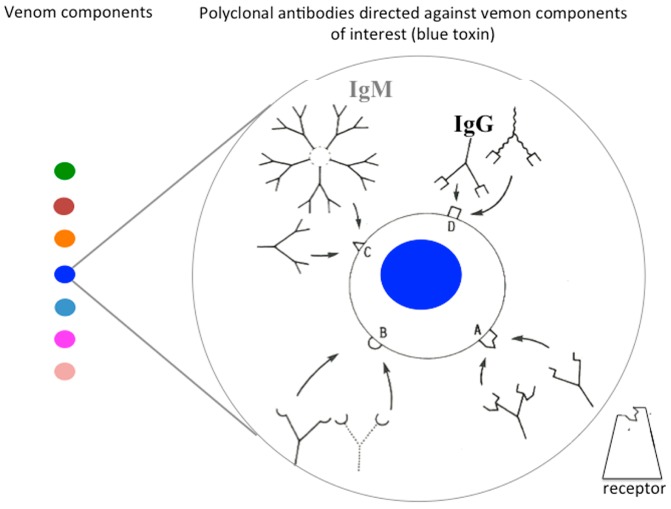
Recognition of a venom component by polyclonal antibody. Antibodies of interest are those that inhibit the interaction of the most potent toxins (blue) with their receptor. Such neutralizing antibodies bind to an epitope (A), which overlaps with the active site of the toxin, create steric hindrance or induce deleterious conformational changes in the toxin upon binding. Immunoglobulins (IgG, IgM) with distinct avidity can compete for the same epitope. Polyclonal antivenoms suffer from several drawbacks, such as heterogeneity and variability in their composition and efficacy, and may be associated with side effects, such as tolerance, when injected into humans.
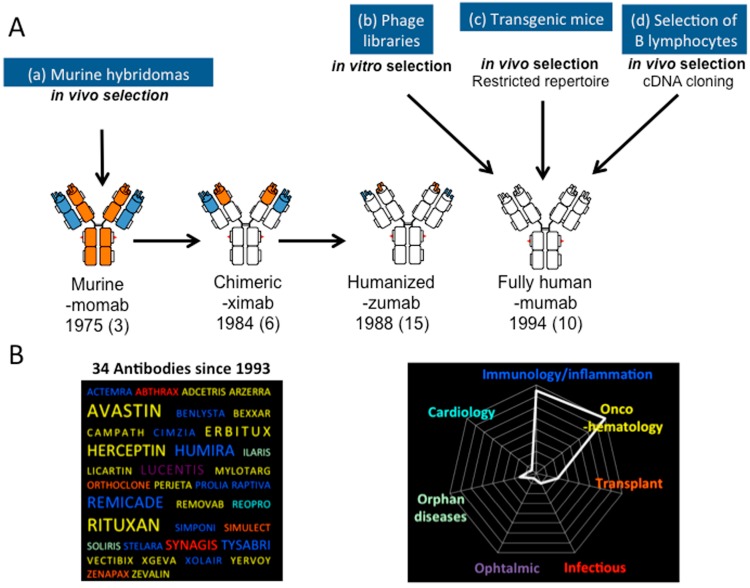
The design of therapeutic antibodies. (A) Therapeutic antibodies can be produced after re-engineering of murine monoclonal antibodies, whose domains are represented in blue and orange (a); leading to chimeric or humanized antibodies that are less immunogenic when injected into humans, while preserving antigen-binding properties (antibody domains from human origin are represented in white). Alternatively, in vitro panning of phage libraries displaying antibody fragments followed by grafting onto human antibody constant domains allows in vitro selection of fully-human antibodies (b); In vivo selection of fully human antibodies can also be performed by using transgenic mice (c) or single peripheral blood B-cells and cDNA cloning (d); Various types of engineered full-sized antibodies are indicated here with the suffix used in the international non-proprietary name (INN), the first year of marketing and the number of molecules approved up to now for the treatment of various diseases, but not envenoming (in brackets); (B) Therapeutic antibodies now represent the fastest growing class of biodrugs approved for therapeutic treatments. (Left) The best-selling molecules are represented with the word size proportional to their respective market share. (Right) The distribution of all therapeutic antibodies according to their indication.
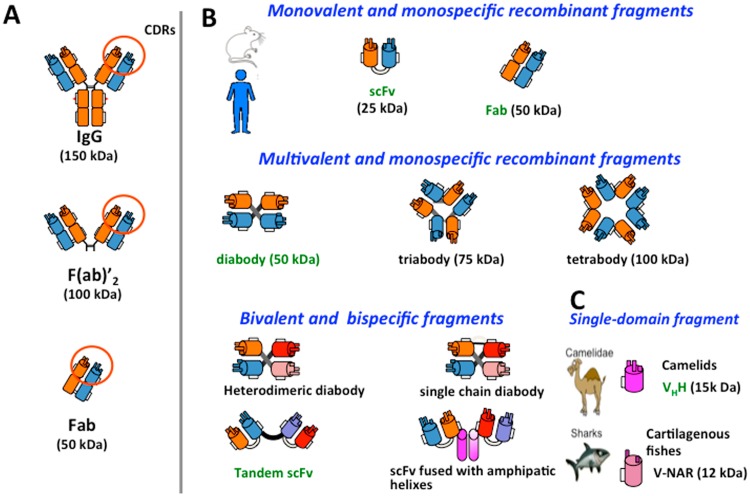
Tailoring antibody fragments. (A) Limited proteolysis of whole IgG molecules allows one to prepare functional F(ab')2 or Fab fragments; (B) molecular engineering allows one to design new formats of antibody fragments, mono- or multi-valent, mono- or bi-specific. These molecules are essentially derived from monoclonal antibodies or antibody phage libraries. They differ from each other in size, PK and PD properties when injected into humans or animal; (C) Recombinant antibody fragments derived from camelids or cartilaginous fish constitute alternatives to conventional antibodies, because their antigen-binding site simply consists of a single antibody domain of 12–15 kDa. In green are indicated some of these molecules under development in research or in the early preclinical phase for the treatment of envenomings.
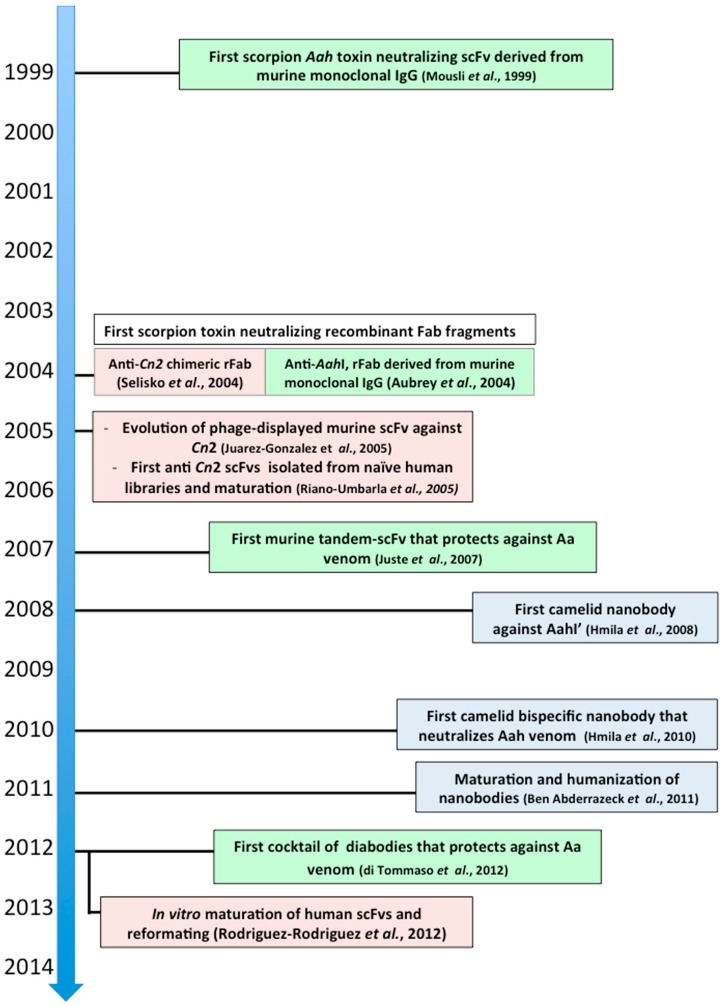
Third generation of neutralizing scorpion toxin antibody fragments. Here are indicated the most significant and pioneering steps in the process of designing new therapeutic candidates. These molecules have been genetically engineered and designed for improved protective capacity against experimental envenomings. Recombinant antibody fragments from murine (green), human (pink) or camelid (light blue) origins.
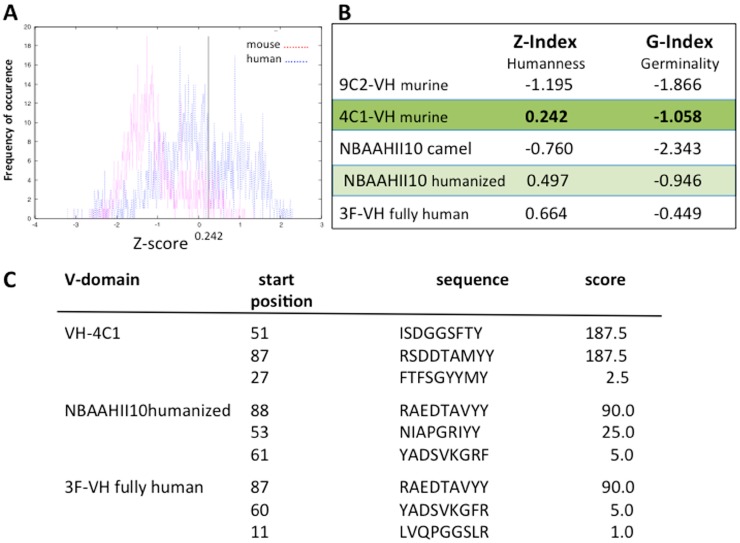
Humanness and germinality indexes of the V-domains of some antibody fragments directed against scorpion toxins. The antibody amino acid residue sequence is compared with a set of human sequences assigned or not to germline-derived families. The Z-score gives an overall similarity to circulating antibodies, while the G-score indicates the similarity to circulating antibodies derived from each human germline family. (A) Histogram of human and mouse pair-wise sequence identities in the 4C1-VH domain. The calculated Z-index is 0.242; (B) The Z-index and G-index for a set of V-domains; (C) Prediction and ranking of potential 9-mer peptides based on a predicted half-life of dissociation to HLA class I molecules (allele A1). Analysis was restricted to 4C1-VH, humanized NBAAHII10 and 3F-VH human variable domains.
References
-
- Goyffon M., Landon C. Scorpion toxins and defensins. C. R. Séances Soc. Biol. Fil. 1998;192:445–462. - PubMed
-
- Behring E., Kitasato S. Ueber das zustandekommen der diphterie-immunitaet und der tetanus-immunitatet bei thieren. Deutsch. Med. Wochenschr. 1890;16:1113–1114. doi: 10.1055/s-0029-1207589. - DOI
Publication types
MeSH terms
Substances
LinkOut - more resources
Full Text Sources
Other Literature Sources
