. 2014 Sep 22;211(10):2061-74.
doi: 10.1084/jem.20132494. Epub 2014 Aug 25.

Passive transfer of modest titers of potent and broadly neutralizing anti-HIV monoclonal antibodies block SHIV infection in macaques

Affiliations

Passive transfer of modest titers of potent and broadly neutralizing anti-HIV monoclonal antibodies block SHIV infection in macaques

Masashi Shingai et al. J Exp Med. .

Abstract

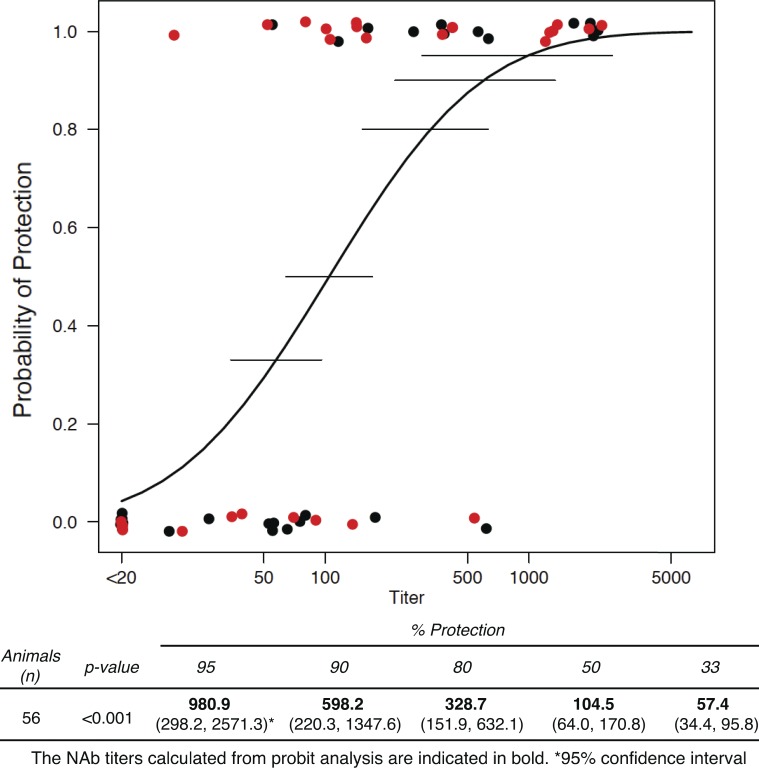
It is widely appreciated that effective human vaccines directed against viral pathogens elicit neutralizing antibodies (NAbs). The passive transfer of anti-HIV-1 NAbs conferring sterilizing immunity to macaques has been used to determine the plasma neutralization titers, which must be present at the time of exposure, to prevent acquisition of SIV/HIV chimeric virus (SHIV) infections. We administered five recently isolated potent and broadly acting anti-HIV neutralizing monoclonal antibodies (mAbs) to rhesus macaques and challenged them intrarectally 24 h later with either of two different R5-tropic SHIVs. By combining the results obtained from 60 challenged animals, we determined that the protective neutralization titer in plasma preventing virus infection in 50% of the exposed monkeys was relatively modest (∼1:100) and potentially achievable by vaccination.


Figures
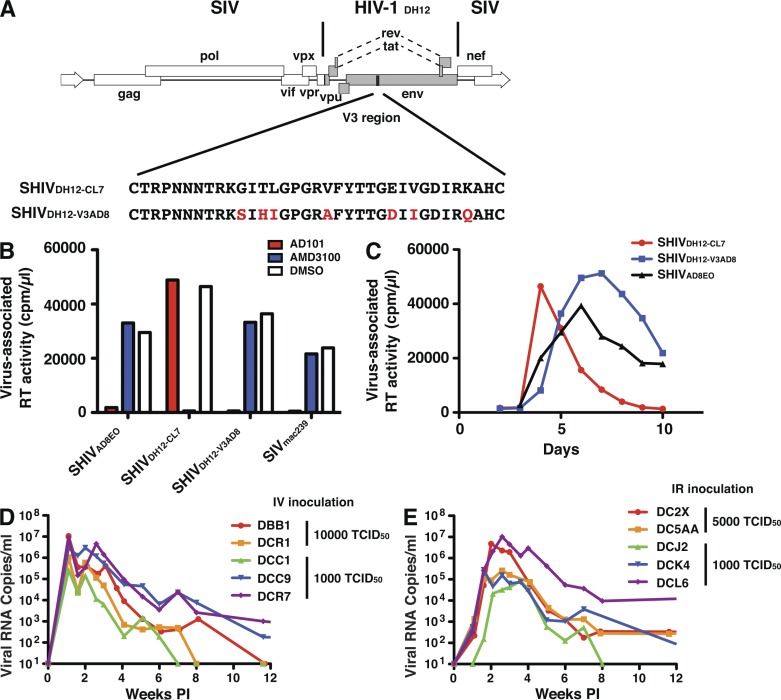
Figure 1.
Figure 1.
Construction and characterization of the R5-tropic SHIVDH12-V3AD8. (A) The entire gp120 V3 region of the X4-tropic SHIVDH12-CL7 (Sadjadpour et al., 2004) was replaced with the gp120 V3 region from the R5-tropic SHIVAD8EO (Shingai et al., 2012) by PCR-mediated mutagenesis. The red letters indicate the amino acid changes from the SHIVAD8EO V3 loop conferring R5 tropism to SHIVDH12-V3AD8. Virus stocks of the resultant SHIVDH12-V3AD8 were prepared in Concanavalin A–stimulated macaque PBMC using 293T cell transfection supernatants. (B) The coreceptor utilization of SHIVDH12-V3AD8 was compared with that of the previously described X4-tropic SHIVDH12-CL7 (Sadjadpour et al., 2004) and the R5-tropic SHIVAD8EO (Shingai et al., 2012) during entry to rhesus PBMC in the presence of the CXCR4 (AMD3100)- or the CCR5 (AD101)-specific inhibitors. Data are representative of two independent experiments. (C) Replication kinetics of the X4-tropic SHIVDH12-CL7 or the R5-tropic SHIVAD8EO and SHIVDH12-V3AD8 in rhesus PBMC were determined by measuring the 32P reverse transcription activity released into the tissue culture medium. Data are representative of two independent experiments. (D and E) SHIVDH12-V3AD8 replication in rhesus macaques after inoculation by intravenous (n = 5; D) or IR (n = 5; E) routes. Plasma viral RNA levels were measured by RT-PCR as previously described (Endo et al., 2000).
Figure 2.
Figure 2.
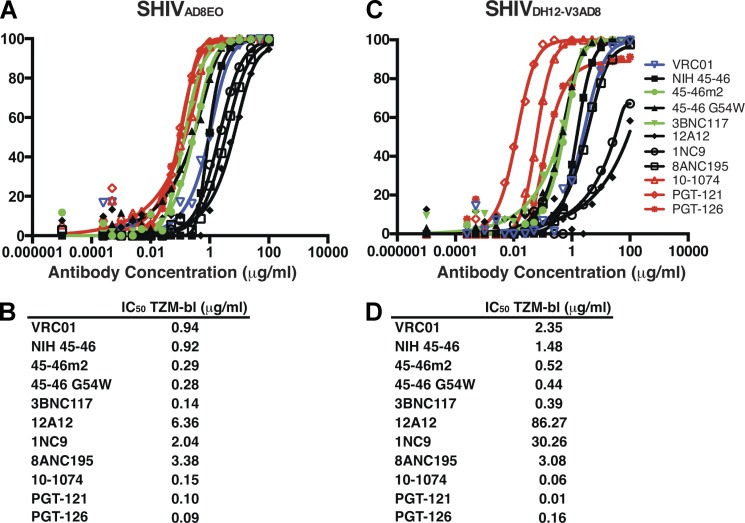
Neutralization of two R5-tropic SHIVs with a panel of 11 broadly acting anti–HIV-1 mAbs. (A and C) Neutralization was performed with SHIVAD8EO (A) or SHIVDH12-V3AD8 (C) pseudovirions and the indicated mAbs using TZM-bl target cells. The titration curves for the glycan-dependent neutralizing mAbs are red; for VRC01 in blue; and two potent CD4bs mAbs (45-46m2 and 3BNC117) in green. (B and D) The calculated IC50 values for neutralizing SHIVAD8EO (B) or SHIVDH12-V3AD8 (D) are shown below. The individual assays were repeated three times.
Figure 3.
Figure 3.
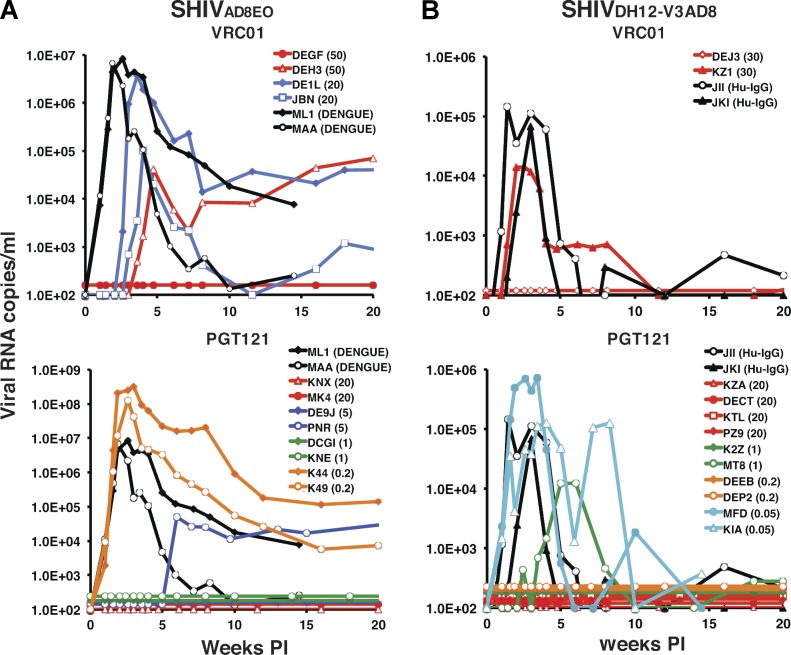
Passive transfer of VRC01 or PGT121 mAbs and subsequent challenge with two different R5-tropic SHIVs. (A and B) Plasma viral loads in rhesus monkeys, administered VRC01 or PGT121 and challenged by the IR route 24 h later with SHIVAD8EO (n = 14; A) or SHIVDH12-V3AD8 (n = 14; B), were determined by RT-PCR. The amounts of mAb injected intravenously (mg/kg) are indicated in parentheses for each animal. Macaques ML1 and MAA received 20 mg/kg of control anti–dengue virus NS1 IgG1 mAb. Human IgG from uninfected individuals was also transferred to macaques JII and JKI as a negative control.
Figure 4.
Figure 4.
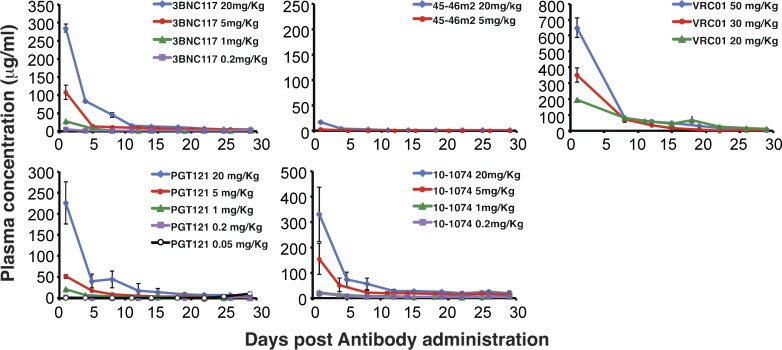
Levels of neutralizing mAbs in the plasma of passively transferred macaques. The concentrations of the indicated mAbs in plasma at various times after administration were determined by ELISA using recombinant HIV-1 gp120. Plasma antibody levels were measured in the animals described in Table 2. Means and SDs are shown.
Figure 5.
Figure 5.
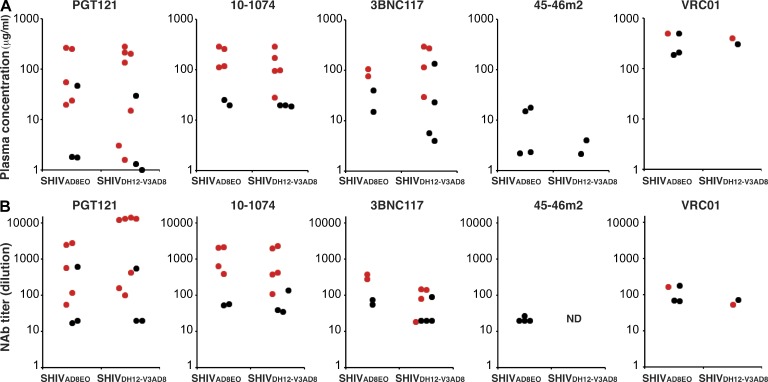
Levels of neutralizing mAbs in the plasma of passively transferred macaques at the time of challenge. (A) The concentrations (µg/ml) of the indicated mAbs in plasma 24 h after passive transfer of mAbs were determined by ELISA using recombinant HIV-1 gp120. (B) The plasma IC50 titers of the indicated mAbs 24 h after passive transfer of mAbs were determined using the TZM-bl cell assay. Red circles indicate protected (no acquisition) monkeys; black circles denote infected animals. Plasma antibody levels and NAb titers were measured in the 60 animals described in Table 2.
Figure 6.
Figure 6.
Probit regression analysis relating NAb titers at the time of virus challenge and probability of protection. The black circles denote SHIVAD8EO challenged monkeys; the red circles denote SHIVDH12-V3AD8 challenged monkeys. Horizontal lines indicate 90% confidence intervals of plasma neutralization titers for 33, 50, 80, 90, and 95% probability of protection. The estimated neutralization titers in plasma conferring different levels of protection and their corresponding 90% confidence intervals are shown at the bottom of the figure.

References

    1. Abela, I.A., Berlinger L., Schanz M., Reynell L., Günthard H.F., Rusert P., and Trkola A.. 2012. Cell-cell transmission enables HIV-1 to evade inhibition by potent CD4bs directed antibodies. PLoS Pathog. 8:e1002634 10.1371/journal.ppat.1002634 - DOI - PMC - PubMed
    1. Advisory Committee on Immunization Practices (ACIP), Fiore A.E., Wasley A., and Bell B.P.. 2006. Prevention of hepatitis A through active or passive immunization: recommendations of the Advisory Committee on Immunization Practices (ACIP). MMWR Recomm. Rep. 55:1–23 - PubMed
    1. Amanna, I.J., and Slifka M.K.. 2011. Contributions of humoral and cellular immunity to vaccine-induced protection in humans. Virology. 411:206–215 10.1016/j.virol.2010.12.016 - DOI - PMC - PubMed
    1. Baba, T.W., Liska V., Hofmann-Lehmann R., Vlasak J., Xu W., Ayehunie S., Cavacini L.A., Posner M.R., Katinger H., Stiegler G., et al. . 2000. Human neutralizing monoclonal antibodies of the IgG1 subtype protect against mucosal simian-human immunodeficiency virus infection. Nat. Med. 6:200–206 10.1038/72309 - DOI - PubMed
    1. Barnett, S.W., Srivastava I.K., Kan E., Zhou F., Goodsell A., Cristillo A.D., Ferrai M.G., Weiss D.E., Letvin N.L., Montefiori D., et al. . 2008. Protection of macaques against vaginal SHIV challenge by systemic or mucosal and systemic vaccinations with HIV-envelope. AIDS. 22:339–348 10.1097/QAD.0b013e3282f3ca57 - DOI - PubMed

Publication types

MeSH terms