. 2014 Aug 27;15(1):721.
doi: 10.1186/1471-2164-15-721.

Overlapping genes: a window on gene evolvability

Affiliations

Overlapping genes: a window on gene evolvability

Maxime Huvet et al. BMC Genomics. .

Abstract

Background: The forces underlying genome architecture and organization are still only poorly understood in detail. Overlapping genes (genes partially or entirely overlapping) represent a genomic feature that is shared widely across biological organisms ranging from viruses to multi-cellular organisms. In bacteria, a third of the annotated genes are involved in an overlap. Despite the widespread nature of this arrangement, its evolutionary origins and biological ramifications have so far eluded explanation.

Results: Here we present a comparative approach using information from 699 bacterial genomes that sheds light on the evolutionary dynamics of overlapping genes. We show that these structures exhibit high levels of plasticity.

Conclusions: We propose a simple model allowing us to explain the observed properties of overlapping genes based on the importance of initiation and termination of transcriptional and translational processes. We believe that taking into account the processes leading to the expression of protein-coding genes hold the key to the understanding of overlapping genes structures.


Figures
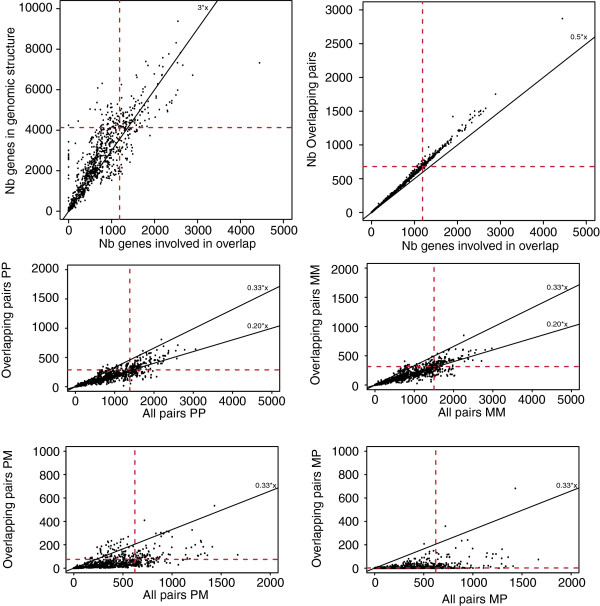
Figure 1
Figure 1
Characteristics of overlapping gene pairs in 699 bacterial species. The red dashed lines represent the values extracted from E. coli. Reference slope are drawn to facilitate the comparison of the different plots. On the second and third line are presented information related to overlapping genes with specific orientation. “P” stands for genes annotated on the plus strand and “M” on the minus strand.
Figure 2
Figure 2
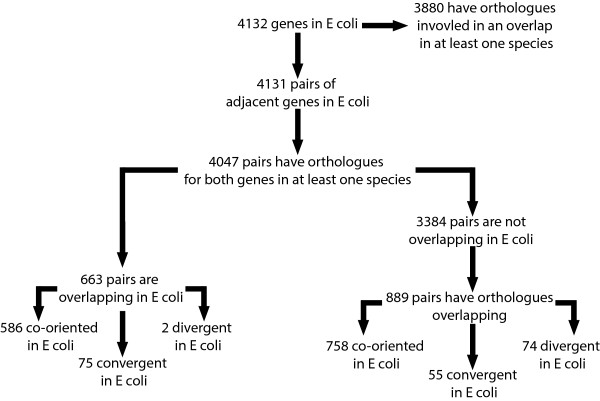
Flowchart representing the categorization of the different genes pairs on E. coli in regard of different genomic organization and orthologues properties.
Figure 3
Figure 3
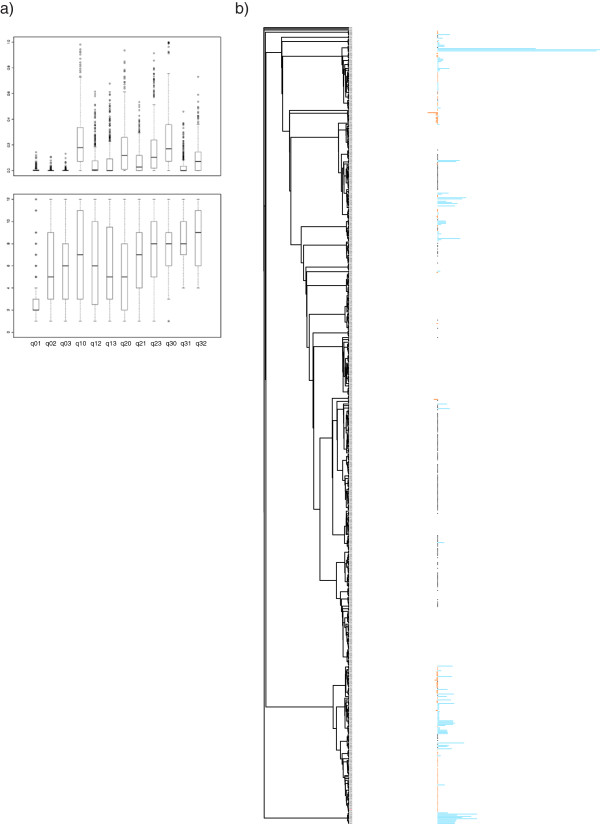
Characteristics of overlapping genes evolution. a) Representation of the transition rate obtained through the BayesTrait analysis of the orthologues of genes overlapping in E. coli. Top - Box plot representation of the normalized values extracted for each gene pairs. Because BayesTrait leads to the generation of transition rates with no upper limits, the normalization allow the comparison of transition rates for the different gene pairs. Bottom - Box plot representation of the order of the different rates (in ascending order) obtained from BayesTrait for each gene pair included in the analysis. b) Example of the observed configuration for one gene pair overlapping in E. coli. The results are presented on the phylogenetic tree build from the 23S rRNA sequences extracted from the different species of interest. The information related to the distance separating orthologues are coded as follow: The segment of DNA forming the overlap for overlapping orthologues is represente in orange, the portion of DNA separating adjacent orthologues is in blue, the orthologues pairs none adjacent are represented by a black dot, and if one or both of the orthologues is missing no mark in made. The length of the segments is proportional to the distance between the two genes of interest.
Figure 4
Figure 4
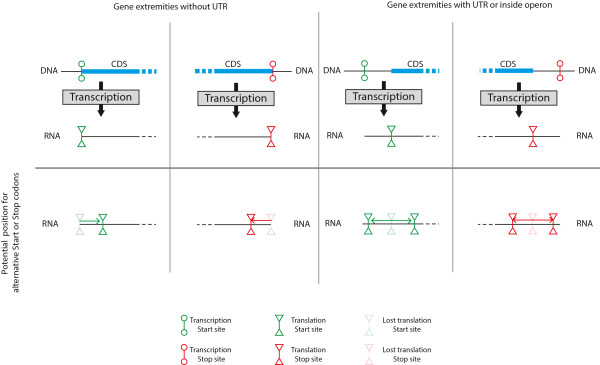
Schema presenting the importance of UTRs in the freedom of movement of START and STOP codon position and by consequence the creation of OGP.

References

    1. Normark S, Bergstrom S, Edlund T. Overlapping genes. Annu Rev Genet. 1983;17:499–525. doi: 10.1146/annurev.ge.17.120183.002435. - DOI - PubMed
    1. Rogozin IB, Spiridonov AN, Sorokin AV, Wolf YI, Jordan IK, Tatusov RL, Koonin EV. Purifying and directional selection in overlapping prokaryotic genes. Trends Genet. 2002;18:228–232. doi: 10.1016/S0168-9525(02)02649-5. - DOI - PubMed
    1. Makalowska I, Lin C-F, Makalowski W. Overlapping genes in vertebrate genomes. Comput Biol Chem. 2005;29:1–12. doi: 10.1016/j.compbiolchem.2004.12.006. - DOI - PubMed
    1. Johnson ZI, Chisholm SW. Properties of overlapping genes are conserved across microbial genomes. Genome Res. 2004;14:2268–2272. doi: 10.1101/gr.2433104. - DOI - PMC - PubMed
    1. Fukuda Y, Nakayama Y, Tomita M. On dynamics of overlapping genes in bacterial genomes. Gene. 2003;323:181–187. doi: 10.1016/j.gene.2003.09.021. - DOI - PubMed

Publication types

LinkOut - more resources