


Critical combinations of radiation dose and volume predict intelligence quotient and academic achievement scores after craniospinal irradiation in children with medulloblastoma
- PMID: 25160611
- PMCID: PMC4703579
- DOI: 10.1016/j.ijrobp.2014.06.058
Critical combinations of radiation dose and volume predict intelligence quotient and academic achievement scores after craniospinal irradiation in children with medulloblastoma
Abstract
Purpose: To prospectively follow children treated with craniospinal irradiation to determine critical combinations of radiation dose and volume that would predict for cognitive effects.
Methods and materials: Between 1996 and 2003, 58 patients (median age 8.14 years, range 3.99-20.11 years) with medulloblastoma received risk-adapted craniospinal irradiation followed by dose-intense chemotherapy and were followed longitudinally with multiple cognitive evaluations (through 5 years after treatment) that included intelligence quotient (estimated intelligence quotient, full-scale, verbal, and performance) and academic achievement (math, reading, spelling) tests. Craniospinal irradiation consisted of 23.4 Gy for average-risk patients (nonmetastatic) and 36-39.6 Gy for high-risk patients (metastatic or residual disease >1.5 cm(2)). The primary site was treated using conformal or intensity modulated radiation therapy using a 2-cm clinical target volume margin. The effect of clinical variables and radiation dose to different brain volumes were modeled to estimate cognitive scores after treatment.
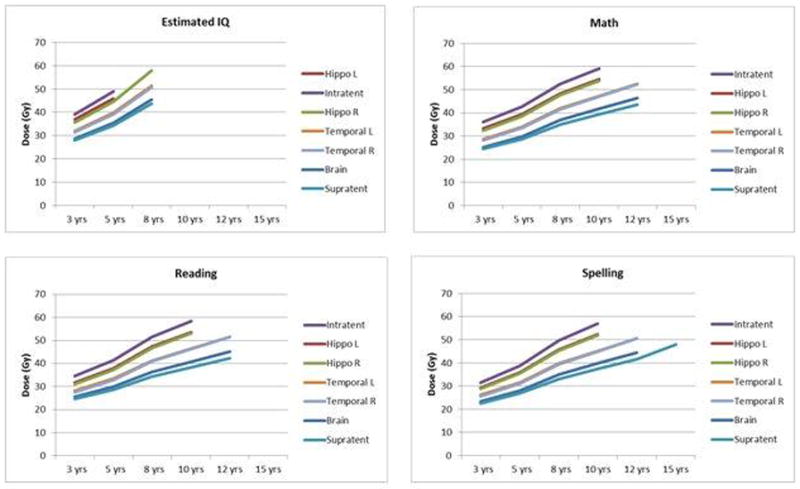
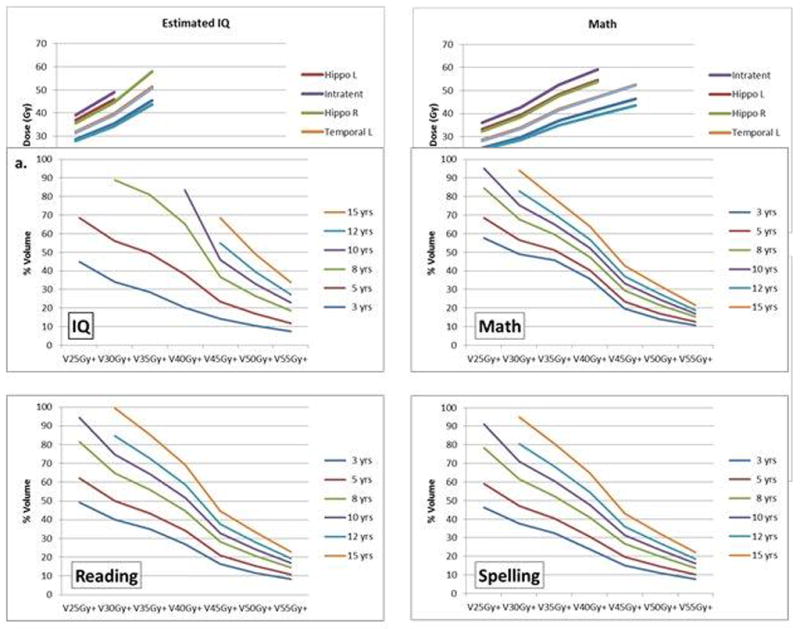
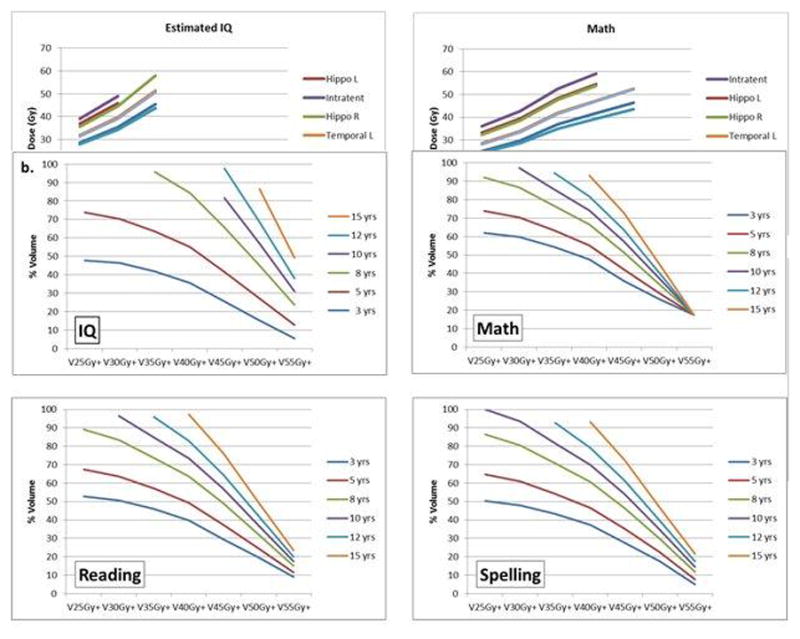
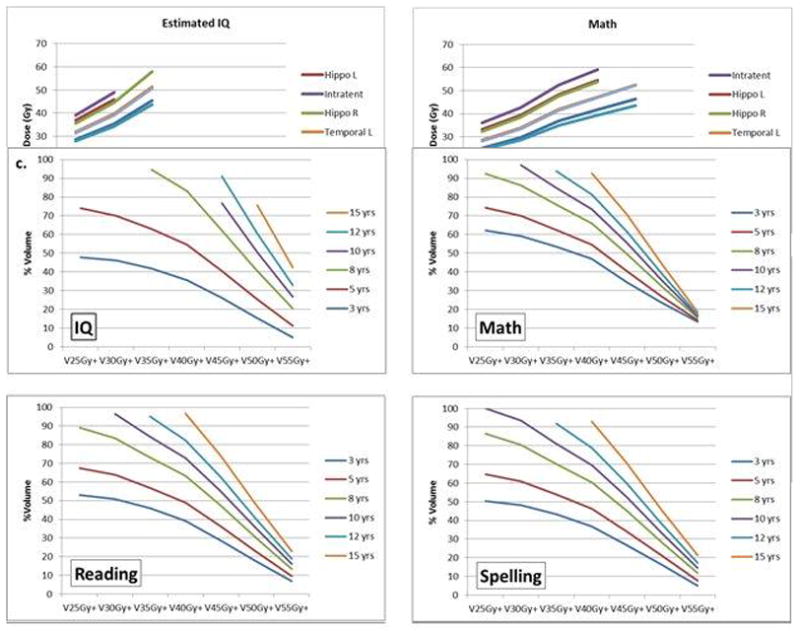
Results: A decline with time for all test scores was observed for the entire cohort. Sex, race, and cerebrospinal fluid shunt status had a significant impact on baseline scores. Age and mean radiation dose to specific brain volumes, including the temporal lobes and hippocampi, had a significant impact on longitudinal scores. Dichotomized dose distributions at 25 Gy, 35 Gy, 45 Gy, and 55 Gy were modeled to show the impact of the high-dose volume on longitudinal test scores. The 50% risk of a below-normal cognitive test score was calculated according to mean dose and dose intervals between 25 Gy and 55 Gy at 10-Gy increments according to brain volume and age.
Conclusions: The ability to predict cognitive outcomes in children with medulloblastoma using dose-effects models for different brain subvolumes will improve treatment planning, guide intervention, and help estimate the value of newer methods of irradiation.
Copyright © 2014 Elsevier Inc. All rights reserved.
Conflict of interest statement
Figures
References
-
- Silverman CL, Palkes H, Talent B, Kovnar E, Clouse JW, Thomas PR. Late effects of radiotherapy on patients with cerebellar medulloblastoma. Cancer. 1984;54(5):825–829. - PubMed
-
- LeBaron S, Zeltzer PM, Zeltzer LK, Scott SE, Marlin AE. Assessment of quality of survival in children with medulloblastoma and cerebellar astrocytoma. Cancer. 1988;62(6):1215–1222. - PubMed
-
- Hoppe-Hirsch E, Renier D, Lellouch-Tubiana A, Sainte-Rose C, Pierre-Kahn A, Hirsch JF. Medulloblastoma in childhood: progressive intellectual deterioration. Childs Nerv Syst. 1990;6(2):60–65. - PubMed
-
- Kao GD, Goldwein JW, Schultz DJ, Radcliffe J, Sutton L, Lange B. The impact of perioperative factors on subsequent intelligence quotient deficits in children treated for medulloblastoma/posterior fossa primitive neuroectodermal tumors. Cancer. 1994;74(3):965–971. - PubMed
-
- Radcliffe J, Bunin GR, Sutton LN, Goldwein JW, Phillips PC. Cognitive deficits in long-term survivors of childhood medulloblastoma and other noncortical tumors: age-dependent effects of whole brain radiation. Int J Dev Neurosci. 1994;12(4):327–334. - PubMed
Publication types
MeSH terms
Grants and funding
LinkOut - more resources
Full Text Sources
Other Literature Sources
