Review
. 2014 Nov;37(11):663-73.
doi: 10.1016/j.tins.2014.07.010. Epub 2014 Aug 24.

Presynaptic long-term depression mediated by Gi/o-coupled receptors

Affiliations
Review

Presynaptic long-term depression mediated by Gi/o-coupled receptors

Brady K Atwood et al. Trends Neurosci. 2014 Nov.

Abstract

Long-term depression (LTD) of the efficacy of synaptic transmission is now recognized as an important mechanism for the regulation of information storage and the control of actions, as well as for synapse, neuron, and circuit development. Studies of LTD mechanisms have focused mainly on postsynaptic AMPA-type glutamate receptor trafficking. However, the focus has now expanded to include presynaptically expressed plasticity, the predominant form being initiated by presynaptically expressed Gi/o-coupled metabotropic receptor (Gi/o-GPCR) activation. Several forms of LTD involving activation of different presynaptic Gi/o-GPCRs as a 'common pathway' are described. We review here the literature on presynaptic Gi/o-GPCR-mediated LTD, discuss known mechanisms, gaps in our knowledge, and evaluate whether all Gi/o-GPCRs are capable of inducing presynaptic LTD.

Keywords: G(i/o)-GPCR; long-term synaptic plasticity; neurotransmitter release; plasticity mechanisms; presynaptic plasticity; synaptic inhibition; vesicle release machinery.


Figures

Figure 1
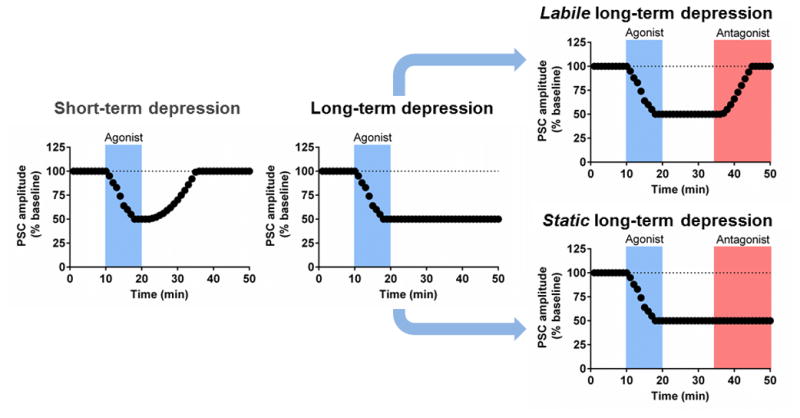
Figure 1. Operational definitions for distinct forms of synaptic depression
(a) Short-term synaptic depression (STD) persists for only as long as the neurotransmitter or agonist is present in the preparation (usually seconds to minutes) and therefore reverses upon washout of receptor agonist or termination of a stimulation induction protocol. (b) Depression that lasts for tens of minutes or longer following termination of receptor agonist application or an induction protocol is defined as long-term depression (LTD). LTD may be further subdivided into two operational definitions; “labile” and “static” LTD. (c) Evidence for labile LTD may be obtained by a chase with a receptor antagonist subsequent to LTD induction, as persistent receptor activation will therefore be blocked and LTD reversed. (d) We refer to the second definition of LTD as “static” LTD. Static LTD does not reverse when a receptor agonist application (or LTD-induction protocol) is followed by a receptor antagonist chase.
Figure 2
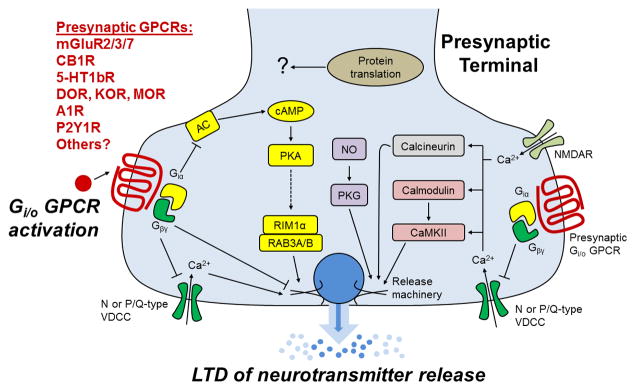
Figure 2. A schematic diagram of the possible mechanisms of presynaptic Gi/o coupled GPCR activation-induced LTD
Activation of presynaptic Gi/o-coupled GPCRs results in the dissociation of the Gαi and Gβγ subunits from the receptor complex. Gβγ subunits directly and negatively couple to voltage-dependent Ca2+ channels (VDCCs) resulting in reduced Ca2+ entry into the presynaptic terminal. Reduced Ca2+ influx decreases vesicle fusion and neurotransmitter release probability. In addition, Gβγ may directly inhibit components of the vesicular release machinery (e.g. SNAP25). The Gαi subunits negatively couple to adenylyl cyclase (AC) resulting in decreased cAMP levels. A decrease in cAMP levels results in dampened PKA activity, which is associated with reduced functionality of RIM1α. RIM1α complexes with the vesicular proteins RAB3A and RAB3B to enhance neurotransmitter release. Therefore, reduced PKA activity directly or indirectly inhibits this complex’s ability to promote neurotransmission. In addition, Ca2+ entry through VDCCs or NMDARs activates the presynaptic kinases calmodulin and CaMKII and the protein phosphatase calcineurin. GPCR modulation of presynaptic Ca2+ levels likely influences the activity of these proteins, which subsequently alters neurotransmitter release. Although not directly modulated by presynaptic Gi/o GPCRs, nitric oxide (NO) signaling intersects with GPCR-mediated signaling to promote LTD. NO signaling results in PKG activation that influences release machinery function. Finally, at some synapses protein translation appears to be a necessary component of LTD maintenance. The mechanisms that engage the protein translation apparatus as well as the proteins that are expressed are currently unknown.
Figure 3
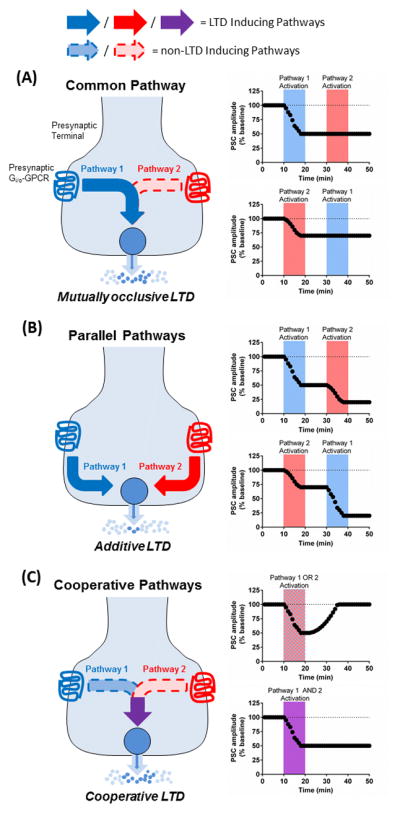
Figure 3. Possible interactions between two Gi/o-coupled receptors co-expressed on the same presynaptic terminal
(a) Two presynaptic Gi/o-GPCRs may signal through pathways that converge upon the same downstream effectors to induce LTD. Alternatively the two receptors may signal through pathways that not only converge, but are nearly identical. In either case, the two receptors will compete at some level for access to signaling proteins. The end result of this interaction will be mutually occlusive: LTD expression mediated by one receptor will prevent LTD by the second receptor. (b) A second possible interactive scenario could occur if two receptors operate through independent, non-converging signaling pathways that each achieved the same end result of inducing LTD. In this case LTD induction by one GPCR would be added to during induction by the second GPCR to increase the degree to which the terminal is depressed resulting in greater, additive LTD. (c) A final possible interaction between two presynaptic receptors is cooperation. In this relationship neither receptor is able to induce LTD on its own, but the ability of one receptor to do so is bolstered by signaling from the other. As such, one receptor would be required for LTD induction and the other would serve a facilitating role. In each of these scenarios, the timing of receptor activation would be critical. Coincident receptor activation could be needed for the hypothesized outcomes to occur, or possibly there may be a time window in which the two pathways could still interact.

References

    1. Yoon BJ, et al. Essential role for a long-term depression mechanism in ocular dominance plasticity. Proceedings of the National Academy of Sciences of the United States of America. 2009;106:9860–9865. - PMC - PubMed
    1. Dolen G, et al. Social reward requires coordinated activity of nucleus accumbens oxytocin and serotonin. Nature. 2013;501:179–184. - PMC - PubMed
    1. Kuzmiski JB, et al. Metaplasticity of hypothalamic synapses following in vivo challenge. Neuron. 2009;62:839–849. - PMC - PubMed
    1. Yin HH, et al. Dynamic reorganization of striatal circuits during the acquisition and consolidation of a skill. Nature neuroscience. 2009;12:333–341. - PMC - PubMed
    1. Huang CC, et al. Repeated cocaine administration impairs group II metabotropic glutamate receptor-mediated long-term depression in rat medial prefrontal cortex. The Journal of neuroscience: the official journal of the Society for Neuroscience. 2007;27:2958–2968. - PMC - PubMed

Publication types

MeSH terms

Substances