


Time-based physical activity interventions for weight loss: a randomized trial
- PMID: 25160843
- PMCID: PMC4340820
- DOI: 10.1249/MSS.0000000000000482
Time-based physical activity interventions for weight loss: a randomized trial
Abstract
Purpose: This study aims to examine whether enhancing standard behavioral weight loss interventions (standard behavioral weight loss program (SBWP)) with additional strategies at the initiation of intervention (ADOPT) or providing the additional strategies at predetermined times over the intervention period (MAINTAIN) enhances 18-month weight loss.
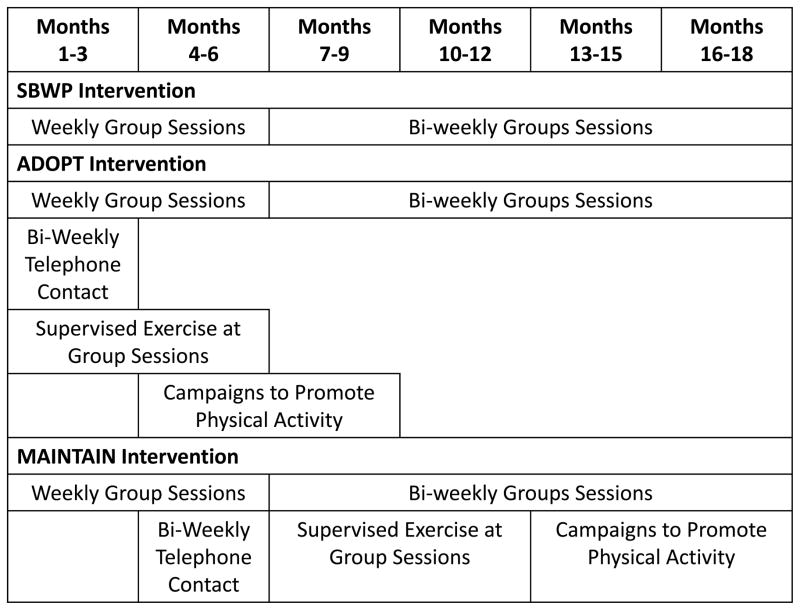
Methods: This was a clinical trial of participants (N = 195; mean ± SEM: age, 43.2 ± 8.6 yr; body mass index, 33.0 ± 3.4 kg·m) randomized to SBWP, ADOPT, or MAINTAIN. All participants were prescribed an energy-restricted diet and physical activity, with group intervention sessions delivered over 18 months. ADOPT participants received additional phone contact (months 1-3), supervised exercise (months 1-6), and behavior campaigns (months 4-9). MAINTAIN participants received additional phone contact (months 4-6), supervised exercise (months 7-12), and behavior campaigns (months 13-18).
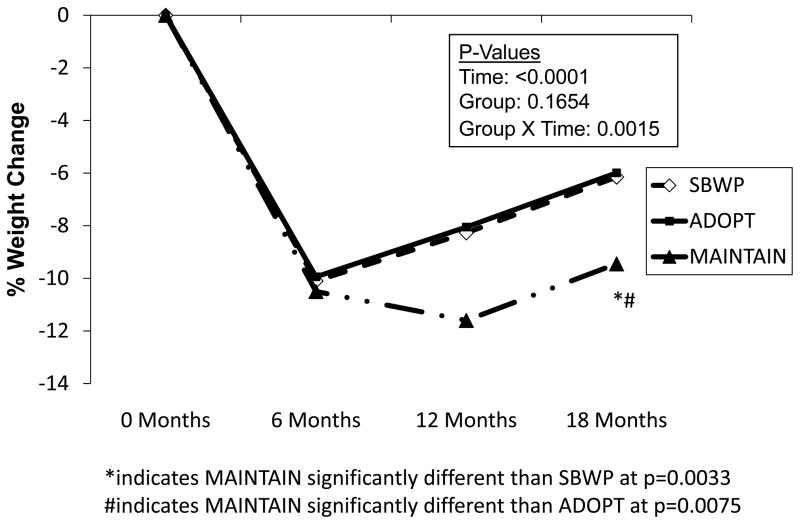
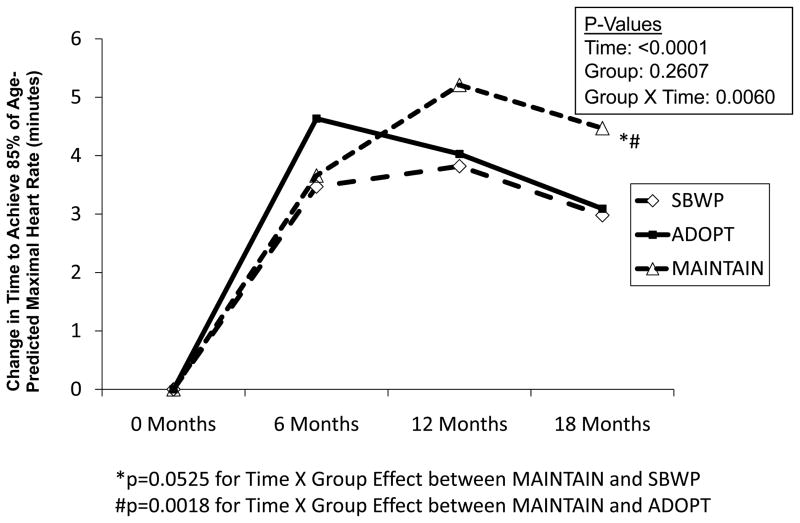
Results: There was a significant group-time interaction for weight loss (P = 0.0032). SBWP participants lost 9.3 ± 0.9, 7.8 ± 1.1, and 5.9 ± 1.2 kg at 6, 12, and 18 months, respectively. ADOPT participants lost 8.9 ± 0.9, 7.6 ± 1.2, and 5.8 ± 1.2 kg, whereas MAINTAIN participants lost 9.7 ± 0.9, 11.0 ± 1.2, and 9.0 ± 1.2 kg at 6, 12, and 18 months, respectively. The group-time interactions for SBWP versus MAINTAIN (P = 0.0033) and for ADOPT versus MAINTAIN (P = 0.0075) were significant. There was a significant group-time interaction for change in fitness (P = 0.0060). The group-time interaction for MAINTAIN versus ADOPT (P = 0.0018) was significant, with a trend for MAINTAIN versus SBWP (P = 0.0525).
Conclusions: MAINTAIN improves 18-month weight loss compared with SBWP and ADOPT, with statistical trends indicating that MAINTAIN results in greater improvements in fitness. These results suggest that time-based strategies emphasizing physical activity confer greater benefits when delivered later and over the full course of intervention. This provides valuable information for the implementation of time-based strategies for improving long-term weight loss and fitness in overweight and obese adults.
Trial registration: ClinicalTrials.gov NCT00177476.
Conflict of interest statement
Dr. Jakicic discloses the following conflicts of interest: Principal Investigator or Co-Investigator on a research grant from BodyMedia, Inc., NIH research grants, and an American Heart Association grant awarded to the University of Pittsburgh; honoraria from Kaiser Permanente, JennyCraig, and the Nestle Nutrition Institute; was on the Scientific Advisory Board for Alere Wellbeing.
Dr. Rickman: No Conflicts of Interest
Dr. Lang: No Conflicts of Interest
Dr. Davis: No Conflicts of Interest
Dr. Gibbs: No Conflicts of Interest
Ms. Neiberg: No Conflicts of Interest:
Dr. Marcus discloses the following conflicts of interest: Travel/accommodations/meeting expenses from the Academy of Eating Disorders and NIDDK.
Figures
References
-
- Pescatello LS, editor. American College of Sports Medicine. ACSM’s Guidelines for Exercise Testing and Prescription. 9. Baltimore: Wolters Kluwer / Lippincott Williams & Wilkins; 2014.
-
- Block G, Woods M, Potosky A, Clifford C. Validation of a self-administered diet history questionnaire using multiple diet records. J Clin Epidemiol. 1990;43:1327–1335. - PubMed
-
- Block G, Hartman AM, Dresser CM, Carol MD, Gannon J, Gardner L. A data-based approach to diet questionnaire design and testing. Am J Epidemiol. 1986;108:161–175. - PubMed
-
- Brownell KD. Public health approaches to obesity and its management. Ann Rev Public Health. 1986;7:521–533. - PubMed
