. 2014 Aug 20:7:21.
doi: 10.1186/1756-8935-7-21. eCollection 2014.

DNA methylation dynamics during ex vivo differentiation and maturation of human dendritic cells

Affiliations

DNA methylation dynamics during ex vivo differentiation and maturation of human dendritic cells

Xue Zhang et al. Epigenetics Chromatin. .

Abstract

Background: Dendritic cells (DCs) are important mediators of innate and adaptive immune responses, but the gene networks governing their lineage differentiation and maturation are poorly understood. To gain insight into the mechanisms that promote human DC differentiation and contribute to the acquisition of their functional phenotypes, we performed genome-wide base-resolution mapping of 5-methylcytosine in purified monocytes and in monocyte-derived immature and mature DCs.

Results: DC development and maturation were associated with a great loss of DNA methylation across many regions, most of which occurs at predicted enhancers and binding sites for known transcription factors affiliated with DC lineage specification and response to immune stimuli. In addition, we discovered novel genes that may contribute to DC differentiation and maturation. Interestingly, many genes close to demethylated CG sites were upregulated in expression. We observed dynamic changes in the expression of TET2, DNMT1, DNMT3A and DNMT3B coupled with temporal locus-specific demethylation, providing possible mechanisms accounting for the dramatic loss in DNA methylation.

Conclusions: Our study is the first to map DNA methylation changes during human DC differentiation and maturation in purified cell populations and will greatly enhance the understanding of DC development and maturation and aid in the development of more efficacious DC-based therapeutic strategies.

Keywords: DNA methylation; DNMT; Differentiation; Human dendritic cells; Maturation; Monocytes; TET.


Figures
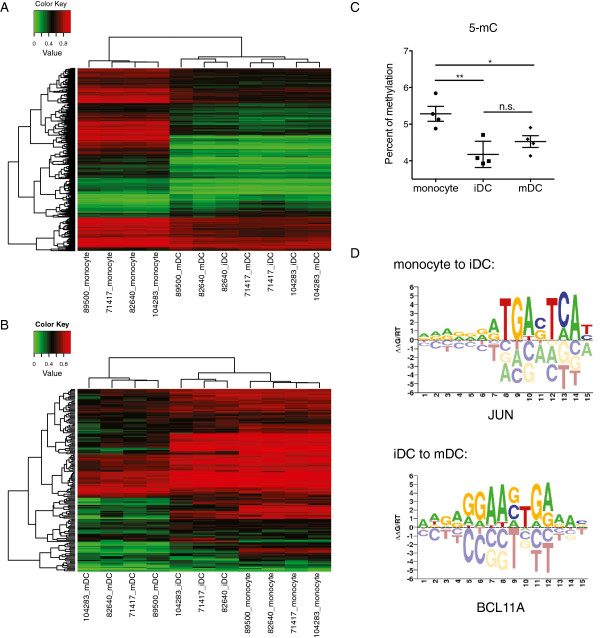
Figure 1
Figure 1
DNA methylation changes occur at non-CGI and transcription factor binding sites during dendritic cell (DC) differentiation and maturation. A) Heatmap showing the CG sites with greater than 10% methylation difference between monocytes and immature dendritic cells (iDCs) among all samples. B) Heatmap showing the CG sites with greater than 10% methylation difference between iDCs and mature dendritic cells (mDCs) among all samples. C) Global DNA methylation levels measured by 5mC ELISA in monocytes, sorted iDCs and sorted mDCs used for microarray analysis. Four technical replicates were used in each cell type, and results are shown as mean ± SD. *P <0.05, **P <0.01, n.s., nonsignificant, paired t test. D) Examples of potential transcription factor binding sites within 50 bp around demethylated CG sites.
Figure 2
Figure 2
Locus-specific bisulfite sequencing validates microarray findings. DNA methylation changes in SRC, AHRR, CYP1B1, PPARG, AKT1, HMOX1, ITGB2, and DNMT3B(A), and PLEKHG6, PDE4B, IL23R, CD86, IL10, CCR7 and CD59(B). Four technical replicates of flow-purified cells were used in each cell type, and results are shown as mean ± SD.
Figure 3
Figure 3
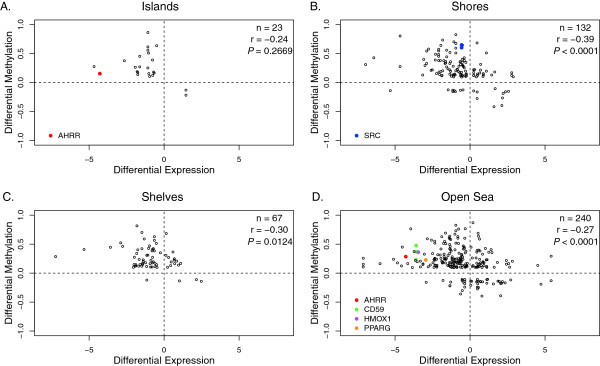
Correlation of DNA methylation changes with gene expression alterations during dendritic cell (DC) differentiation. CG sites with significant DNA methylation changes were grouped by its relative distance to CGI. A. CpG island; B. CG shores: 0 to 2 kb from an island; C. Shelves: 2 to 4 kb from an island; D. Open sea: 4 kb away from an island. The changes in expression levels of differentially expressed genes (false discovery rate (FDR) <0.05) were then correlated with changes in beta values of differentially methylated points (DMPs), and Pearson’s correlation coefficients were reported for CG sites in each category. CG sites validated in Figure 2 whose associated gene expression levels also significantly altered were highlighted with different colors.
Figure 4
Figure 4
Dynamic changes in expression levels of TET2/3 and DNMTs. Gene expression levels of DNMT1, DNMT3A, and DNMT3B(A), TET2, TET3 in (B). Independent experiments for each donor were performed and expression levels were normalized to GADPH, and three biological replicates were used in each condition. Bar graphs shown in this figure represent pooled data analyses from all the four independent experiments. Comparisons were made for Day-0 versus Day-1, Day-4 versus Mature Day-1, and Mature Day-1 versus Mature Day-2 using paired t-test. *P <0.05, **P <0.01.
Figure 5
Figure 5
Locus-specific dynamic DNA methylation and expression changes during dendritic cell (DC) differentiation and maturation. DNA methylation at CG sites at the promoter of SRC, PLEKHG6 and ITGB2(A) and gene expression changes (B) were measured during the differentiation of monocyte into iDC (day 0 to day 4) and immature dendritic cell (iDC) maturation into mature dendritic cell (mDC) (day 4 to Mature day 1 to Mature day 2). iDCs without addition of maturation cocktail were grown for additional two days as well (day 5 and 6). Expression level in B was normalized to GADPH, and three biological replicates were used in each condition. One representative experiment among four replicates is shown here. Comparisons were made for Day 0 versus Day-1, Day-4 versus Mature Day-1, and Mature Day-1 versus Mature Day-2 using paired t-test. *P <0.05, **P <0.01, ***P <0.001, n.s., nonsignificant.

References

    1. Steinman RM. Decisions about dendritic cells: past, present, and future. Annu Rev Immunol. 2012;30:1–22. - PubMed
    1. Cao H, Verge V, Baron C, Martinache C, Leon A, Scholl S, Gorin NC, Salamero J, Assari S, Bernard J, Lopez M. In vitro generation of dendritic cells from human blood monocytes in experimental conditions compatible for in vivo cell therapy. J Hematother Stem Cell Res. 2000;9:183–194. - PubMed
    1. Randolph GJ, Inaba K, Robbiani DF, Steinman RM, Muller WA. Differentiation of phagocytic monocytes into lymph node dendritic cells in vivo. Immunity. 1999;11:753–761. - PubMed
    1. Lung TL, Saurwein-Teissl M, Parson W, Schonitzer D, Grubeck-Loebenstein B. Unimpaired dendritic cells can be derived from monocytes in old age and can mobilize residual function in senescent T cells. Vaccine. 2000;18:1606–1612. - PubMed
    1. Jonuleit H, Kuhn U, Muller G, Steinbrink K, Paragnik L, Schmitt E, Knop J, Enk AH. Pro-inflammatory cytokines and prostaglandins induce maturation of potent immunostimulatory dendritic cells under fetal calf serum-free conditions. Eur J Immunol. 1997;27:3135–3142. - PubMed