


Mobile phone text messaging intervention for cervical cancer screening: changes in knowledge and behavior pre-post intervention
- PMID: 25164545
- PMCID: PMC4180333
- DOI: 10.2196/jmir.3576
Mobile phone text messaging intervention for cervical cancer screening: changes in knowledge and behavior pre-post intervention
Abstract
Background: Cervical cancer poses a significant threat to Korean American women, who are reported to have one of the highest cervical cancer mortality rates in the United States. Studies consistently report that Korean American women have the lowest Pap test screening rates across US ethnic groups.
Objective: In response to the need to enhance cervical cancer screening in this vulnerable population, we developed and tested a 7-day mobile phone text message-based cervical cancer Screening (mScreening) intervention designed to promote the receipt of Pap tests by young Korean American women.
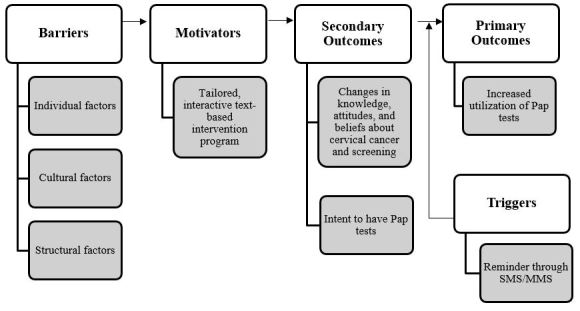
Methods: We developed and assessed the acceptability and feasibility of a 1-week mScreening intervention to increase knowledge of cervical cancer screening, intent to receive screening, and the receipt of a Pap test. Fogg's Behavior Model was the conceptual framework that guided the development of the mScreening intervention. A series of focus groups were conducted to inform the development of the intervention. The messages were individually tailored for each participant and delivered to them for a 7-day period at each participant's preferred time. A quasi-experimental research design of 30 Korean American women aged 21 to 29 years was utilized with baseline, post (1 week after the completion of mScreening), and follow-up (3 months after the completion of mScreening) testing.
Results: Findings revealed a significant increase in participants' knowledge of cervical cancer (P<.001) and guidelines for cervical cancer screening (P=.006). A total of 23% (7/30) (95% CI 9.9-42.3) of the mScreening participants received a Pap test; 83% (25/30) of the participants expressed satisfaction with the intervention and 97% (29/30) reported that they would recommend the program to their friends, indicating excellent acceptability and feasibility of the intervention.
Conclusions: This study provides evidence of the effectiveness and feasibility of the mScreening intervention. Mobile technology is a promising tool to increase both knowledge and receipt of cervical cancer screening. Given the widespread usage of mobile phones among young adults, a mobile phone-based health intervention could be a low-cost and effective method of reaching populations with low cervical cancer screening rates, using individually tailored messages that cover broad content areas and overcome restrictions to place and time of delivery.
Keywords: Korean American women; Pap test; cervical cancer; health behavior change; health disparity; mobile health; text-messaging intervention.
Conflict of interest statement
Conflicts of Interest: None declared.
References
-
- Lee EE, Fogg L, Menon U. Knowledge and beliefs related to cervical cancer and screening among Korean American women. West J Nurs Res. 2008 Dec;30(8):960–74. doi: 10.1177/0193945908319250. http://europepmc.org/abstract/MED/18539883 - DOI - PMC - PubMed
-
- U.S. Department of Health and Human Services. [2014-07-18]. Healthy People 2020 http://www.healthypeople.gov/2020/default.aspx.
-
- McCracken M, Olsen M, Chen MS, Jemal A, Thun M, Cokkinides V, Deapen D, Ward E. Cancer incidence, mortality, and associated risk factors among Asian Americans of Chinese, Filipino, Vietnamese, Korean, and Japanese ethnicities. CA Cancer J Clin. 2007;57(4):190–205. - PubMed
Publication types
MeSH terms
Grants and funding
LinkOut - more resources
Full Text Sources
Other Literature Sources
Medical
Research Materials
