


Why climate change will invariably alter selection pressures on phenology
- PMID: 25165771
- PMCID: PMC4173688
- DOI: 10.1098/rspb.2014.1611
Why climate change will invariably alter selection pressures on phenology
Abstract
The seasonal timing of lifecycle events is closely linked to individual fitness and hence, maladaptation in phenological traits may impact population dynamics. However, few studies have analysed whether and why climate change will alter selection pressures and hence possibly induce maladaptation in phenology. To fill this gap, we here use a theoretical modelling approach. In our models, the phenologies of consumer and resource are (potentially) environmentally sensitive and depend on two different but correlated environmental variables. Fitness of the consumer depends on the phenological match with the resource. Because we explicitly model the dependence of the phenologies on environmental variables, we can test how differential (heterogeneous) versus equal (homogeneous) rates of change in the environmental variables affect selection on consumer phenology. As expected, under heterogeneous change, phenotypic plasticity is insufficient and thus selection on consumer phenology arises. However, even homogeneous change leads to directional selection on consumer phenology. This is because the consumer reaction norm has historically evolved to be flatter than the resource reaction norm, owing to time lags and imperfect cue reliability. Climate change will therefore lead to increased selection on consumer phenology across a broad range of situations.
Keywords: climate change; phenology; phenotypic plasticity; reaction norm; selection.
© 2014 The Author(s) Published by the Royal Society. All rights reserved.
Figures
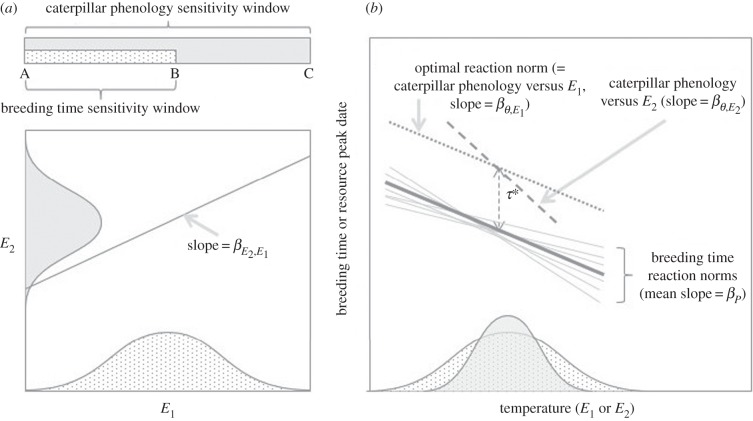
 ). The thick solid line indicates the population-average reaction norm and the thin grey lines indicate individual-specific reaction norms. The optimal reaction norm slope with respect to E1 (dotted line) is equal to the resource reaction norm slope
  multiplied by the slope of E2 versus E1
 . Ignoring the existing mismatch between bird and caterpillar phenology (see Discussion), the initial difference in elevation between the reaction norm elevations, τ*, is set to approximately 30 days, so that food demands and availability coincide.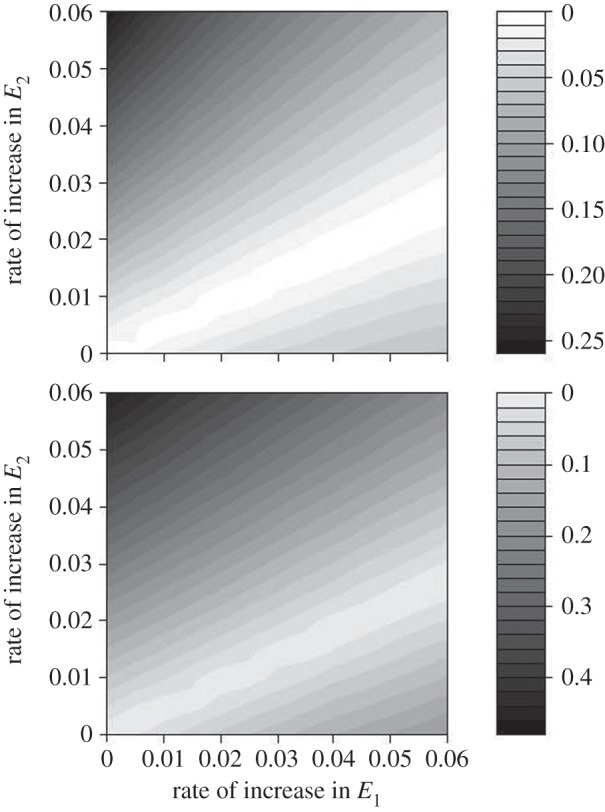
References
-
- Kelly MG, Levin DA. 1997. Fitness consequences and heritability aspects of emergence date in Phlox drummondii. J. Ecol. 85, 755–766. ( 10.2307/2960599) - DOI
-
- Philippart CJM, van Aken HM, Beukema JJ, Bos OG, Cadee GC, Dekker R. 2003. Climate-related changes in recruitment of the bivalve Macoma balthica. Limnol. Oceanogr. 48, 2171–2185. ( 10.4319/lo.2003.48.6.2171) - DOI
-
- Prop J, Black JM, Shimmings P. 2003. Travel schedules to the high Arctic: barnacle geese trade-off the timing of migration with accumulation of fat deposits. Oikos 103, 403–414. ( 10.1034/j.1600-0706.2003.12042.x) - DOI
Publication types
MeSH terms
LinkOut - more resources
Full Text Sources
Other Literature Sources
Medical
Miscellaneous
