


Expectancies for cigarettes, e-cigarettes, and nicotine replacement therapies among e-cigarette users (aka vapers)
- PMID: 25168035
- PMCID: PMC4438353
- DOI: 10.1093/ntr/ntu149
Expectancies for cigarettes, e-cigarettes, and nicotine replacement therapies among e-cigarette users (aka vapers)
Abstract
Introduction: Use of e-cigarettes has been increasing exponentially, with the primary motivation reported as smoking cessation. To understand why smokers choose e-cigarettes as an alternative to cigarettes, as well as to US Food and Drug Administration (FDA)--approved nicotine replacement therapies (NRT), we compared outcome expectancies (beliefs about the results of drug use) for the three nicotine delivery systems among vapers, i.e., e-cigarette users, who were former smokers.
Methods: Vapers (N = 1,434) completed an online survey assessing 14 expectancy domains as well as perceived cost and convenience. We focused on comparisons between e-cigarettes and cigarettes to determine the attraction of e-cigarettes as a smoking alternative and between e-cigarettes and NRT to determine perceived advantages of e-cigarettes over FDA-approved pharmacotherapy.
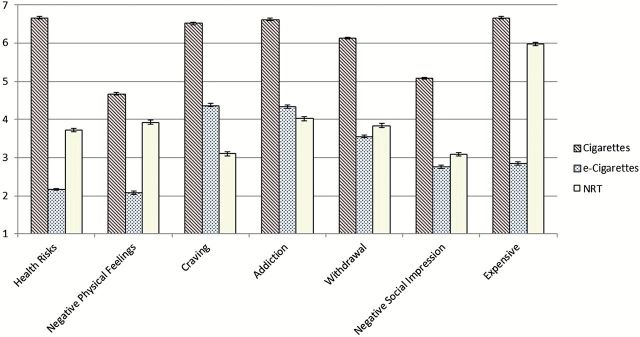
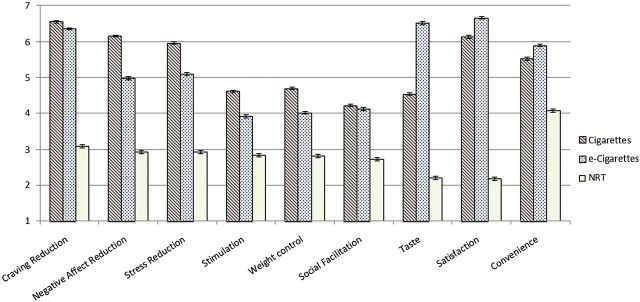
Results: Participants believed that e-cigarettes, in comparison to conventional cigarettes, had fewer health risks; caused less craving, withdrawal, addiction, and negative physical feelings; tasted better; and were more satisfying. In contrast, conventional cigarettes were perceived as better than e-cigarettes for reducing negative affect, controlling weight, providing stimulation, and reducing stress. E-cigarettes, compared to NRT, were perceived to be less risky, cost less, cause fewer negative physical feelings, taste better, provide more satisfaction, and be better at reducing craving, negative affect, and stress. Moderator analyses indicated history with ad libitum forms of NRT was associated with less positive NRT expectancies.
Conclusions: The degree to which expectancies for e-cigarettes differed from expectancies for either tobacco cigarettes or NRT offers insight into the motivation of e-cigarette users and provides guidance for public health and clinical interventions to encourage smoking-related behavior change.
© The Author 2014. Published by Oxford University Press on behalf of the Society for Research on Nicotine and Tobacco. All rights reserved. For permissions, please e-mail: journals.permissions@oup.com.
Figures
References
-
- USDHHS. The Health Consequences of Smoking-50 Years of Progress: A Report of the Surgeon General. Atlanta, GA: US Department of Health and Human Services, Centers for Disease Control and Prevention, National Center for Chronic Disease Prevention and Health Promotion, Office on Smoking and Health; 2014. - PubMed
-
- Fiore MC, Jaen CR, Baker TB, et al. Treating tobacco use and dependence: 2008 update. Rockville, MD: US Department of Health and Human Services, Public Health Service; 2008.
-
- Cokkinides VE, Ward E, Jemal A, Thun MJ. Under-use of smoking-cessation treatments: results from the National Health Interview Survey, 2000. Am J Prev Med. 2005;28:119–122. - PubMed
-
- Cummings KM, Hyland A. Impact of nicotine replacement therapy on smoking behavior. Annu Rev Public Health. 2005;26:583–599. - PubMed
Publication types
MeSH terms
Substances
Grants and funding
LinkOut - more resources
Full Text Sources
Other Literature Sources
Medical
