. 2014 Nov;35(11):1363-71.
doi: 10.1002/humu.22681.

Impaired function is a common feature of neuropathy-associated glycyl-tRNA synthetase mutations

Affiliations

Impaired function is a common feature of neuropathy-associated glycyl-tRNA synthetase mutations

Laurie B Griffin et al. Hum Mutat. 2014 Nov.

Abstract

Charcot-Marie-Tooth disease type 2D (CMT2D) is an autosomal-dominant axonal peripheral neuropathy characterized by impaired motor and sensory function in the distal extremities. Mutations in the glycyl-tRNA synthetase (GARS) gene cause CMT2D. GARS is a member of the ubiquitously expressed aminoacyl-tRNA synthetase (ARS) family and is responsible for charging tRNA with glycine. To date, 13 GARS mutations have been identified in patients with CMT disease. While functional studies have revealed loss-of-function characteristics, only four GARS mutations have been rigorously studied. Here, we report the functional evaluation of nine CMT-associated GARS mutations in tRNA charging, yeast complementation, and subcellular localization assays. Our results demonstrate that impaired function is a common characteristic of CMT-associated GARS mutations. Additionally, one mutation previously associated with CMT disease (p.Ser581Leu) does not demonstrate impaired function, was identified in the general population, and failed to segregate with disease in two newly identified families with CMT disease. Thus, we propose that this variant is not a disease-causing mutation. Together, our data indicate that impaired function is a key component of GARS-mediated CMT disease and emphasize the need for careful genetic and functional evaluation before implicating a variant in disease onset.

Keywords: Charcot-Marie-Tooth disease; GARS; aminoacyl-tRNA synthetase; glycyl-tRNA synthetase; peripheral neuropathy.


Figures

Figure 1
Figure 1
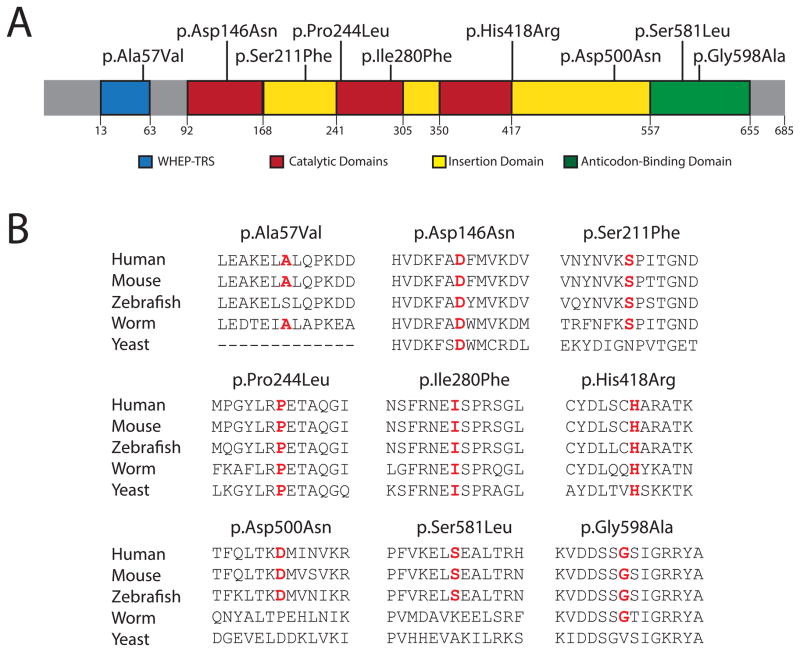
Localization and conservation of GARS variants. (A) Mutations are depicted on a cartoon of the known functional and structural domains of GARS in blue (WHEP-TRS domain), red (catalytic domain), yellow (insertion domains), and green (anticodon-binding domain). The amino-acid positions for each domain are indicated below the cartoon. (B) GARS protein sequence alignments from multiple, evolutionarily diverse species are depicted. The amino acid change is listed at the top of each protein fragment. The affected amino acid is highlighted in red.
Figure 2
Figure 2
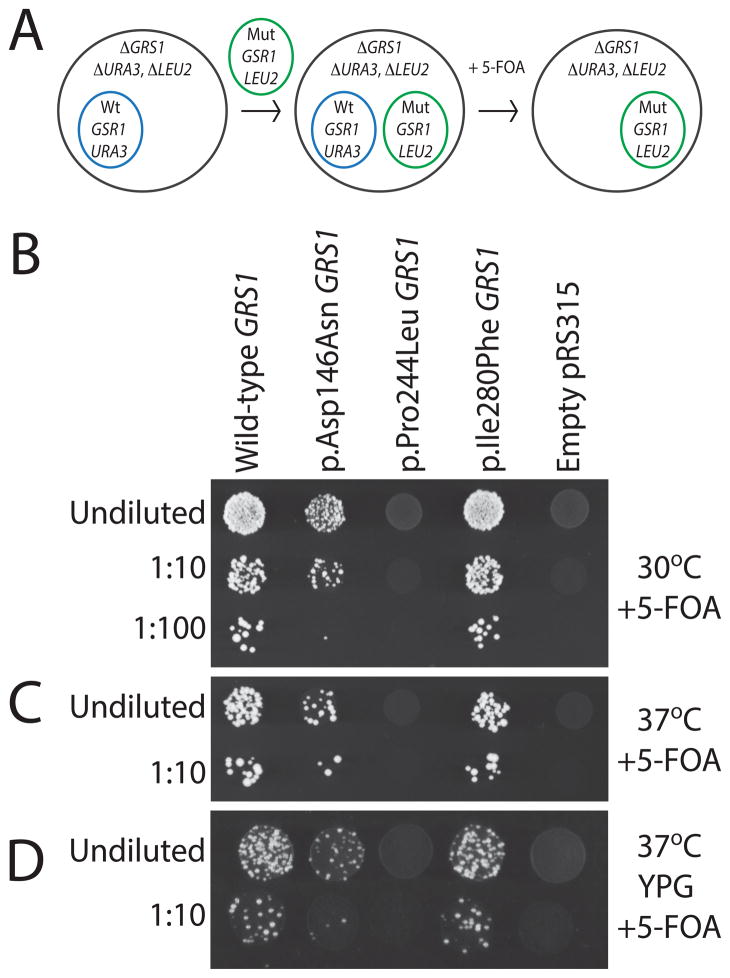
Characterization of yeast expressing wild-type and mutant GRS1. Cartoon illustrates yeast complementation strategy (A). Each yeast strain was transformed with a LEU2-bearing pRS315 vector containing wild-type GRS1 (Wt), the indicated mutant form of GRS1 (Mut), or no insert (‘Empty’). Cultures for each strain (labeled along the top for each panel in B, C, and D) were grown for two days in liquid media and spotted on selective solid growth medium directly or after dilution as indicated. Strains were plated on medium containing 5-FOA to determine if the GRS1 alleles complement loss of endogenous GRS1 gene at 30°C (B) and 37°C (C). (D) Strains were plated on solid medium containing 5-FOA and glycerol (YPG) to assess for an effect on mitochondrial function.
Figure 3
Figure 3
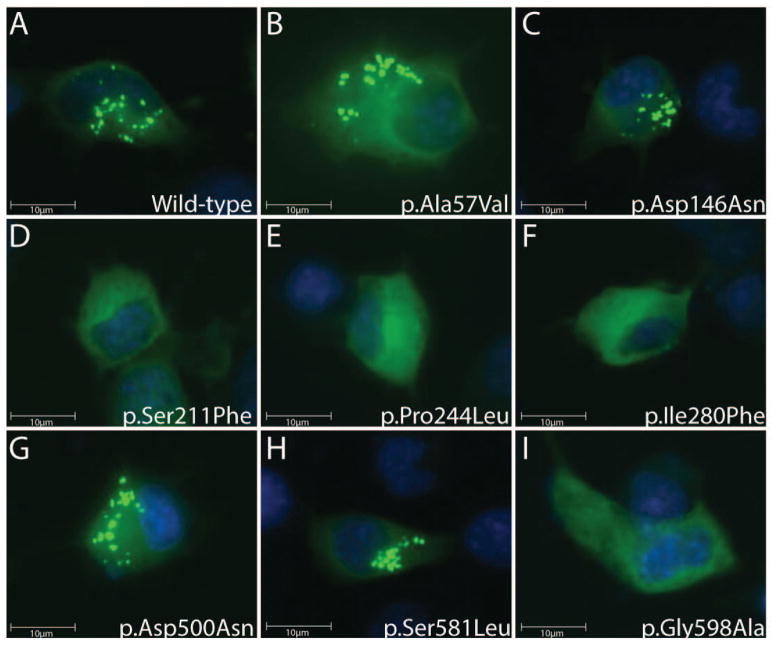
Expression of wild-type and mutant GARS in mouse motor neuron-derived cells. MN-1 cells expressing EGFP-tagged wild-type (A), p.Ala57Val (B), p.Asp146Asn (C), p.Ser211Phe (D), p.Pro244Leu (E), p.Ile280Phe (F), p.Asp500Asn (G), p.Ser581Leu (H), or p.Gly598Ala GARS (I) were evaluated for the presence or absence of puncta by fluorescence microscopy.
Figure 4
Figure 4
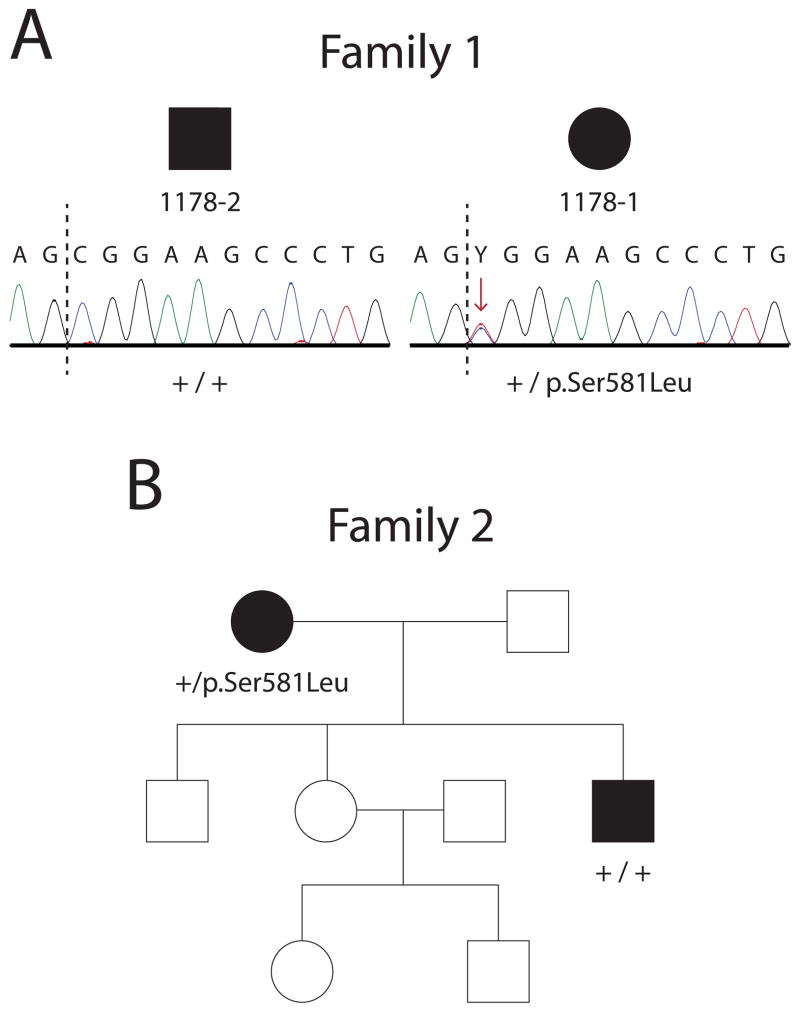
p.Ser581Leu GARS does not segregate with CMT disease. DNA samples from affected individuals from two presumably unrelated families with autosomal dominant, axonal CMT disease were genotyped for p.Ser581Leu GARS. Female patients are indicated with circles and male patients are indicated with squares. Filled symbols represent affected individuals with a diagnosis of dominant axonal CMT disease and empty symbols indicate unaffected individuals. Where applicable, an individual’s genotype is indicted with + (for the wild-type allele) or p.Ser581Leu (for the variant allele). (A) Samples from individuals in Family 1 were anonymized resulting in loss of the pedigree structure for this family; however, individuals 1178–1 and 1178–2 are directly related, both affected, and reside in a pedigree originally described as dominant axonal CMT disease. Representative chromatographs from sequencing analysis of genomic DNA from affected individuals are shown. The sequence includes the AG splice site acceptor at the 3′ end of intron 15 followed by the first 12 nucleotides of exon 16 (intron/exon junction marked by dashed line). The p.Ser581 codon (TCG) is encoded by the last nucleotide of exon 15 (T; not shown) and the first two nucleotides (CG) of exon 16. Individual 1178–1 is heterozygous for a C>T mutation (red arrow) in the first base of exon 16 resulting in the p.Ser581Leu allele. 1178–2 is homozygous for the wild-type genotype at this nucleotide (C). (B) The pedigree for Family 2 illustrates the affected status of each family member and the p.Ser581Leu genotypes of two affected individuals with dominant axonal CMT disease.

References

    1. Abe A, Hayasaka K. The GARS gene is rarely mutated in Japanese patients with Charcot-Marie-Tooth neuropathy. Journal of human genetics. 2009;54:310–312. - PubMed
    1. Achilli F, Bros-Facer V, Williams HP, Banks GT, AlQatari M, Chia R, Tucci V, Groves M, Nickols CD, Seburn KL, Kendall R, Cader MZ, et al. An ENU-induced mutation in mouse glycyl-tRNA synthetase (GARS) causes peripheral sensory and motor phenotypes creating a model of Charcot-Marie-Tooth type 2D peripheral neuropathy. Disease Models & Mechanisms. 2009;2:359–373. - PMC - PubMed
    1. Antonellis A, Ellsworth RE, Sambuughin N, Puls I, Abel A, Lee-Lin S-Q, Jordanova A, Kremensky I, Christodoulou K, Middleton LT, Sivakumar K, Ionasescu V, et al. Glycyl tRNA Synthetase Mutations in Charcot-Marie-Tooth Disease Type 2D and Distal Spinal Muscular Atrophy Type V. The American Journal of Human Genetics. 2003;72:1293–1299. - PMC - PubMed
    1. Antonellis A, Green ED. The Role of Aminoacyl-tRNA Synthetases in Genetic Diseases*. Annual Review of Genomics and Human Genetics. 2008;9:87–107. - PubMed
    1. Antonellis A, Lee-Lin SQ, Wasterlain A, Leo P, Quezado M, Goldfarb LG, Myung K, Burgess S, Fischbeck KH, Green ED. Functional Analyses of Glycyl-tRNA Synthetase Mutations Suggest a Key Role for tRNA-Charging Enzymes in Peripheral Axons. Journal of Neuroscience. 2006;26:10397–10406. - PMC - PubMed

Publication types

MeSH terms

Substances

Supplementary concepts