. 2015 Jan;13(1):78-85.
doi: 10.1158/1541-7786.MCR-14-0334. Epub 2014 Aug 28.

Notch3 overexpression promotes anoikis resistance in epithelial ovarian cancer via upregulation of COL4A2

Affiliations

Notch3 overexpression promotes anoikis resistance in epithelial ovarian cancer via upregulation of COL4A2

Caitlin W Brown et al. Mol Cancer Res. 2015 Jan.

Abstract

Ovarian cancer is a lethal disease with the majority of diagnosed women having distant metastases. Interestingly, although Notch3 overexpression has been correlated with poor survival in epithelial ovarian cancer (EOC), little is known about its mechanism of action. Data show that Notch3 specifically promotes anoikis resistance. In addition, data indicate a positive role for focal adhesion kinase (FAK) as well as downstream signaling kinases such as Akt and Erk 1/2 in promoting anchorage-independent growth. Mechanistically, both mRNA transcript and protein levels of type IV collagen (COL4A2) are reduced when Notch3 levels are decreased and exogenous collagen IV supplementation reverses the anoikis sensitivity. Reduction of COL4A2 expression by RNAI-mediated knockdown induces cell death. Finally, elevated Notch3 expression levels correlate with higher COL4A2 expression in human ovarian tumor specimens.

Implications: These data highlight type IV collagen as a novel therapeutic target for metastatic EOC. Visual Overview: http://mcr.aacrjournals.org/content/early/2014/11/25/1541-7786.MCR-14-0334/F1.large.jpg


Figures

Figure 1
Figure 1
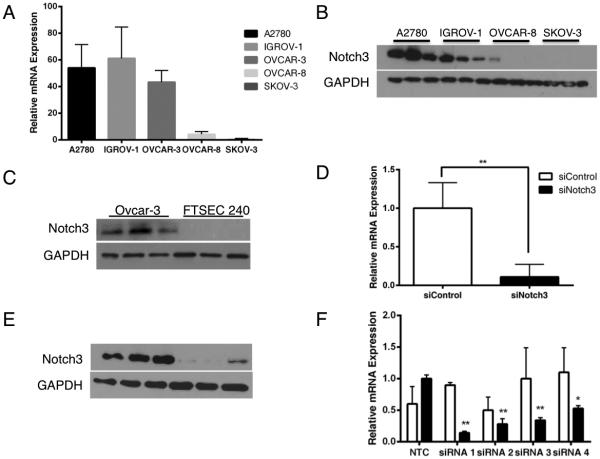
Human IGROV-1 ovarian cancer cells model the upregulation of Notch3 in human ovarian tumors. A2780, IGROV-1 and OVCAR-3 cells express significantly more Notch3 mRNA (A) and protein (B) than OVCAR-8 or SKOV-3 cells. OVCAR-3 cells express Notch3 whereas FTSEC 240 cells do not (C). Transfection with Notch3 siRNA efficiently reduces expression of the Notch3 receptor at the mRNA (D) and protein (E) levels (p < 0.01). (F) Individual Notch3 siRNA strands significantly reduce Notch3 mRNA expression (* p <0.05 and ** p < 0.01).
Figure 2
Figure 2
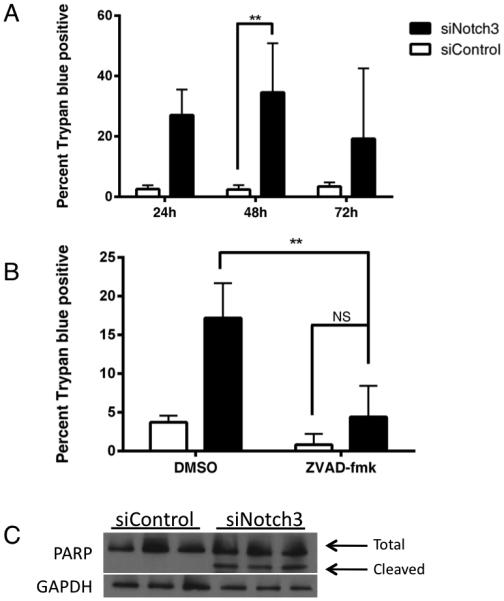
Notch 3 is required for survival of IGROV-1 cells. (A) Cell count analysis by trypan blue exclusion showed significantly fewer cells at 96h between 0h siCtrl-48h siCtrl and 0h siNotch3-48h siNotch3. (B) Treatment of siNotch3 IGROV-1 cells with the pan-caspase inhibitor Z-VAD-FMK showed a significant reduction of apoptotic cells compared with vehicle treated siNotch3 cells. There was a significant (p < 0.01) increase in trypan blue positive cells in siNotch3 DMSO treated cells as compared with siControl DMSO treated cells and a non-significant reduction in siControl cells treated with Z-VAD-FMK. These relationships are not shown for clarity of the figure. (C) siNotch3 cells express cleaved PARP whereas siControl cells do not.
Figure 3
Figure 3
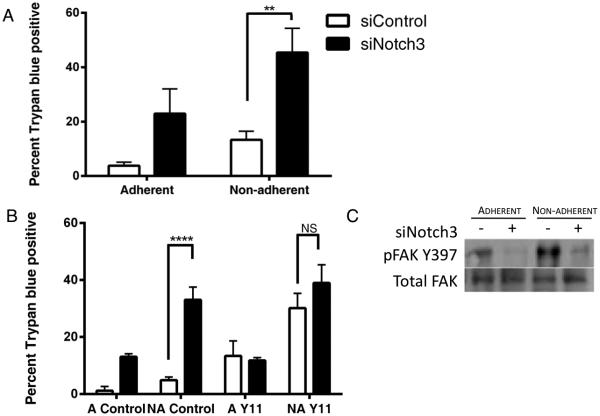
Notch3 promotes anoikis resistance. (A) Cells treated with control or Notch3 siRNA were incubated in adherent (A=Adherent) or non-adherent (NA= Non-adherent) conditions for 24, 48 and 72 hours and counted by trypan blue exclusion. siNotch3 cells plated in non-adherent conditions undergo significantly more apoptosis than their siControl counterparts. There was a significant increase (p < 0.01) in trypan blue positive cells in adherent siNotch3 samples as compared with siControl samples. There was no significant difference in siControl adherent and non-adherent samples. These relationships are not shown for clarity of the figure. (B) Pharmacological inhibition of focal adhesion kinase (FAK) activation by Y11 in control cells phenocopies the Notch3 knockdown and Y11 treatment did not significantly alter the number of apoptotic siNotch3 cells. Significantly more trypan blue positive cells were seen in non-adherent siNotch3 cells compared with siControl cells (p < 0.001). (C) Phosphorylated FAK (Y397) is decreased in siNotch3 compared with siControl cells in both adherent and non-adherent conditions.
Figure 4
Figure 4
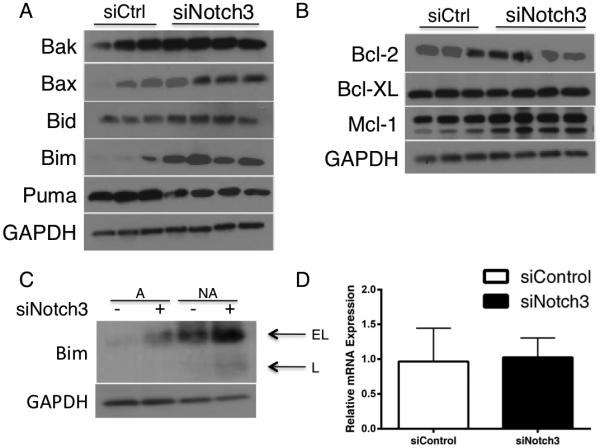
Bim expression and activation correlates with reduced Notch3 expression and increased anoikis. (A) IGROV-1 cells treated with Notch3 siRNA have increased Bim EL expression compared with control counterparts. (B) siNotch3 cells in non-adherent conditions express more Bim than siNotch3 cells in adherent conditions or siCtrl cells in adherent or non-adherent conditions. (C) Bim mRNA expression does not significantly change with Notch3 reduction.
Figure 5
Figure 5
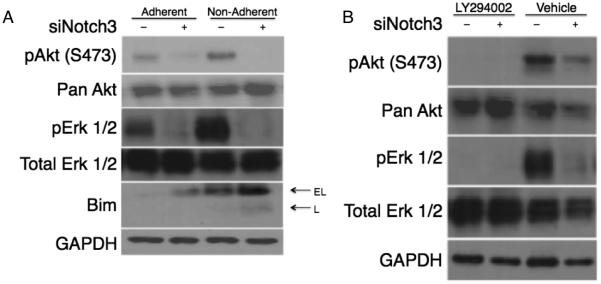
Notch3 signaling promotes Akt and Erk regulation of Bim. Notch3 signaling induces phosphorylation of Akt Ser473 and Erk 1/2 in both adherent and non-adherent conditions. (A) The reduction of pAkt and pErk 1/2 result in an increase in Bim expression. Inhibition of PI3K is sufficient to reduce both Akt and Erk 1/2 activation. (B) Treatment of siCtrl and siNotch3 cells with the PI3K inhibitor LY294002 (50μM) for 1h in adherent conditions is sufficient to inhibit phosphorylation of Erk 1/2 comparable to vehicle treated siNotch3 cells.
Figure 6
Figure 6
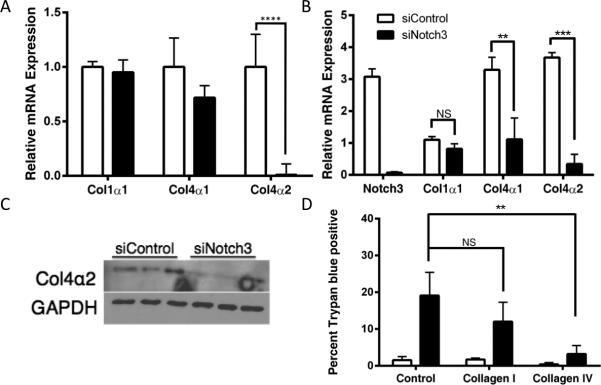
Notch3 is required for proper expression of col4α2. Both IGROV-1 and OVCAR-3 siNotch3 cells express significantly less col4α2 mRNA (A and B) than their control counterparts (** p = < 0.01, *** = p < 0.005, **** = p < 0.001). Col4α2 mRNA expression is not significantly altered in siNotch1 cells. (C) Protein-level expression of the col4α2 chain is reduced in IGROV-1 siNotch3 cells as compared with siControl cell by immunoblot. (D) Exogenous collagen IV rescues Notch3 knockdown cells (** = p < 0.01, *** = p < 0.005). IGROV-1 cells 24h post-transfection with Notch3 siRNA show significantly less cell death when plated on exogenous human collagen type IV for 24h than siNotch3 cells plated in human collagen Type I or control wells (p < 0.01).
Figure 7
Figure 7
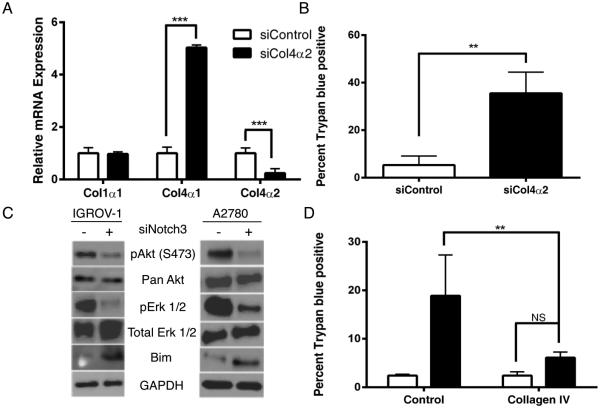
Collagen type IVα2 is critical to ovarian cancer cell survival. (A) Reduction in Col4α2 expression induces cell death. IGROV-1 cells transfected with Col4α2 siRNA have significantly more cell death and fewer total cells compared with their control counterparts (p < 0.005). (B) Type IV collagen is sufficient to rescue siCol4α2 cells from cell death (p < 0.01). (C) siCol4α2 show a reduction in phosphorylated Akt and Erk 1/2 as well as an increase in Bim. Shown are representative samples of 3 biological replicates. (D) siCol4α2 cells plated on exogenous collagen type IV have significantly fewer dead cells and more total cells than siCol4α2 cells plated in control wells (p < 0.01).
Figure 8
Figure 8
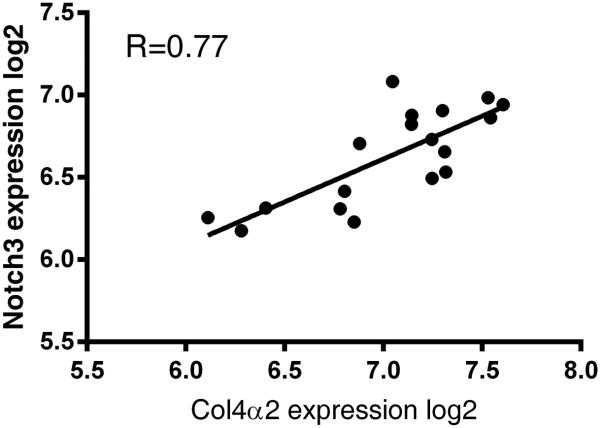
Notch3 overexpression correlates with increased col4α2 expression in metastatic versus primary human ovarian tumors. Pearson correlation of 0.77 indicates a strong correlation between notch3 expression and col4α2 expression (p < 0.000143)

References

    1. Howlader N, Noone AM, Krapcho M, Garshell J, Neyman N, Altekruse SF, et al. SEER Cancer Statistics Review 1975-2010 National Cancer Institute. Natl. Cancer Inst. 2013;1:1992–2010.
    1. Cancer Genome Atlas Research Network Integrated genomic analyses of ovarian carcinoma. Nature. 2011;474:609–15. - PMC - PubMed
    1. Park JT, Shih I-M, Wang T-L. Identification of Pbx1, a potential oncogene, as a Notch3 target gene in ovarian cancer. Cancer Res. 2008;68:8852–60. - PMC - PubMed
    1. Choi JH, Park JT, Davidson B, Morin PJ, Shih LM, Wang TL. Jagged-1 and Notch3 juxtacrine loop regulates ovarian tumor growth and adhesion. Cancer Res. 2008;68:5716–23. - PMC - PubMed
    1. Park JT, Li M, Nakayama K, Mao TL, Davidson B, Zhang Z, et al. Notch3 gene amplification in ovarian cancer. Cancer Res. 2006;66:6312–8. - PubMed

Publication types

MeSH terms