


Developmental changes of TGF-β1 and Smads signaling pathway in intestinal adaption of weaned pigs
- PMID: 25170924
- PMCID: PMC4149345
- DOI: 10.1371/journal.pone.0104589
Developmental changes of TGF-β1 and Smads signaling pathway in intestinal adaption of weaned pigs
Abstract
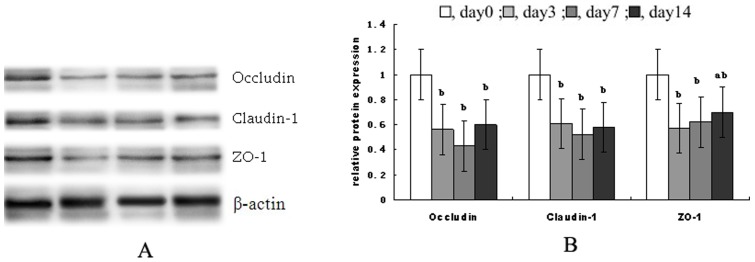
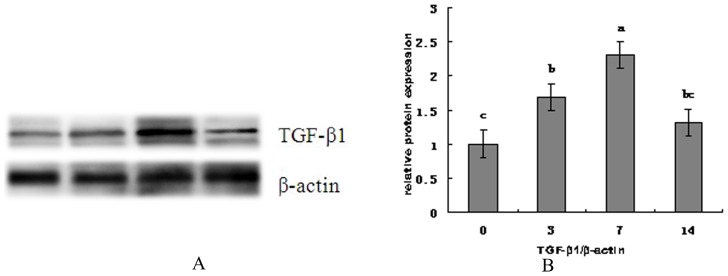
Weaning stress caused marked changes in intestinal structure and function. Transforming growth factor-β1 (TGF-β1) and canonical Smads signaling pathway are suspected to play an important regulatory role in post-weaning adaptation of the small intestine. In the present study, the intestinal morphology and permeability, developmental expressions of tight junction proteins and TGF-β1 in the intestine of piglets during the 2 weeks after weaning were assessed. The expressions of TGF-β receptor I/II (TβRI, TβRII), smad2/3, smad4 and smad7 were determined to investigate whether canonical smads signaling pathways were involved in early weaning adaption process. The results showed that a shorter villus and deeper crypt were observed on d 3 and d 7 postweaning and intestinal morphology recovered to preweaning values on d 14 postweaning. Early weaning increased (P<0.05) plasma level of diamine oxidase (DAO) and decreased DAO activities (P<0.05) in intestinal mucosa on d 3 and d 7 post-weaning. Compared with the pre-weaning stage (d 0), tight junction proteins level of occludin and claudin-1 were reduced (P<0.05) on d 3, 7 and 14 post-weaning, and ZO-1 protein was reduced (P<0.05) on d 3 and d 7 post-weaning. An increase (P<0.05) of TGF-β1 in intestinal mucosa was observed on d 3 and d 7 and then level down on d 14 post-weaning. Although there was an increase (P<0.05) of TβR II protein expression in the intestinal mucosa on d3 and d 7, no significant increase of mRNA of TβRI, TβRII, smad2/3, smad4 and smad7 was observed during postweaning. The results indicated that TGF-β1 was associated with the restoration of intestinal morphology and barrier function following weaning stress. The increased intestinal endogenous TGF-β1 didn't activate the canonical Smads signaling pathway.
Conflict of interest statement
Figures

References
-
- Moeser AJ, Ryan KA, Nighot PK, Blikslager AT (2007) Gastrointestinal dysfunction induced by early weaning is attenuated by delayed weaning and mast cell blockade in pigs. Am. J. Physiol Gastrointest Liver Physiol 293: G413–G421. - PubMed
-
- Hu CH, Xiao K, Song J, Luan ZS (2013) Effects of ZnO supported on zeolite on growth performance, intestinal microflora and permeability, and cytokines expression of weaned pigs. Anim Feed Sci Tech 181: 65–71.
-
- Hu CH, Xiao K, Luan ZS, Song J (2013) Early weaning increases intestinal permeability, alters expression of cytokine and tight junction protein, and activates mitogen-activated protein kinases in pigs. J Anim Sci 91: 1094–1101. - PubMed
-
- Yin J, Wu MM, Xiao H, Ren WK, Duan JL, et al. (2014) Development of an antioxidant system after early weaning in piglets. J Anim Sci 92: 612–619. - PubMed
Publication types
MeSH terms
Substances
LinkOut - more resources
Full Text Sources
Other Literature Sources
Miscellaneous
