


Proinflammation of aging central arteries: a mini-review
- PMID: 25171100
- PMCID: PMC4209183
- DOI: 10.1159/000362548
Proinflammation of aging central arteries: a mini-review
Abstract
Arterial aging is a cornerstone of organismal aging. The central arterial wall structurally and functionally remodels under chronic proinflammatory stress over a lifetime. The low-grade proinflammation that accompanies advancing age causes arterial wall thickening and stiffening. These structural and functional alterations are consequences of adverse molecular and cellular events, e.g. an increase in local angiotensin II signaling that induces an inflammatory phenotypic shift of endothelial and smooth muscle cells. Thus, interventions to restrict proinflammatory signaling are a rational approach to delay or prevent age-associated adverse arterial remodeling.
© 2014 S. Karger AG, Basel.
Conflict of interest statement
None
Figures
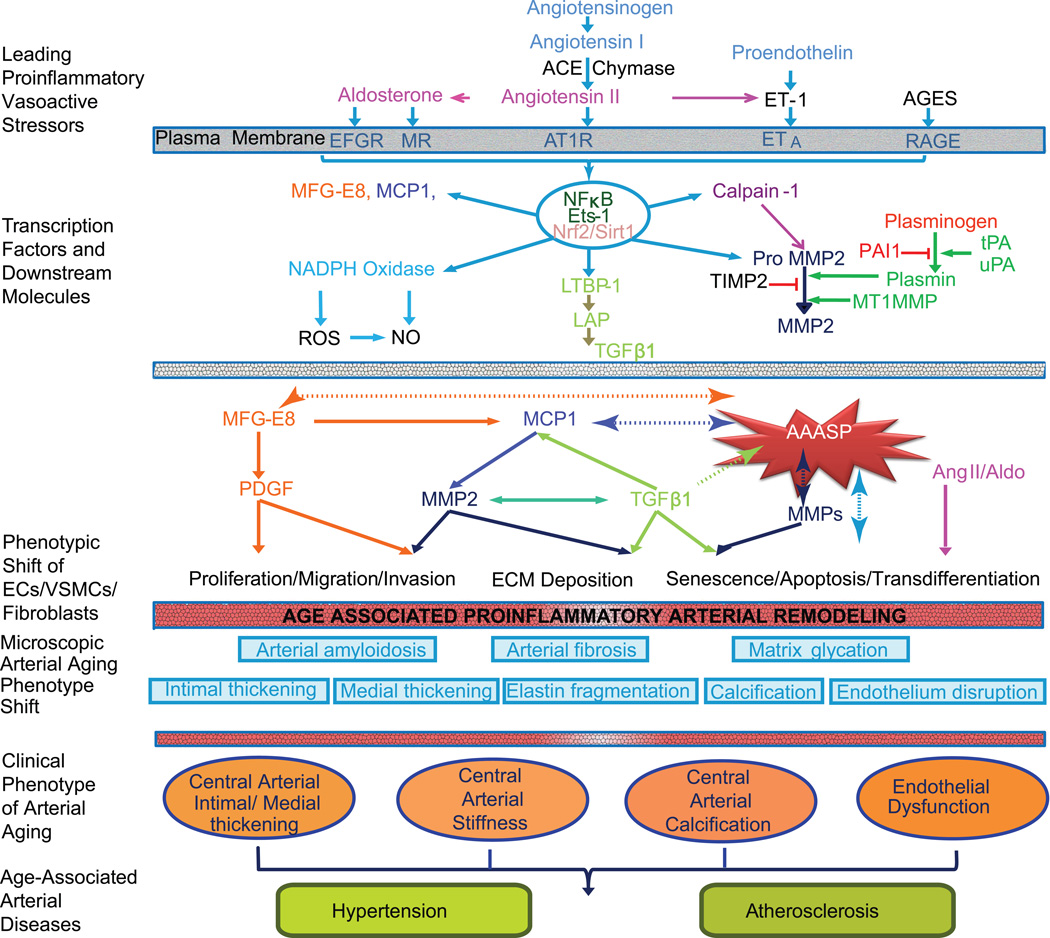
The chronic proinflammatory profile within central arteries with advancing age is characterized by alterations in signaling systems that include Ang II signaling via its receptor AT1, aldosterone/MR, ET-1/ETA signaling. AGEs recruit inflammatory molecules by interaction with their cellular transduction receptor for AGEs (RAGE)
Proinflammatory transcription factors such as nuclear factor NF-κB and Ets-1 are activated within the aging arterial wall, whereas protective factors such as Nrf-2 and Sirt1 are reduced.
Downstream signaling molecules include MFG-E8, MMPs, calpain-1, MCP-1, TGF-β1. Activation of calpain-1, MMPs, TGF-β1, NADPH oxidase increases whereas NO bioavailability decreases with advancing age.
Differences of age-associated arterial secretory phenotype (AAASP) are observed in the cytokine secretion profile of primary VSMCs derived from young and aged nonhuman primates. Compared to young VSMCs, old cells exhibit secretion of increased amounts of MFG-E8, MCP-1, MMP2 and TGF-β1. Concurrent proinflammatory proliferation, migration, secretion, senescence, and extracellular matrix remodeling are characteristic features of ECs, VSMCs, and (myo) fibroblasts within the aged arterial wall.
Microscopic arterial aging changes include: disruption of the endothelium, intima-media thickening, arterial amyloidosis, fibrosis, elastin fracture, matrix glycoxidative modifications, and calcification that are consequences of the enhanced signaling via these receptor signaling cascades.
There is growing evidence that a significant interaction exists between aging and hypertension/atherosclerosis.
Abbreviations and acronyms: Ang II: angiotensin II; ET1: endothelin-1; MMPs: matrix metalloproteases; MCP-1: monocyte chemo-attractant protein-1; CCR2: C-C chemokine receptor type 2; TGF-β1: transforming growth factor β1; TβIIR: TGF beta receptor type II; NADPH oxidase: nicotinamide adenine dinucleotide phosphate-oxidase; NO: nitric oxide; TNFα: tumor necrosis factor alpha; ICAM: intercellular adhesion molecule; MFG-E8: milk fat globule epidermal growth factor-8; PDGF: platelet-derived growth factor; PDGFR: PDGF receptor; tPA: tissue plasminogen activator; uPA-urine plasminogen activator; PAI-1: plasminogen activator inhibitor-1; AGEs: advanced glycation end-products; RAGE: receptor for advanced glycation end-products; IL; inter-leukin; MR: mineral corticoid receptor; NF-κB: nuclear factor kappa-light-chain-enhancer of activated B cells; Ets-1: the v-ets erythroblastosis virus E26 oncogene homolog 1; NrF2: NF-E2-related factor 2; SiT1: silent information regulation 2 homolog 1; EC: endothelial cell; IMT: intima-media thickening; FN: fibronection; VSMC: vascular smooth muscle cell. Modified from reference [3].
References
-
- Go AS, Mozaffarian D, Roger VL, Benjamin EJ, Berry JD, Blaha MJ, Dai S, Ford ES, Fox CS, Franco S, Fullerton HJ, Gillespie C, Hailpern SM, Heit JA, Howard VJ, Huffman MD, Judd SE, Kissela BM, Kittner SJ, Lackland DT, Lichtman JH, Lisabeth LD, Mackey RH, Magid DJ, Marcus GM, Marelli A, Matchar DB, McGuire DK, Mohler ER3rd, Moy CS, Mussolino ME, Neumar RW, Nichol G, Pandey DK, Paynter NP, Reeves MJ, Sorlie PD, Stein J, Towfighi A, Turan TN, Virani SS, Wong ND, Woo D, Turner MB. American Heart Association Statistics Committee and Stroke Statistics Subcommittee. Heart disease and stroke statistics--2014 update: a report from the American Heart Association. Circulation. 2014;129:e28–e292. - PMC - PubMed
Publication types
MeSH terms
Substances
Grants and funding
LinkOut - more resources
Full Text Sources
Other Literature Sources
Medical
