Review
. 2014 Dec;19(12):1964-70.
doi: 10.1016/j.drudis.2014.08.011. Epub 2014 Aug 27.

HCV E2 core structures and mAbs: something is still missing

Affiliations
Review

HCV E2 core structures and mAbs: something is still missing

Matteo Castelli et al. Drug Discov Today. 2014 Dec.

Abstract

The lack of structural information on hepatitis C virus (HCV) surface proteins has so far hampered the development of effective vaccines. Recently, two crystallographic structures have described the core portion (E2c) of E2 surface glycoprotein, the primary mediator of HCV entry. Despite the importance of these studies, the E2 overall structure is still unknown and, most importantly, several biochemical and functional studies are in disagreement with E2c structures. Here, the main literature will be discussed and an alternative disulfide bridge pattern will be proposed, based on unpublished human monoclonal antibody reactivity. A modeling strategy aiming at recapitulating the available structural and functional studies of E2 will also be proposed.


Figures

Figure 1
Figure 1
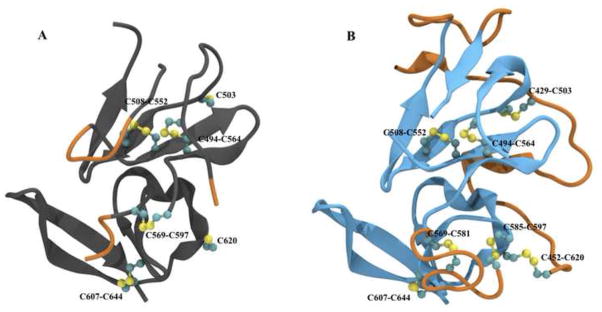
Comparison between 4NX3 and 4MWF E2 crystallographic structures. Shared structures (Ig-like domain and the C-terminal β-sheet) are colored in gray (4NX3) and cyan (4MWF). Orange segments indicate discrepancies between structures. Cysteines are represented in ball-and-stick configuration.
Figure 2
Figure 2
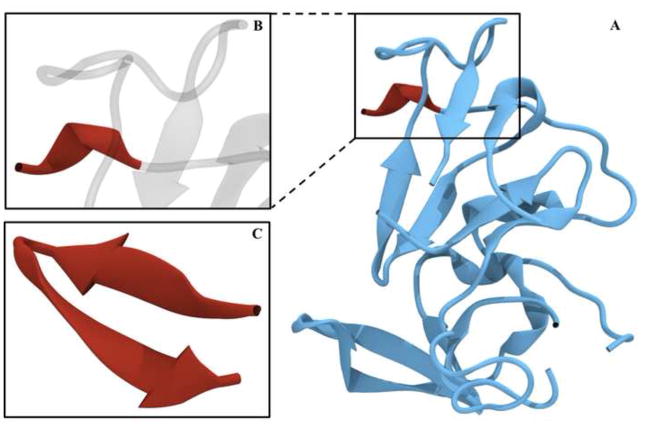
Structural comparison of an E2 segment spanning residues 412–423 in 4MWF and co-crystallized with neutralizing murine mAb AP33 (PDB ID: 4GAJ). (a) The 4MWF structure in cyan, solved portion of residues 412–423 in red. (b) A zoomed in representation of these residues in red, the remaining is transparent. (c) E2 residues 412–423 in 4GAJ structure.
Figure 3
Figure 3
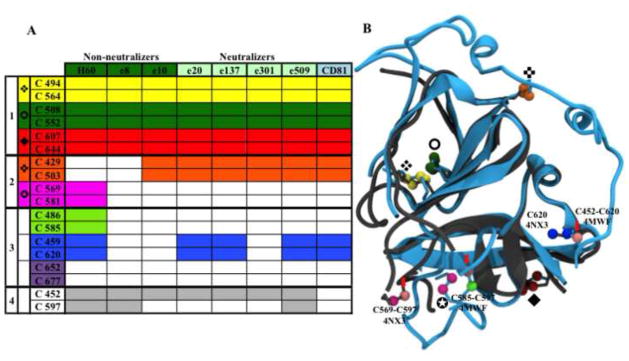
Proposed disulfide bond pairs for E2. (a) Monoclonal antibody (mAb) and CD81 large extracellular loop (LEL) reactivity patterns against C→A mutants of full-length E2 (H77 strain) co-expressed with E1 in human HEK293 cells [31]. Single C→A mutants showing a binding below 30% compared with the wild type (WT) are marked with colored blocks. Cysteine pairs are grouped to highlight (1) disulfide bridges confirmed by 4NX3, 4MWF and mAb binding, (2) disulfide bridges confirmed by 4MWF and mAb binding, (3) disulfide bridges proposed according to mAb reactivity patterns and (4) free cysteines. Disulfide bridges belonging to groups (1) and (2) are marked with different symbols in (a) and (b). (b) 4NX3 (in gray) and 4MWF (in cyan) superimposed structures. Cysteines are colored as in (a); E2c cysteines that are inconsistent with mAb reactivity are reported in light pink, marked with red arrows and labeled. In 4MWF C652 and C677 are outside the crystallized constructs, whereas C459 and C486 are not solved; in 4NX3, C429, C452, C652 and C677 are not included in the construct, whereas C459, C486, C581 and C585 are not solved. Consequently, all of them are not shown in (b).

References

    1. Lavanchy D. Evolving epidemiology of hepatitis C virus. Clin Microbiol Infect. 2011;17:107–115. - PubMed
    1. Delemos AS, Chung RT. Hepatitis C treatment: an incipient therapeutic revolution. Trends Mol Med. 2014;20:315–321. - PubMed
    1. Rose L, et al. Sofosbuvir: a nucleotide NS5B inhibitor for the treatment of chronic hepatitis C infection. Ann Pharmacother. 2014;48:1019–1029. - PubMed
    1. Scheel TK, Rice CM. Understanding the hepatitis C virus life cycle paves the way for highly effective therapies. Nat Med. 2013;19:837–849. - PMC - PubMed
    1. Liu S, et al. Tight junction proteins claudin-1 and occludin control hepatitis C virus entry and are downregulated during infection to prevent superinfection. J Virol. 2009;83:2011–2014. - PMC - PubMed

LinkOut - more resources