Increased blood-oxygen binding affinity in Tibetan and Han Chinese residents at 4200 m
- PMID: 25172885
- PMCID: PMC4272572
- DOI: 10.1113/expphysiol.2014.080820
Increased blood-oxygen binding affinity in Tibetan and Han Chinese residents at 4200 m
Abstract
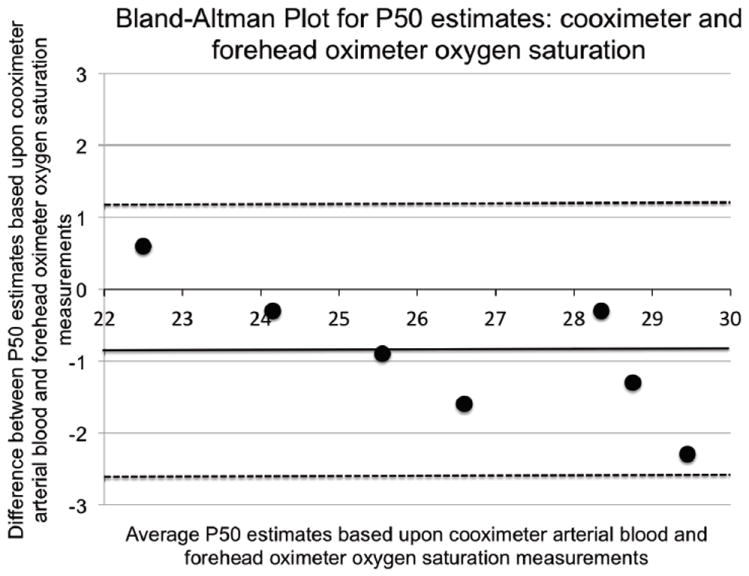
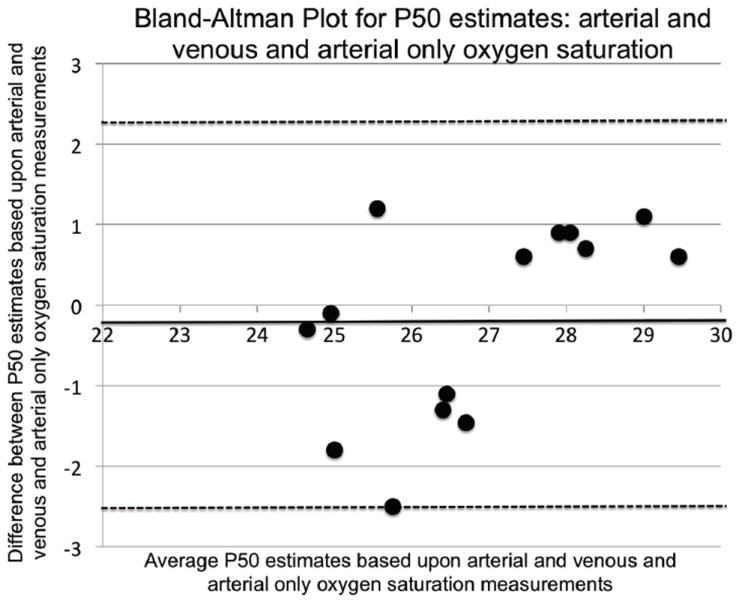
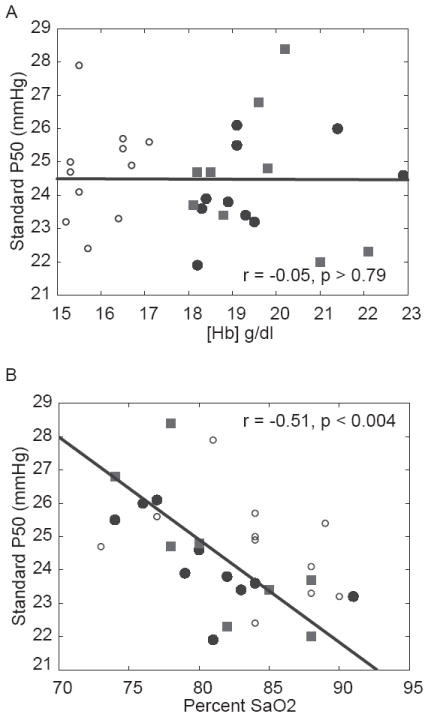
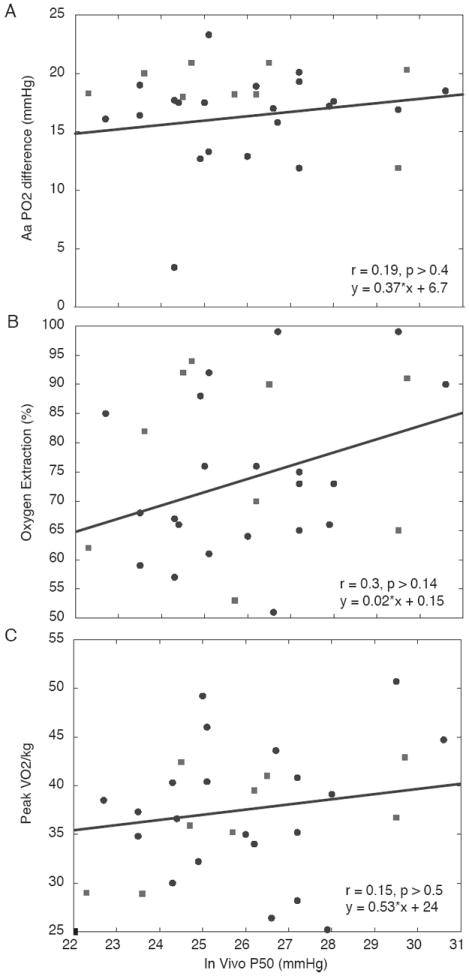
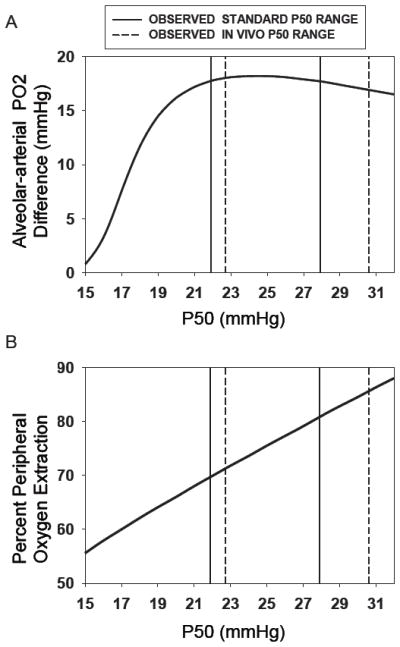
High-altitude natives are challenged by hypoxia, and a potential compensatory mechanism could be reduced blood oxygen-binding affinity (P50), as seen in several high-altitude mammalian species. In 21 Qinghai Tibetan and nine Han Chinese men, all resident at 4200 m, standard P50 was calculated from measurements of arterial PO2 and forehead oximeter oxygen saturation, which was validated in a separate examination of 13 healthy subjects residing at sea level. In both Tibetans and Han Chinese, standard P50 was 24.5 ± 1.4 and 24.5 ± 2.0 mmHg, respectively, and was lower than in the sea-level subjects (26.2 ± 0.6 mmHg, P < 0.01). There was no relationship between P50 and haemoglobin concentration (the latter ranging from 15.2 to 22.9 g dl(-1) in Tibetans). During peak exercise, P50 was not associated with alveolar-arterial PO2 difference or peak O2 uptake per kilogram. There appears to be no apparent benefit of a lower P50 in this adult high-altitude Tibetan population.
© 2014 The Authors. Experimental Physiology © 2014 The Physiological Society.
Figures
Comment in
-
High-altitude adaptation: where Tibetans and Han Chinese agree.Exp Physiol. 2014 Dec 1;99(12):1593-4. doi: 10.1113/expphysiol.2014.082677. Exp Physiol. 2014. PMID: 25447687 No abstract available.
-
Oxygen dissociation curves in altitude and sea-level residents.Exp Physiol. 2015 Mar;100(3):341. doi: 10.1113/EP085007. Exp Physiol. 2015. PMID: 25720664 No abstract available.
-
Reply: To PMID 25172885.Exp Physiol. 2015 Mar;100(3):342. doi: 10.1113/EP085032. Exp Physiol. 2015. PMID: 25720665 No abstract available.
References
-
- Adams WH, Graves IL, Pyakural S. Hematologic observations on the yak. Proc Soc Exp Biol Med. 1975;148:701–705. - PubMed
-
- Beall CM, Cavalleri GL, Deng L, Elston RC, Gao Y, Knight J, Li C, Li JC, Liang Y, McCormack M, Montgomery HE, Pan H, Robbins PA, Shianna KV, Tam SC, Tsering N, Veeramah KR, Wang W, Wangdui P, Weale ME, Xu Y, Xu Z, Yang L, Zaman MJ, Zeng C, Zhang L, Zhang X, Zhaxi P, Zheng YT. Natural selection on EPAS1 (HIF2alpha) associated with low hemoglobin concentration in Tibetan highlanders. Proc Natl Acad Sci U S A. 2010;107:11459–11464. - PMC - PubMed
-
- Bland JM, Altman DG. Statistical methods for assessing agreement between two methods of clinical measurement. Lancet. 1986;1(8476):307–310. - PubMed
-
- Brutsaert TD. Do high-altitude natives have enhanced exercise performance at altitude? Appl Physiol Nutr Metab. 2008;33:582–592. - PubMed
-
- Eaton JW, Skelton TD, Berger E. Survival at extreme altitude: protective effect of increased hemoglobin-oxygen affinity. Science. 1974;183:743–744. - PubMed
Publication types
MeSH terms
Substances
Grants and funding
LinkOut - more resources
Full Text Sources
Other Literature Sources
Research Materials