


Surgical intervention versus expectant management for endometrial polyps in subfertile women
- PMID: 25172985
- PMCID: PMC6544777
- DOI: 10.1002/14651858.CD009592.pub2
Surgical intervention versus expectant management for endometrial polyps in subfertile women
Abstract
Background: Endometrial polyps, which are benign growths of the endometrium, may be a factor in female subfertility. Possible mechanisms include physical interference with gamete transport, alteration of the endometrial milieu and unresponsiveness to the cyclical global endometrial changes. As such polyps remain mostly asymptomatic, their diagnosis is often incidental during routine investigations prior to embarking on assisted reproductive treatment. Transvaginal sonography, hysterosalpingography and saline infusion sonography are the diagnostic tools most commonly employed. However, hysteroscopy remains the gold standard for diagnosis, as well as for treatment. Due to the possible effect of endometrial polyps on fertility, their removal prior to any subfertility treatment is widely practiced.
Objectives: To determine the effectiveness and safety of removal of endometrial polyps in subfertile women.
Search methods: Electronic databases were searched, including the Cochrane Menstrual Disorders and Subfertility Group Specialised Register, the Cochrane Central Register of Controlled Trials (CENTRAL), MEDLINE, EMBASE, PsycINFO, CINAHL and trial registers. The reference lists of identified articles were checked. The last search was performed on 30 July 2014.
Selection criteria: Only randomised controlled trials, reporting pregnancy or live birth rates and complication rates as primary or secondary outcomes, in which polyps were removed surgically prior to treatment of subfertility were eligible for inclusion. The diagnosis of endometrial polyps was required to be made by transvaginal ultrasound, hysterosalpingography, saline infusion, sono-hysterography or hysteroscopy. Any surgical technique of polyp removal was acceptable, with no intervention in the control groups.
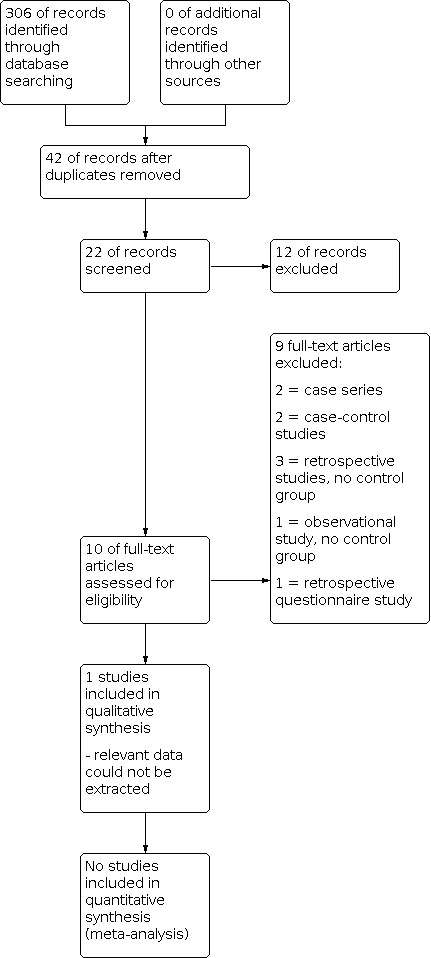
Data collection and analysis: Two review authors independently screened the titles, abstracts and full articles to assess their suitability for inclusion in this review. Quality assessment was attempted independently by two authors with discrepancies being settled by consensus or consultation with a third review author.No data extraction was performed due to the absence of useable data in the one eligible study. If there had been data to include, two review authors would have independently extracted the data from the studies using a data extraction form designed and pilot tested by the authors. Any disagreements would have been resolved by discussion or by a third review author.
Main results: Only one randomised controlled trial of endometrial polypectomy was identified for inclusion. However, a single set of data could not be extracted from this study due to internal inconsistencies of the results reported. Attempts to contact the authors to resolve the issue were unsuccessful, by phone, post and e-mail.
Authors' conclusions: Removal of endometrial polyps in subfertile women is commonly being performed in many countries with an aim to improve the reproductive outcome. We did not identify any analysable randomised trials which would allow us to reach any sound scientific conclusions on the efficacy of endometrial polypectomy in subfertile women. Well designed, methodologically sound, randomised controlled trials are urgently needed.
Conflict of interest statement
The authors have no commercial interest to disclose.
Figures
Update of
References
References to studies included in this review
Perez‐Medina 2005 {published data only}
-
- Pérez-Medina T, Bajo-Arenas J, Salazar F, Redondo T, Sanfrutos L, Alvarez P, Engels V. Endometrial polyps and their implication in the pregnancy rates of patients undergoing intrauterine insemination. Human Reproduction June 2005;20(6):1632-5. - PubMed
References to studies excluded from this review
Batioglu 2005 {published data only}
-
- Batioglu S, Kaymak O. Does hysteroscopic polypectomy without cycle cancellation affect IVF? Reproductive Biomedicine Online Jun 2005;10(6):767-9. - PubMed
Isikoglu 2006 {published data only}
-
- Isikoglu M, Berkkanoglu M, Senturk Z, Coetzee K, Ozgur K. Endometrial polyps smaller than 1.5 cm do not affect ICSI outcome. Reproductive Biomedicine Online Feb 2006;12(2):199-204. - PubMed
Lass 1999 {published data only}
Madani 2009 {published data only}
-
- Madani T, Ghaffari F, Kiani K, Hosseini F. Hysteroscopic polypectomy without cycle cancellation in IVF cycles. Reproductive Biomedicine Online Mar 2009;18(3):412-5. - PubMed
Spiewankiewicz 2003 {published data only}
-
- Spiewankiewicz B, Stelmachów J, Sawicki W, Cendrowski K, Wypych P, Swiderska K. The effectiveness of hysteroscopic polypectomy in cases of female infertility. Clinical and Experimental Obstetrics & Gynecology 2003;30(1):23-5. - PubMed
Stamatellos 2008 {published data only}
-
- Stamatellos I, Apostolides A, Stamatopoulos P, Bontis J. Pregnancy rates after hysteroscopic polypectomy depending on the size or number of the polyps. Archives of Gynecology and Obstetrics May 2008;277(5):395-9. - PubMed
Valle 1984 {published data only}
-
- Valle RF. Therapeutic hysteroscopy in infertility. International Journal of Fertility 1984;29(3):143-8. - PubMed
Varasteh 1999 {published data only}
-
- Varasteh NN, Neuwirth RS, Levin B, Keltz MD. Pregnancy rates after hysteroscopic polypectomy and myomectomy in infertile women. Obstetrics and Gynecology Aug 1999;94(2):168-71. - PubMed
Yanaihara 2008 {published data only}
-
- Yanaihara A, Yorimitsu T, Motoyama H, Iwasaki S, Kawamura T. Location of endometrial polyp and pregnancy rate in infertility patients. Fertility and Sterility Jul 2008;90(1):180-2. - PubMed
Additional references
Afifi 2010
-
- Afifi K, Anand S, Nallapeta S, Gelbaya TA. Management of endometrial polyps in subfertile women: a systematic review. European Journal of Obstetrics, Gynecology, and Reproductive Biology 2010;151:117-21. - PubMed
Ben‐Nagi 2009
-
- Ben-Nagi J, Miell J, Yazbek J, Holland T, Jurkovic D. The effect of hysteroscopic polypectomy on the concentrations of endometrial implantation factors in uterine flushings. Reproductive BioMedicine Online 2009;19:737-44. - PubMed
de Sa Rosa e de Silva 2005
-
- Sa Rosa e de Silva AC, Rosa e Silva JC, Candido dos Reis FJ, Nogueira AA, Ferriani RA. Routine office hysteroscopy in the investigation of infertile couples before assisted reproduction. Journal of Reproductive Medicine 2005;50:501-6. - PubMed
Kim 2003
-
- Kim MR, Kim YA, Jo MY, Hwang KJ, Ryu HS. High frequency of endometrial polyps in endometriosis. The Journal of the American Association of Gynecologic Laparoscopists 2003;10:46-8. - PubMed
Lopez 2007
-
- Lopes RG, Baracat EC, Albuquerque Neto LC, Ramos JF, Yatabe S, Depesr DB, Lippi UG. Analysis of estrogen- and progesterone-receptor expression in endometrial polyps. Journal of Minimally Invasive Gynecology 2007;14:300-3. - PubMed
Mittal 1996
-
- Mittal K, Schwartz L, Goswami S, Demopoulos R. Estrogen and progesterone receptor expression in endometrial polyps. International Journal of Gynecological Pathology 1996;15:345-8. - PubMed
Nastri 2012
-
- Nastri CO, Gibreel A, Raine-Fenning N, Maheshwari A, Ferriani RA, Bhattacharya S, Martins WP. Endometrial injury in women undergoing assisted reproductive techniques. Cochrane Database of Systematic Reviews 11.07.2012;7:CD009517. doi: 10.1002/14651858.CD009517.pub2.. - PubMed
Richlin 2002
-
- Richlin SS, Ramachandran S, Shanti A, Murphy AA, Parthasarathy S. Glycodelin levels in uterine flushings and in plasma of patients with leiomyomas and polyps: implications for implantation. Human Reproduction 2002;17:2742-7. - PubMed
Spiewankiewicz 2003
-
- Spiewankiewicz B, Stelmachow J, Sawicki W, Cendrowski K, Wypych P, Swiderska K. The effectiveness of hysteroscopic polypectomy in cases of female infertility. Clinical and Experimental Obstetrics & Gynecology 2003;30:23-5. - PubMed
Taylor 2008
-
- Taylor E, Gomel V. The uterus and fertility. Fertility and Sterility 2008;89:1-16. - PubMed
Publication types
MeSH terms
LinkOut - more resources
Full Text Sources
Other Literature Sources
Medical
Research Materials
