


Comparison of David V valve-sparing root replacement and bioprosthetic valve conduit for aortic root aneurysm
- PMID: 25173127
- PMCID: PMC4433158
- DOI: 10.1016/j.jtcvs.2014.05.092
Comparison of David V valve-sparing root replacement and bioprosthetic valve conduit for aortic root aneurysm
Abstract
Objective: Valve sparing root replacement (VSRR) is an attractive option for the management of aortic root aneurysms with a normal native aortic valve. Therefore, we reviewed our experience with a modification of the David V VSRR and compared it with stented pericardial bioprosthetic valve conduit (BVC) root replacement in an age-matched cohort of older patients.
Methods: A total of 48 VSRRs were performed at our institution, excluding those on bicuspid aortic valves. We compared these cases with 15 aortic root replacements performed using a BVC during the same period. Subgroup analysis was performed comparing 16 VSRR cases and 15 age-matched BVC cases.
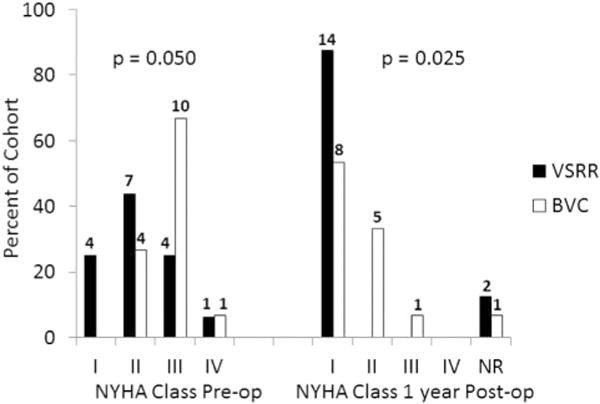
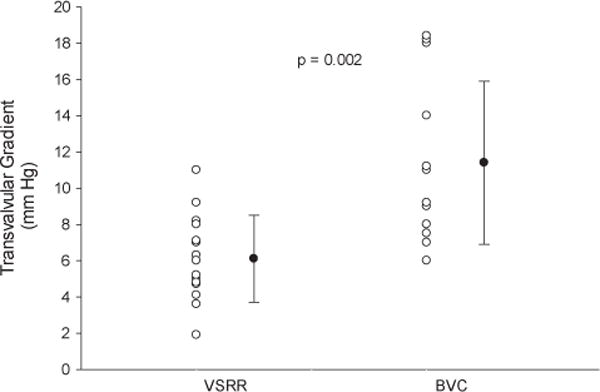
Results: The greatest disparity between the VSRR and BVC groups was age (53 vs 69 years, respectively; P < .0005). The matched patients were similar in terms of baseline demographics and differed only in concomitant coronary artery bypass grafting (2 VSRR vs 7 BVC patients; P = .036). None of the VSRR and 3 of the BVC procedures were performed for associated dissection (P = .101). Postoperative aortic insufficiency grade was significantly different between the 2 groups (P = .004). The cardiopulmonary bypass, crossclamp, and circulatory arrest times were not different between the VSRR and BVC groups (174 vs 187 minutes, P = .205; 128 vs 133 minutes, P = .376; and 10 vs 13 minutes, respectively; P = .175). No differences were found between the 2 groups with respect to postoperative complications. One postoperative death occurred in the BVC group and none in the VSRR group. The postoperative length of stay and aortic valve gradients were less in the VSRR group (6 vs 8 days, P = .038; 6 vs 11.4 mm Hg, P = .001). The intensive care unit length of stay was significantly less in the VSRR group (54 vs 110 hours, P = .001).
Conclusions: VSRR is an effective alternative to the BVC for aortic root aneurysm.
Copyright © 2014 The American Association for Thoracic Surgery. Published by Elsevier Inc. All rights reserved.
Figures
References
-
- Wheat MW, Jr, Boruchow IB, Ramsey HW. Surgical treatment of aneurysms of the aortic root. Ann Thorac Surg. 1971;12:593–607. - PubMed
-
- David TE, Feindel CM. An aortic valve-sparing operation for patients with aortic incompetence and aneurysm of the ascending aorta. J Thorac Cardiovasc Surg. 1992;103:617–21. - PubMed
-
- Sarsam MA, Yacoub M. Remodeling of the aortic valve annulus. J Thorac Cardiovasc Surg. 1993;105:435–8. - PubMed
-
- David TE. Aortic root aneurysms: remodeling or composite replacement? Ann Thorac Surg. 1997;64:1564–8. - PubMed
Publication types
MeSH terms
Grants and funding
LinkOut - more resources
Full Text Sources
Other Literature Sources
Medical
