


Efficacy of nasal mometasone for the treatment of chronic sinonasal disease in patients with inadequately controlled asthma
- PMID: 25174863
- PMCID: PMC4344935
- DOI: 10.1016/j.jaci.2014.06.038
Efficacy of nasal mometasone for the treatment of chronic sinonasal disease in patients with inadequately controlled asthma
Abstract
Background: Chronic sinonasal disease is common in asthmatic patients and associated with poor asthma control; however, there are no long-term trials addressing whether chronic treatment of sinonasal disease improves asthma control.
Objective: We sought to determine whether treatment of chronic sinonasal disease with nasal corticosteroids improves asthma control, as measured by the Childhood Asthma Control Test and Asthma Control Test in children and adults, respectively.
Methods: A 24-week multicenter, randomized, placebo-controlled, double-blind trial of placebo versus nasal mometasone in adults and children with inadequately controlled asthma was performed. Treatments were randomly assigned, with concealment of allocation.
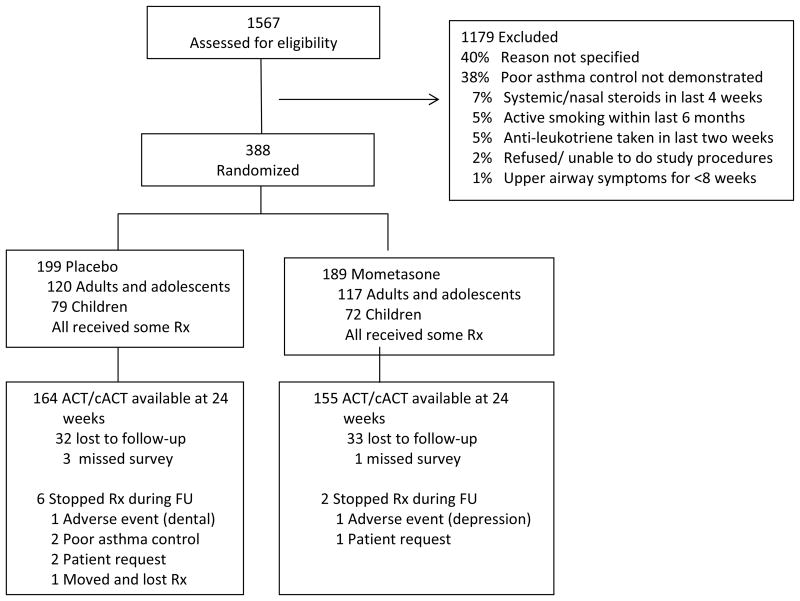
Results: Two hundred thirty-seven adults and 151 children were randomized to nasal mometasone versus placebo, and 319 participants completed the study. There was no difference in the Childhood Asthma Control Test score (difference in change with mometasone - change with placebo [ΔM - ΔP], -0.38; 95% CI, -2.19 to 1.44; P = .68; age 6-11 years) or the Asthma Control Test score (ΔM - ΔP, 0.51; 95% CI, -0.46 to 1.48; P = .30; age ≥12 years) in those assigned to mometasone versus placebo. In children and adolescents (age 6-17 years) there was no difference in asthma or sinus symptoms but a decrease in episodes of poorly controlled asthma defined by a decrease in peak flow. In adults there was a small difference in asthma symptoms measured by using the Asthma Symptom Utility Index (ΔM - ΔP, 0.06; 95% CI, 0.01 to 0.11; P < .01) and in nasal symptoms (sinus symptom score ΔM - ΔP, -3.82; 95% CI, -7.19 to -0.45; P = .03) but no difference in asthma quality of life, lung function, or episodes of poorly controlled asthma in adults assigned to mometasone versus placebo.
Conclusions: Treatment of chronic sinonasal disease with nasal corticosteroids for 24 weeks does not improve asthma control. Treatment of sinonasal disease in asthmatic patients should be determined by the need to treat sinonasal disease rather than to improve asthma control.
Keywords: Asthma; asthma control; asthma exacerbation; lung function; rhinitis; sinonasal; sinusitis.
Copyright © 2014 American Academy of Allergy, Asthma & Immunology. Published by Elsevier Inc. All rights reserved.
Figures
Comment in
-
Will a nasal corticosteroid improve control for patients with step 3 or higher persistent asthma?J Allergy Clin Immunol. 2015 Mar;135(3):710-1. doi: 10.1016/j.jaci.2014.12.1910. Epub 2015 Jan 25. J Allergy Clin Immunol. 2015. PMID: 25630938 No abstract available.
-
Reply: To PMID 25174863.J Allergy Clin Immunol. 2015 Jul;136(1):212-3. doi: 10.1016/j.jaci.2015.04.003. Epub 2015 May 8. J Allergy Clin Immunol. 2015. PMID: 25959669 Free PMC article. No abstract available.
-
Nasal endoscopy to characterize sinonasal disease.J Allergy Clin Immunol. 2015 Jul;136(1):212. doi: 10.1016/j.jaci.2015.04.004. Epub 2015 May 8. J Allergy Clin Immunol. 2015. PMID: 25959672 No abstract available.
References
-
- Thomas M, Kocevar VS, Zhang Q, et al. Asthma-related health care resource use among asthmatic children with and without concomitant allergic rhinitis. Pediatrics. 2005;115:129–134. - PubMed
-
- Sazonov Kocevar V, Thomas J, 3rd, Jonsson L, et al. Association between allergic rhinitis and hospital resource use among asthmatic children in Norway. Allergy. 2005;60:338–342. - PubMed
-
- Bousquet J, Boushey HA, Busse WW, et al. Characteristics of patients with seasonal allergic rhinitis and concomitant asthma. Clin Exp Allergy. 2004;34:897–903. - PubMed
-
- ten Brinke A, Grootendorst DC, Schmidt JT, et al. Chronic sinusitis in severe asthma is related to sputum eosinophilia. J Allergy Clin Immunol. 2002;109:621–626. - PubMed
-
- Bresciani M, Paradis L, Des Roches A, et al. Rhinosinusitis in severe asthma. J Allergy Clin Immunol. 2001;107:73–80. - PubMed
Publication types
MeSH terms
Substances
Grants and funding
LinkOut - more resources
Full Text Sources
Other Literature Sources
Medical
