. 2014 Oct;47(5):427-34.
doi: 10.1111/cpr.12129. Epub 2014 Sep 1.

Overexpression of metadherin mediates metastasis of osteosarcoma by regulating epithelial-mesenchymal transition

Affiliations

Overexpression of metadherin mediates metastasis of osteosarcoma by regulating epithelial-mesenchymal transition

J Tang et al. Cell Prolif. 2014 Oct.

Abstract

Objectives: Osteosarcoma (OS) is one of the most common primary malignant bone tumours of childhood and adolescence, and is characterized by high propensity for metastasis (specially to the lung), which is the main cause of death. However, molecular mechanisms underlying metastasis of OS are still poorly understood.

Materials and methods: Metadherin (MTDH) was identified to be significantly upregulated in OS tissues that had metastasized compared to OS without metastasis, using a two-dimensional approach of electrophoresis, coupled with mass spectrometry. To understand the function of MTDH in OS, OS cell lines U2OS and SOSP-M were transfected with retroviral shRNA vector against MTDH.

Results: It was found that metastatic propensity as well as cell proliferation were significantly reduced in both U2OS and SOSP-M. Migration and invasion of U2OS and SOSP-M cells were significantly lower after knock-down of MTDH. In addition, epithelial-mesenchymal transition (EMT) was reduced after knock-down of MTDH. Clinicopathologically, overexpression of MTDH was significantly associated with metastasis and poor survival of patients with OS.

Conclusion: Taken together, our results demonstrate that MTDH mediated metastasis of OS through regulating EMT. This could be an ideal therapeutic target against metastasis of OS.


Conflict of interest statement

The authors declare that there are no conflicts of interest.

Figures
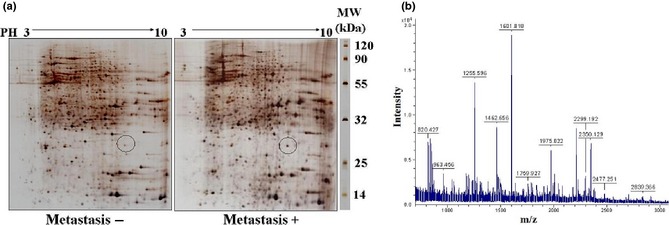
Figure 1
Figure 1
Differential upregulation of proteins in osteosarcoma ( OS ) tissues between metastasis and non‐metastasis using the proteomics approach. (a) Representative images of 2‐D gel for OS with metastasis to lung (M+) and non‐metastasis (M−). Isoelectric focusing at pH 3–10 was carried out at first dimension electrophoresis using 18 cm immobilized pH gradient (IPG) strips with higher loading of proteins. Differential spots between M+ and M− labelled with a circle. (b) Mass spectrum of metadherin (MTDH) generated from digested peptides of 2‐DE spot no. 1, identified by mass spectrometry and peptide mass fingerprinting.
Figure 2
Figure 2
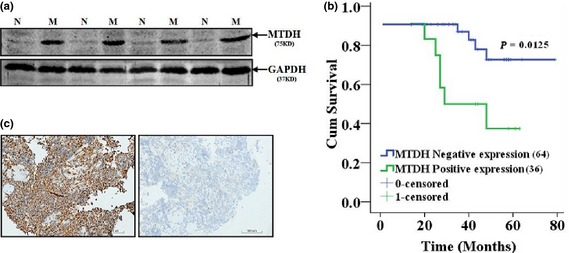
Confirmation of expression of metadherin ( MTDH ) in osteosarcoma ( OS ) tissues with metastasis ( M ) and non‐metastasis ( N ). (a) Confirmation of MTDH in fresh OS tissues with metastasis and without metastasis using immunoblotting method. (b) Confirmation of MTDH using immunohistochemistry method. (c) Survival analysis using Kaplan–Meier curve in 102 cases of OS.
Figure 3
Figure 3
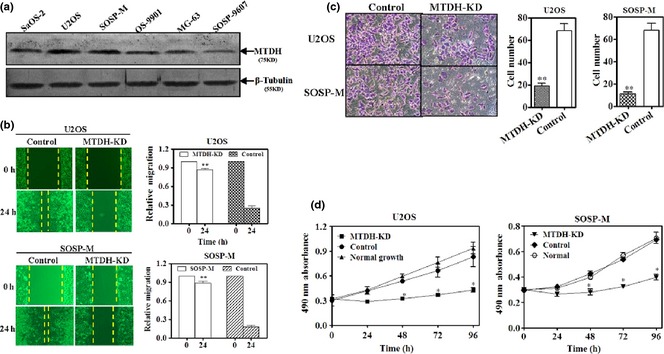
Metadherin ( MTDH ) promoted migration, invasion and proliferation of osteosarcoma ( OS ) cell lines. (a) Endogenous expression of MTDH in a panel of OS cell lines was detected using immunoblotting. β‐tubulin, loading control. Total protein of 80 μg was loaded per lane, separated by 10% SDSPAGE, followed by visualization with WesternBreeze kit (Invitrogen, USA). (b) Wound‐healing assay for U2OS and SOSP‐M after knock‐down of MTDH using retroviral shRNA vector transfection for 24 h. Left – qualification assay, right – quantification assay of wound‐healing. (c) Transwell assays for U2OS and SOSP‐M after knock‐down of MTDH using retroviral shRNA vector transfection for 48 h. Left – qualification assay, right – quantification assay of transwell. (d) MTT assay for U2OS and SOSP‐M after knock‐down of MTDH using retroviral shRNA vector transfection for 0, 24, 48, 72 and 96 h (**P < 0.01, *P < 0.05, independent Student's t‐test or one‐way ANOVA analysis).
Figure 4
Figure 4
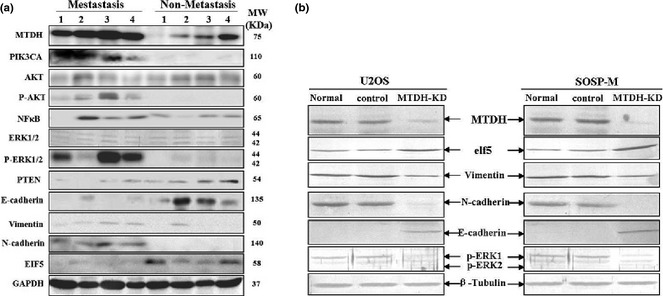
Metadherin ( MTDH ) promoted metastasis via epithelial–mesenchymal transition ( EMT ). (a) Canonical markers of EMT as well as ERK signalling pathway were assayed using immuoblotting in four cases of metastasis and non‐metastasis osteosarcoma (OS) tissues. (b) In parallel, markers of EMT as well as ERK signalling pathway were assayed using immuoblotting in U2OS and SOSP‐M cells after knock‐down of MTDH by retroviral shRNA vector transfection for 72 h. GAPDH and β‐tubulin – loading control. Total protein of 80 μg was loaded per lane, separated by 10% SDSPAGE, followed by visualization with WesternBreeze kit (Invitrogen, USA) and with enhanced chemiluminescence plus (Amersham Pharmacia Biotech, Piscataway, NJ, USA).

References

    1. Long XH, Mao JH, Peng AF, Zhou Y, Huang SH, Liu ZL (2013) Tumor suppressive microRNA‐424 inhibits osteosarcoma cell migration and invasion via targeting fatty acid synthase. Exp. Ther. Med. 5, 1048–1052. - PMC - PubMed
    1. Mao J, Niu M, Yang M, Zhang L, Xi Y (2013) Role of relaxin‐2 in human primary osteosarcoma. Cancer Cell Int. 13, 59. - PMC - PubMed
    1. Hegyi M, Semsei AF, Jakab Z, Antal I, Kiss J et al (2011) Good prognosis of localized osteosarcoma in young patients treated with limb‐salvage surgery and chemotherapy. Pediatr. Blood Cancer 57, 415–422. - PubMed
    1. Hanahan D, Weinberg RA (2011) Hallmarks of cancer: the next generation. Cell 144, 646–674. - PubMed
    1. Lu X, Kang Y (2007) Organotropism of breast cancer metastasis. J. Mammary Gland Biol. Neoplasia 12, 153–162. - PubMed

MeSH terms