Review
. 2014 Sep;31(3):227-34.
doi: 10.1055/s-0034-1382789.

Percutaneous Portosystemic Shunts: TIPS and Beyond

Affiliations
Review

Percutaneous Portosystemic Shunts: TIPS and Beyond

Leigh C Casadaban et al. Semin Intervent Radiol. 2014 Sep.

Abstract

Percutaneous interventions for portal hypertension have been available since the 1990s. Over time, improved technology-including covered stent grafts-and clinical understanding has expanded the available procedures for percutaneous portal decompression. While transjugular intrahepatic portosystemic shunt creation is the most commonly cited percutaneous intervention, direct intrahepatic portocaval shunt and percutaneous mesocaval shunt creation are important alternatives with specific advantages and applications. This article reviews contemporary, minimally invasive interventional approaches to percutaneous portosystemic shunt creation in terms of procedure rationale, patient selection, interventional technique, and technical outcomes.

Keywords: direct intrahepatic portocaval shunt; interventional radiology; mesocaval shunt; percutaneous; transjugular intrahepatic portosystemic shunt.


Conflict of interest statement

Financial Support, Disclosures, and Conflicts of Interest None.

Figures

Figure 1
Figure 1
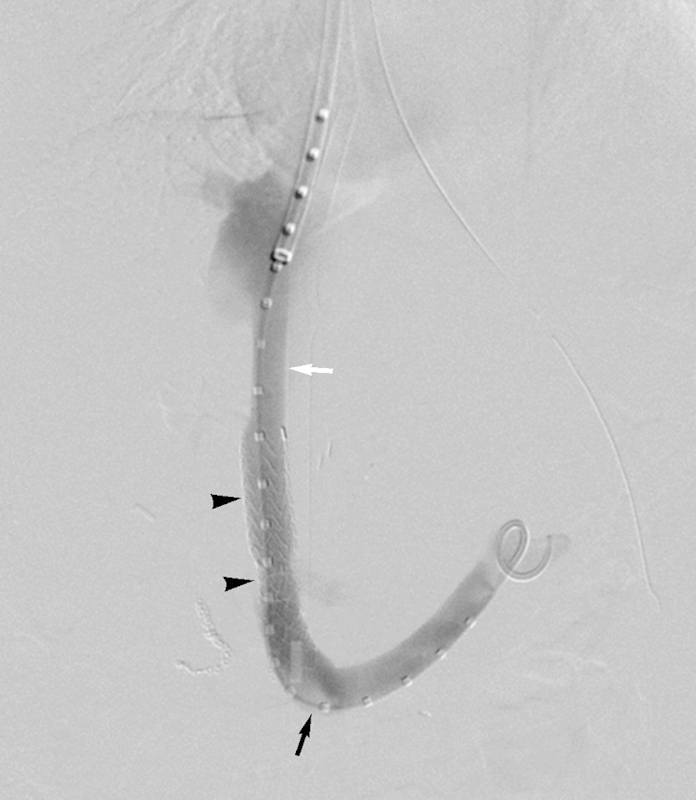
Representative TIPS created in a 49-year-old woman with intractable ascites. Post-TIPS venogram displays covered stent graft lined hepatic intraparenchymal shunt (arrowheads) extending from right portal vein (black arrow) to confluence of right hepatic vein and IVC (white arrow). IVC, inferior vena cava; TIPS, transjugular intrahepatic portosystemic shunt.
Figure 2
Figure 2
DIPS created in a 46-year-old man with variceal hemorrhage. Final venogram shows covered stent graft lined shunt (arrowheads) within liver caudate lobe, which spans from main portal vein (black arrow) to IVC (white arrow) (case courtesy of John D. Louie, MD, and Rajesh P. Shah, MD, Division of Interventional Radiology, Department of Radiology, Stanford University Medical Center). DIPS, direct intrahepatic portocaval shunt; IVC, inferior vena cava.
Figure 3
Figure 3
Percutaneous mesocaval shunt created in a 9-year-old girl with biliary atresia status postliver transplant complicated by portal vein thrombosis and development of varices. Completion venogram demonstrates covered stent graft lined intraperitoneal shunt (arrowheads), which crosses from confluence of SMV and splenic vein (black arrow) to IVC (white arrow) (case courtesy of John D. Louie, MD, and Rajesh P. Shah, MD, Division of Interventional Radiology, Department of Radiology, Stanford University Medical Center). IVC, inferior vena cava; SMV, superior mesenteric vein.

References

    1. Jenkins R L, Gedaly R, Pomposelli J J, Pomfret E A, Gordon F, Lewis W D. Distal splenorenal shunt: role, indications, and utility in the era of liver transplantation. Arch Surg. 1999;134(4):416–420. - PubMed
    1. Sarfeh I J, Rypins E B. Partial versus total portacaval shunt in alcoholic cirrhosis. Results of a prospective, randomized clinical trial. Ann Surg. 1994;219(4):353–361. - PMC - PubMed
    1. Orozco H, Mercado M A, Granados Garcia J. et al.Selective shunts for portal hypertension: current role of a 21-year experience. Liver Transpl Surg. 1997;3(5):475–480. - PubMed
    1. Hermann R E Henderson J M Vogt D P Mayes J T Geisinger M A Agnor C Fifty years of surgery for portal hypertension at the Cleveland Clinic Foundation. Lessons and prospects Ann Surg 19952215459–466., discussion 466–468 - PMC - PubMed
    1. Henderson J M, Nagle A, Curtas S, Geisinger M, Barnes D. Surgical shunts and TIPS for variceal decompression in the 1990s. Surgery. 2000;128(4):540–547. - PubMed