Review
. 2014 Aug 15:5:263.
doi: 10.3389/fgene.2014.00263. eCollection 2014.

Toward a systems-level view of dynamic phosphorylation networks

Affiliations
Review

Toward a systems-level view of dynamic phosphorylation networks

Robert H Newman et al. Front Genet. .

Abstract

To better understand how cells sense and respond to their environment, it is important to understand the organization and regulation of the phosphorylation networks that underlie most cellular signal transduction pathways. These networks, which are composed of protein kinases, protein phosphatases and their respective cellular targets, are highly dynamic. Importantly, to achieve signaling specificity, phosphorylation networks must be regulated at several levels, including at the level of protein expression, substrate recognition, and spatiotemporal modulation of enzymatic activity. Here, we briefly summarize some of the traditional methods used to study the phosphorylation status of cellular proteins before focusing our attention on several recent technological advances, such as protein microarrays, quantitative mass spectrometry, and genetically-targetable fluorescent biosensors, that are offering new insights into the organization and regulation of cellular phosphorylation networks. Together, these approaches promise to lead to a systems-level view of dynamic phosphorylation networks.

Keywords: cell signaling and regulation; fluorescent biosensors; kinase-substrate relationship; phosphoproteomics; protein microarrays; protein phosphorylation networks; quantitative mass spectrometry; systems biology.


Figures
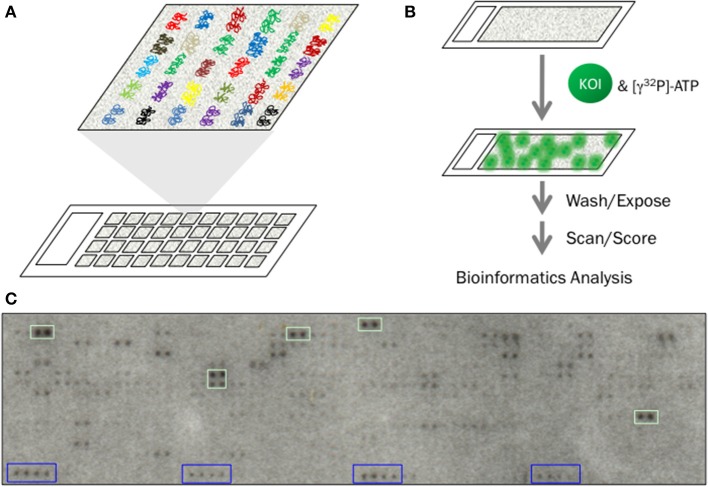
Figure 1
Figure 1
Identification of KSRs using functional protein microarrays. (A) Functional protein microarrays are composed of thousands of purified proteins immobilized on a functionalized glass surface. Each protein is printed in duplicate and in a defined location on the array. (B) Basic workflow for a phosphorylation assay using functional protein microarrays. Individual microarrays are first blocked and then incubated with the kinase-of-interest (KOI) in the presence of [γ32P]-ATP. Following incubation, the microarrays are washed extensively to remove unincorporated [γ32P]-ATP, dried and exposed to high-resolution X-ray film. Autoradiograms are then scanned and scored before being subjected to bioinformatics analysis to identify those KSRs that are likely to occur inside the cell. (C) Autoradiogram from a typical phosphorylation assay. Duplicate spots that each exhibit a normalized signal intensity 3 SD above the mean (green boxes) are considered positive hits. General kinase substrates, such as histone H3 and H4, printed in each block (blue boxes) are used as landmarks to orient the grid during scoring.
Figure 2
Figure 2
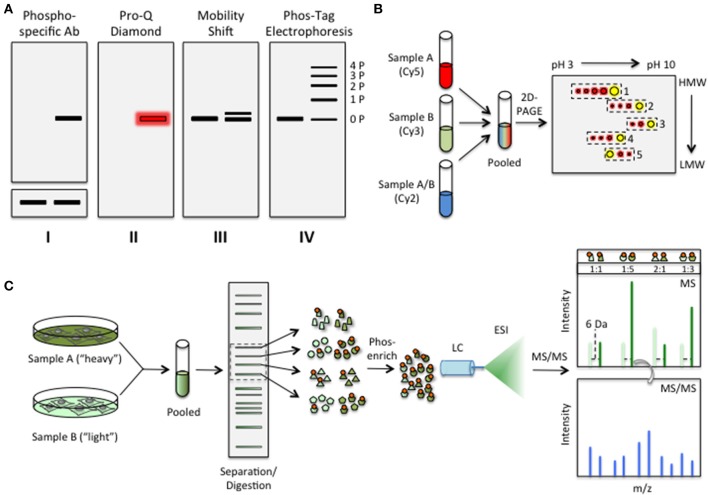
“Top-down” approaches to assess changes in the phosphorylation status of cellular proteins. (A) Approaches based on 1D PAGE. I Western blot analysis using an antibody that specifically recognizes a particular phosphosite. To account for phosphorylation-dependent changes in protein stability, the signal must be normalized to that obtained using an antibody that recognizes the unphosphorylated form of the protein-of-interest (below); II Detection using a general phosphorylation detection reagent, such as Pro-Q Diamond or the Phos-Tag phospho-chelator; III Phosphorylation of some proteins can be assessed based on changes in their electrophoretic mobility through a standard SDS-PAGE gel; IV Phos-Tag electrophoresis allows detection of a wide range of phosphorylation events, often resulting in a ladder corresponding to multiply phosphorylated species (1P, 2P, 3P, etc.). (B) Approaches based on 2D-PAGE. The general workflow of a 2D-DIGE experiment is shown. Accordingly, lysates from treated (Sample A) or untreated (Sample B) cells are first labeled with size- and charge-matched fluorescent dyes, such as Cy3 and Cy5, before being pooled together. A third sample, composed of both lysates labeled with a third dye (e.g., Cy2), may also be included as an internal reference. The pooled samples are then resolved on a 2D-PAGE gel, which generally uses IEF in the first dimension to separate cellular proteins based on their pI's followed by SDS-PAGE in the second dimension to separate the proteins based on size (HMW, high MW; LMW, low MW). Composite spots [e.g., Cy3 (green) and Cy5 (red)] are shown in yellow. Meanwhile, cellular proteins that are uniquely phosphorylated in the treated sample exhibit a spot train moving from right to left (e.g., boxes 1–4) while those proteins that are dephosphorylated under the experimental conditions are characterized by a spot train that moves in the opposite direction (e.g., box 5). The number of spots in the train corresponds to the number of phosphosites that are occupied in the protein (i.e., four spots represents four phosphorylation events). The intensity of each spot in the train can be used to gauge the relative levels of each phosphorylation state under each condition. (C) Approaches based on MS/MS. The basic workflow for a SILAC experiment is shown. To metabolically label proteins, cells are grown in the presence of either a “heavy” isotope of a particular amino acid (e.g., 13C-Arg) or its “light” counterpart (e.g., 12C-Arg). Cells are then pooled and lysed. Cellular proteins are resolved by 1D SDS-PAGE before being digested in the gel by an Arg/Lys-directed protease, such as trypsin. Peptide fragments in individual gel slices (represented by either parallelograms, circles, triangles, or pentagons) are then electro-eluted and phosphorylated species are enriched using one of several phospho-enrichment strategies outlined in the text. Phosphopeptides are then resolved by reverse-phase liquid chromatography (LC) and ionized by electrospray ionization (ESI) before being analyzed by in-line MS/MS. In the MS spectrum, fragments containing heavy isotopes are off-set by a known amount (e.g., 6 Da for 13C-Arg), allowing quantitation based on the relative intensity of each peak. The identity of individual peaks is determined based on the MS/MS spectrum.
Figure 3
Figure 3
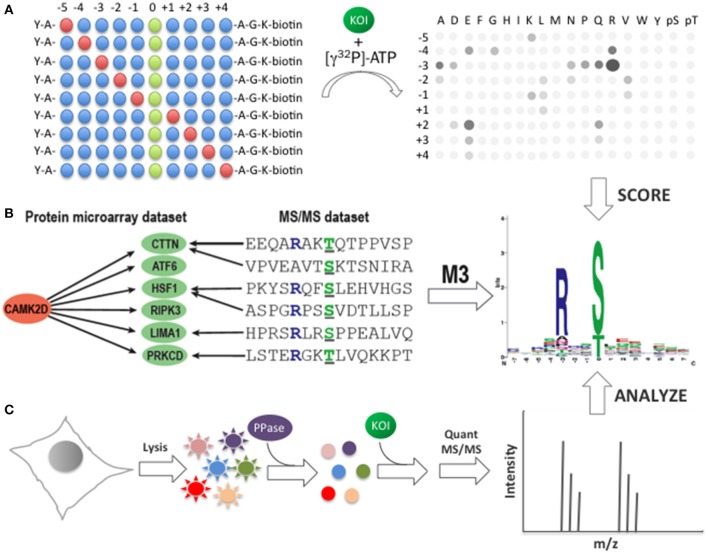
Identification of consensus phosphorylation motifs. (A) Determination of phosphorylation motifs using scanning peptide arrays. A library of biotinylated peptides is first synthesized in which one position is fixed (red circles) at a defined position relative to the phosphoacceptor site (green circles). The fixed position can be any of the 20 canonical amino acids, as well as pThr or pTyr. All other positions in the peptide mixture contain equimolar amounts of the canonical amino acids, excluding Ser, Thr, and Cys (blue circles). To determine the consensus motif, each peptide mixture is incubated with the kinase-of-interest (KOI) in the presence of [γ32P]-ATP before being immobilized on a streptavidin-coated membrane (right). The membrane is then washed, dried, and imaged. The resulting autoradiogram can be used to determine a consensus phosphorylation motif for the KOI based on the relative intensity of each spot in the array. (B) Consensus phosphorylation motif identification using the M3 algorithm. Known in vivo phosphorylation sites, determined primarily by MS/MS analysis, are first mapped onto each of the substrates of the KOI (e.g., CAMK2D) identified by phosphorylation assays using functional protein microarrays. M3 then uses an iterative approach to identify those residues that are enriched at each position relative to the phosphoacceptor site. The resulting matrix is used to construct a consensus phosphorylation motif for the KOI. (C) Consensus phosphorylation motif prediction using quantitative MS/MS. Cell lysates are first dephosphorylated, then incubated with the KOI and analyzed by quantitative MS/MS using phospho-enrichment. Statistically-overrepresented residues are used to construct a consensus phosphorylation motif for the KOI.
Figure 4
Figure 4
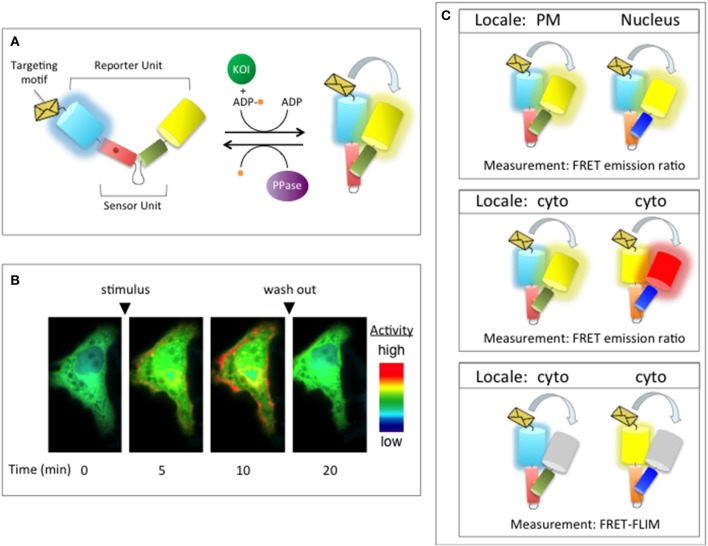
Genetically-targetable FRET-based biosensors. (A) Design of a FRET-based kinase activity reporter based on an engineered molecular switch. In this design, the sensor unit is composed of a PAABD (red cylinder) tethered to a substrate domain (green cylinder) that is specifically phosphorylated by the kinase-of-interest (KOI; green circle). The sensor unit is sandwiched between the reporter unit, which is comprised of two FPs that are able to undergo FRET [e.g., CFP (cyan cylinder) and YFP (yellow cylinder)]. A targeting motif (orange envelope) is used to direct the reporter to distinct subcellular regions. In the unphosphorylated state, the FPs are far removed from one another and, therefore, do not undergo FRET. An increase in the activity of the KOI leads to a phosphorylation-dependent conformational change that alters the distance and/or orientation of the FPs, increasing FRET between them. Phosphatase (PPase; purple oval)-mediated dephosphorylation of the reporter switches it back to the open conformation, reducing FRET. (B) Pseudocolor images of a live cell imaging experiment. In this experiment, a time-dependent increase in the FRET emission ratio (YFP FRET/CFP) is observed following stimulation with a pharmacological activator (stimulus). Upon removal of the stimulus (wash out), the emission ratio returns to basal levels. Warmer colors represent high activity while cooler colors indicate low activity. (C) Several ways in which genetically-targetable biosensors can be used to monitor real-time changes in the activity profiles of two or more signaling enzymes in the same cell. Top panel: Activity reporters that utilize the same FP FRET pair can be monitored simultaneously in the same cell provided that each biosensor is targeted to a distinct subcellular locale, such as the plasma membrane (PM) and the nucleus. Middle and bottom panels: To track the activities of two or more signaling enzymes in the same subcellular region, activity reporters that utilize spectrally distinct FP FRET pairs (e.g., CFP/YFP and YFP/RFP) can be used (middle panel) or alternative fluorescence imaging techniques, such as FRET-fluorescence lifetime imaging (FRET-FLIM), which only measures changes in emission of the donor fluorophore, can be employed (bottom panel). Cyto, cytoplasm; PM, plasma membrane.

References

    1. Agrawal U., Reilly D. T., Schroeder C. M. (2013). Zooming in on biological processes with fluorescence nanoscopy. Curr. Opin. Biotechnol. 24, 646–653 10.1016/j.copbio.2013.02.016 - DOI - PubMed
    1. Aguilar H. N., Tracey C. N., Tsang S. C., McGinnis J. M., Mitchell B. F. (2011). Phos-tag-based analysis of myosin regulatory light chain phosphorylation in human uterine myocytes. PLoS ONE 6:e20903 10.1371/journal.pone.0020903 - DOI - PMC - PubMed
    1. Ai H. W., Baird M. A., Shen Y., Davidson M. W., Campbell R. E. (2014). Engineering and characterizing monomeric fluorescent proteins for live-cell imaging applications. Nat. Protoc. 9, 910–928 10.1038/nprot.2014.054 - DOI - PubMed
    1. Ai H. W., Hazelwood K. L., Davidson M. W., Campbell R. E. (2008). Fluorescent protein FRET pairs for ratiometric imaging of dual biosensors. Nat. Methods 5, 401–403 10.1038/nmeth.1207 - DOI - PubMed
    1. Ananthanarayanan B., Fosbrink M., Rahdar M., Zhang J. (2007). Live-cell molecular analysis of Akt activation reveals roles for activation loop phosphorylation. J. Biol. Chem. 282, 36634–36641 10.1074/jbc.M706227200 - DOI - PubMed

LinkOut - more resources