


A novel, ultrasensitive assay for tau: potential for assessing traumatic brain injury in tissues and biofluids
- PMID: 25177776
- PMCID: PMC4348038
- DOI: 10.1089/neu.2014.3548
A novel, ultrasensitive assay for tau: potential for assessing traumatic brain injury in tissues and biofluids
Abstract
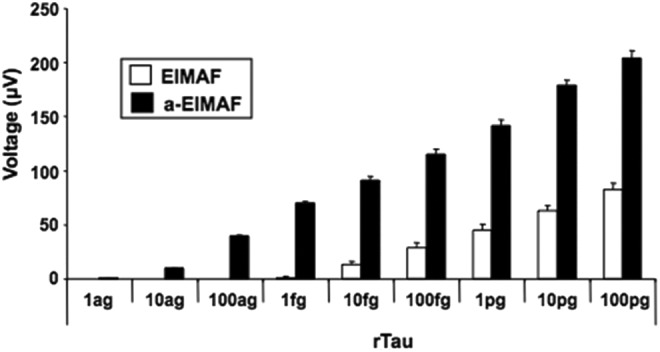
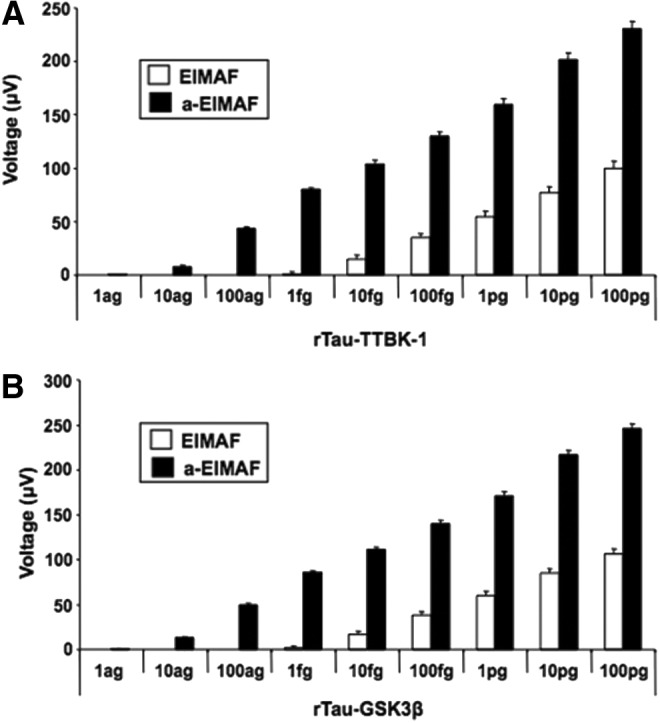
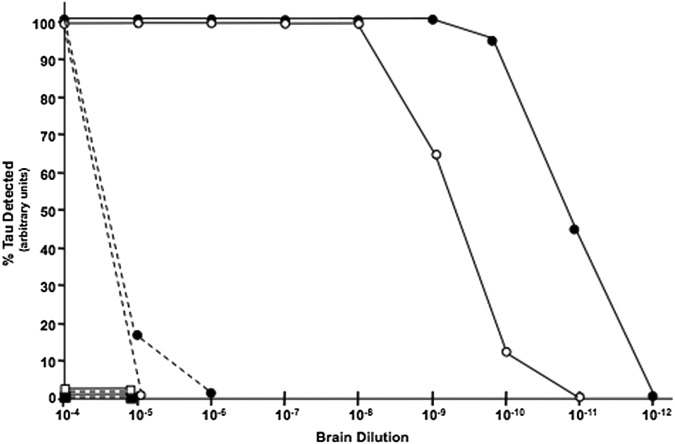
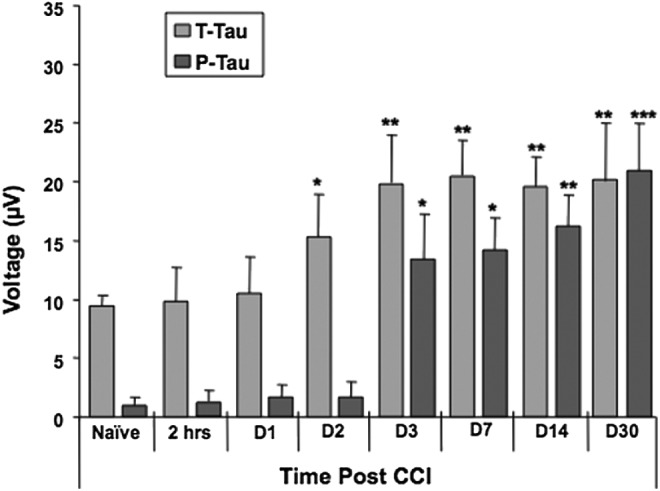
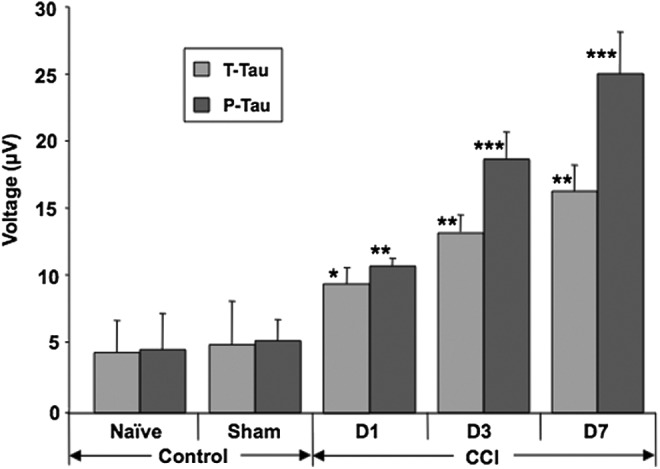
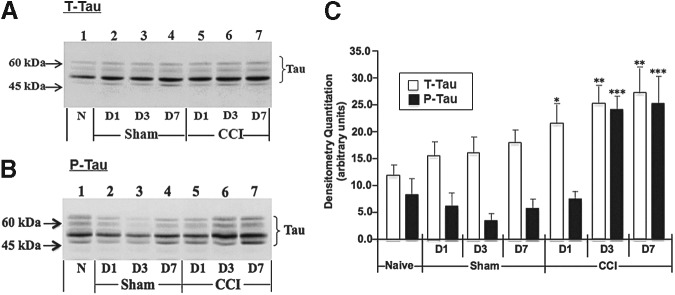
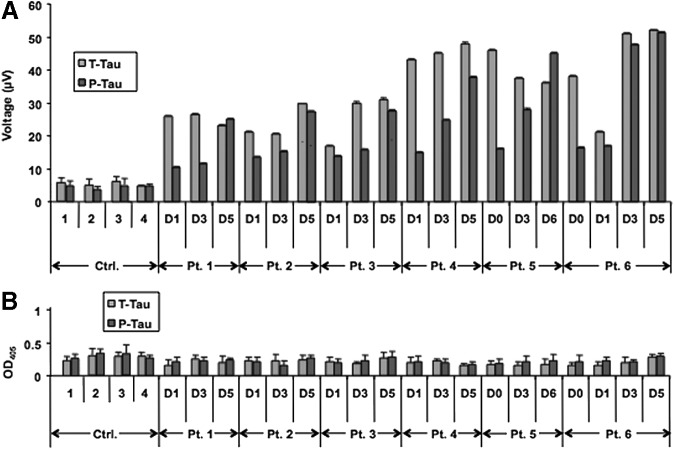
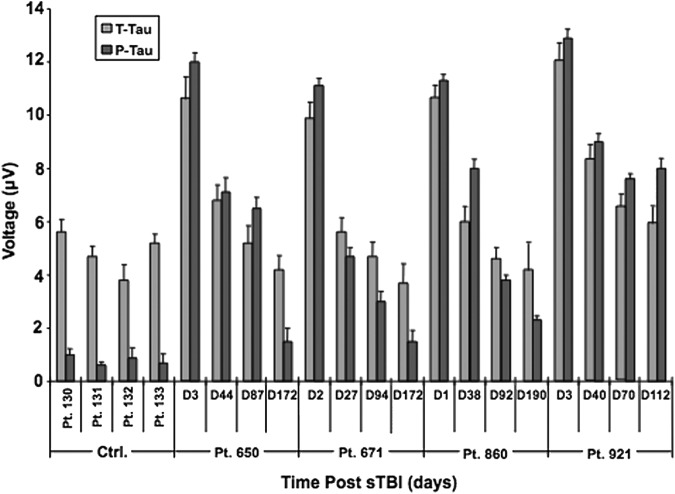
Traumatic brain injury (TBI) is a cause of death and disability and can lead to tauopathy-related dementia at an early age. Pathologically, TBI results in axonal injury that is coupled to tau hyperphosphorylation, leading to microtubule instability and tau-mediated neurodegeneration. This suggests that the forms of this protein might serve as neuroinjury-related biomarkers for diagnosis of injury severity and prognosis of the neurological damage prior to clinical expression. We initially determined whether we could detect tau in body fluids using a highly sensitive assay. We used a novel immunoassay, enhanced immunoassay using multi-arrayed fiberoptics (EIMAF) either alone or in combination with rolling circle amplification (a-EIMAF) for the detection of total (T) and phosphorylated (P) tau proteins from brains and biofluids (blood, CSF) of rodents following controlled cortical impact (CCI) and human patients post severe TBI (sTBI). This assay technology for tau is the most sensitive to date with a detection limit of approximately 100 ag/mL for either T-tau and P-tau. In the rodent models, T-tau and P-tau levels in brain and blood increased following CCI during the acute phase and remained high during the chronic phase (30 d). In human CSF samples, T-tau and P-tau increased during the sampling period (5-6 d). T-tau and P-tau in human serum rose during the acute phase and decreased during the chronic stage but was still detectable beyond six months post sTBI. Thus, EIMAF has the potential for assessing both the severity of the proximal injury and the prognosis using easily accessible samples.
Keywords: EIMAF; brain and biofluids; rolling circle amplification; severe traumatic brain injury; total and phosphorylated tau.
Figures
References
-
- Chiu W.T., Huang S.J., Tsai S.H., Lin J-W., Tsai M-D., and Lin T-J. (2007). The impact of time, legislation, and geography on the epidemiology of traumatic brain injury. J. Clin. Neurosci. 14, 930–935 - PubMed
-
- Clinton J., Ambler M.W., and Roberts G.W. (1991). Post-traumatic Alzheimer's disease: preponderance of a single plaque type. Neuropathol. Appl. Neurobiol. 17, 69–74 - PubMed
-
- Mortimer J.A., Van Duijn C.M., Chandra V., Fratiglioni L., Graves A.B., Heyman A., Jorm A.F., Kokmen E., Rocca W.A., Shalat S.L., Soininen H., and Hofman A. (1991). Head trauma as a risk factor for Alzheimer's disease: a collaborative re-analysis of case-control studies. EURODEM Risk Factors Research Group. Int. J. Epidemiol. 20, S28–S35 - PubMed
-
- Breteler M.M., Claus J.J., Van Duijn C.M., Launer L.J., and Hofman A. (1992). Epidemiology of Alzheimer's disease. Epidemiol Rev 14, 59–82 - PubMed
-
- Mayeux R., Ottman R., Tang M.X., Noboa-Bauza L., Marder K., Gurland B., and Stem Y. (1993). Genetic susceptibility and head injury as risk factors for Alzheimer's disease among community-dwelling elderly persons and their first-degree relatives. Ann. Neurol. 33, 494–501 - PubMed
MeSH terms
Substances
LinkOut - more resources
Full Text Sources
Other Literature Sources
