The association between residency training and internists' ability to practice conservatively
- PMID: 25179515
- PMCID: PMC4445367
- DOI: 10.1001/jamainternmed.2014.3337
The association between residency training and internists' ability to practice conservatively
Abstract
Importance: Growing concern about rising costs and potential harms of medical care has stimulated interest in assessing physicians' ability to minimize the provision of unnecessary care.
Objective: To assess whether graduates of residency programs characterized by low-intensity practice patterns are more capable of managing patients' care conservatively, when appropriate, and whether graduates of these programs are less capable of providing appropriately aggressive care.
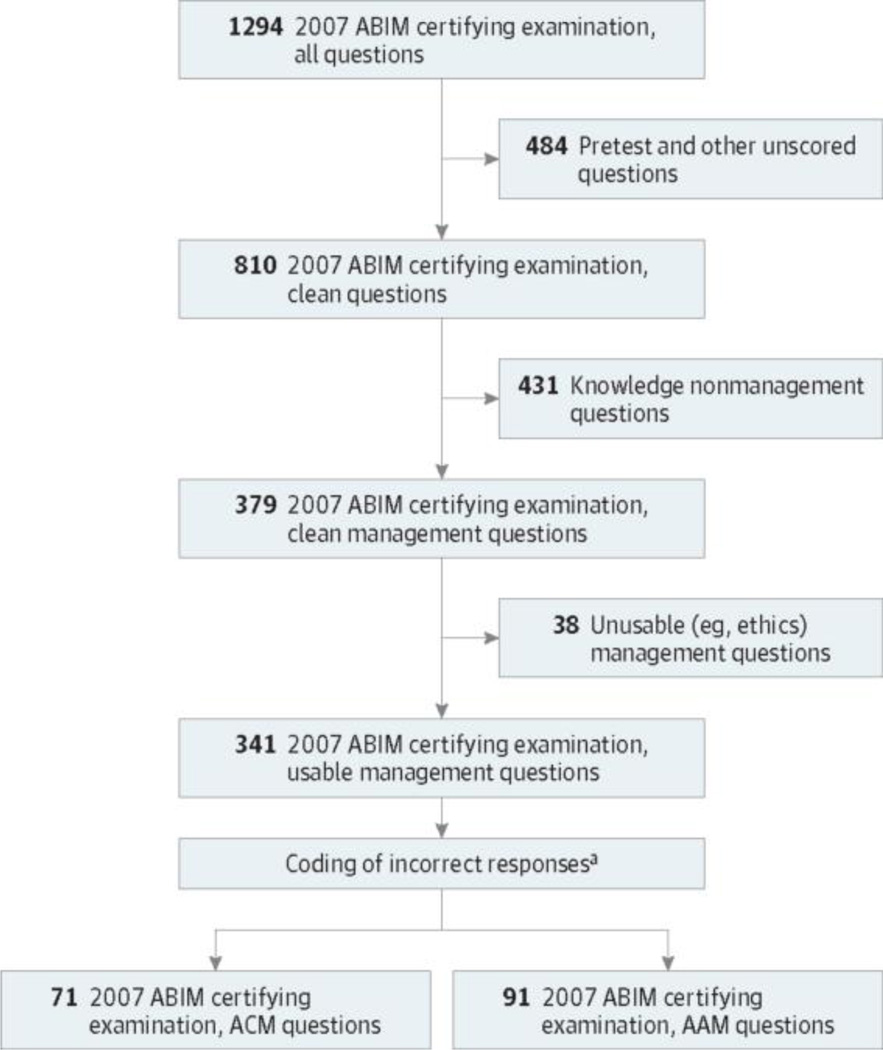
Design, setting, and participants: Cross-sectional comparison of 6639 first-time takers of the 2007 American Board of Internal Medicine certifying examination, aggregated by residency program (n = 357).
Exposures: Intensity of practice, measured using the End-of-Life Visit Index, which is the mean number of physician visits within the last 6 months of life among Medicare beneficiaries 65 years and older in the residency program's hospital referral region.
Main outcomes and measures: The mean score by program on the Appropriately Conservative Management (ACM) (and Appropriately Aggressive Management [AAM]) subscales, comprising all American Board of Internal Medicine certifying examination questions for which the correct response represented the least (or most, respectively) aggressive management strategy. Mean scores on the remainder of the examination were used to stratify programs into 4 knowledge tiers. Data were analyzed by linear regression of ACM (or AAM) scores on the End-of-Life Visit Index, stratified by knowledge tier.
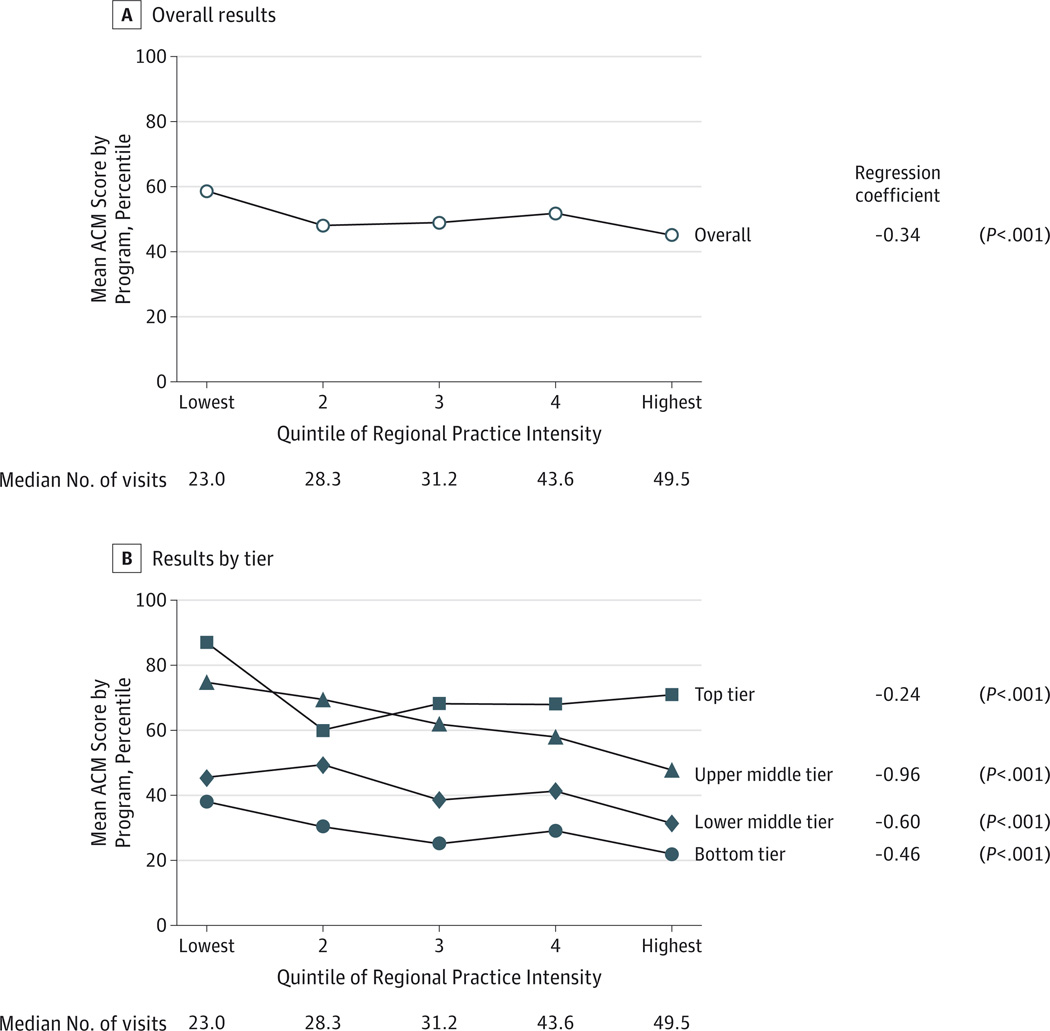
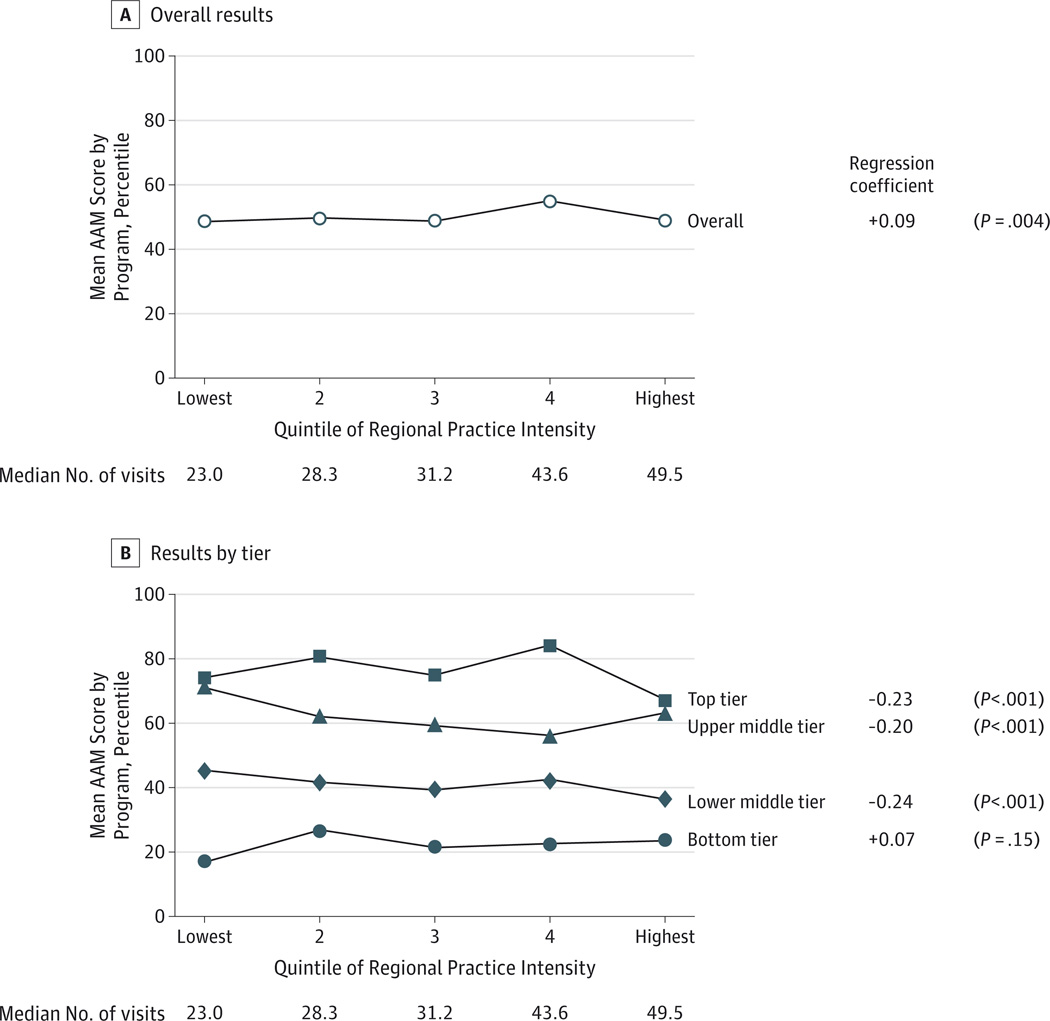
Results: Within each knowledge tier, the lower the intensity of health care practice in the hospital referral region, the better residency program graduates scored on the ACM subscale (P < .001 for the linear trend in each tier). In knowledge tier 4 (poorest), for example, graduates of programs in the lowest-intensity regions had a mean ACM score in the 38th percentile compared with the 22nd percentile for programs in the highest-intensity regions; in tier 2, ACM scores ranged from the 75th to the 48th percentile in regions from lowest to highest intensity. Graduates of programs in low-intensity regions tended, more weakly, to score better on the AAM subscale (in 3 of 4 knowledge tiers).
Conclusions and relevance: Regardless of overall medical knowledge, internists trained at programs in hospital referral regions with lower-intensity medical practice are more likely to recognize when conservative management is appropriate. These internists remain capable of choosing an aggressive approach when indicated.
Conflict of interest statement
Figures
Comment in
-
Celebrating minimalism in residency training.JAMA Intern Med. 2014 Oct;174(10):1649-50. doi: 10.1001/jamainternmed.2014.3326. JAMA Intern Med. 2014. PMID: 25178865 No abstract available.
-
Evaluating clinical management decisions by recent graduates in the era of high-value, cost-conscious care.JAMA Intern Med. 2015 Apr;175(4):651-2. doi: 10.1001/jamainternmed.2014.8087. JAMA Intern Med. 2015. PMID: 25844741 No abstract available.
-
Evaluating clinical management decisions by recent graduates in the era of high-value, cost-conscious care--reply.JAMA Intern Med. 2015 Apr;175(4):652-3. doi: 10.1001/jamainternmed.2014.8090. JAMA Intern Med. 2015. PMID: 25844743 No abstract available.
References
-
- Smith C, Cowan C, Sensenig A, Catlin A Health Accounts Team. Health spending growth slows in 2003. Health Aff (Millwood) 2005;24(1):185–194. - PubMed
-
- Congressional Budget Office. [Accessed October 7, 2013];How Have CBO’s projections of spending for Medicare and Medicaid changed since the August 2012 baseline? 2013 Feb 21; http://www.cbo.gov/publication/43947.
-
- Business Week. [Accessed July 1, 2014];Is the US losing its competitive edge? in the World Economic Forum’s global competitiveness ranking, the US drops from first place to sixth thanks to its deficits and health care. http://www.businessweek.com/stories/2006-09-27/is-the-u-dot-s-dot-losing....
-
- US Government Accountability Office. Fiscal and Health Care Challenges. Washington, DC: US Government Accountability Office; 2007. Publication GAO-07-577CG.
-
- Fisher ES, Wennberg DE, Stukel TA, Gottlieb DJ, Lucas FL, Pinder EL. The implications of regional variations in Medicare spending: part 1: the content, quality, and accessibility of care. Ann Intern Med. 2003;138(4):273–287. - PubMed
Publication types
MeSH terms
Grants and funding
LinkOut - more resources
Full Text Sources
Other Literature Sources