


Fractional flow reserve vs. angiography in guiding management to optimize outcomes in non-ST-segment elevation myocardial infarction: the British Heart Foundation FAMOUS-NSTEMI randomized trial
- PMID: 25179764
- PMCID: PMC4291317
- DOI: 10.1093/eurheartj/ehu338
Fractional flow reserve vs. angiography in guiding management to optimize outcomes in non-ST-segment elevation myocardial infarction: the British Heart Foundation FAMOUS-NSTEMI randomized trial
Abstract
Aim: We assessed the management and outcomes of non-ST segment elevation myocardial infarction (NSTEMI) patients randomly assigned to fractional flow reserve (FFR)-guided management or angiography-guided standard care.
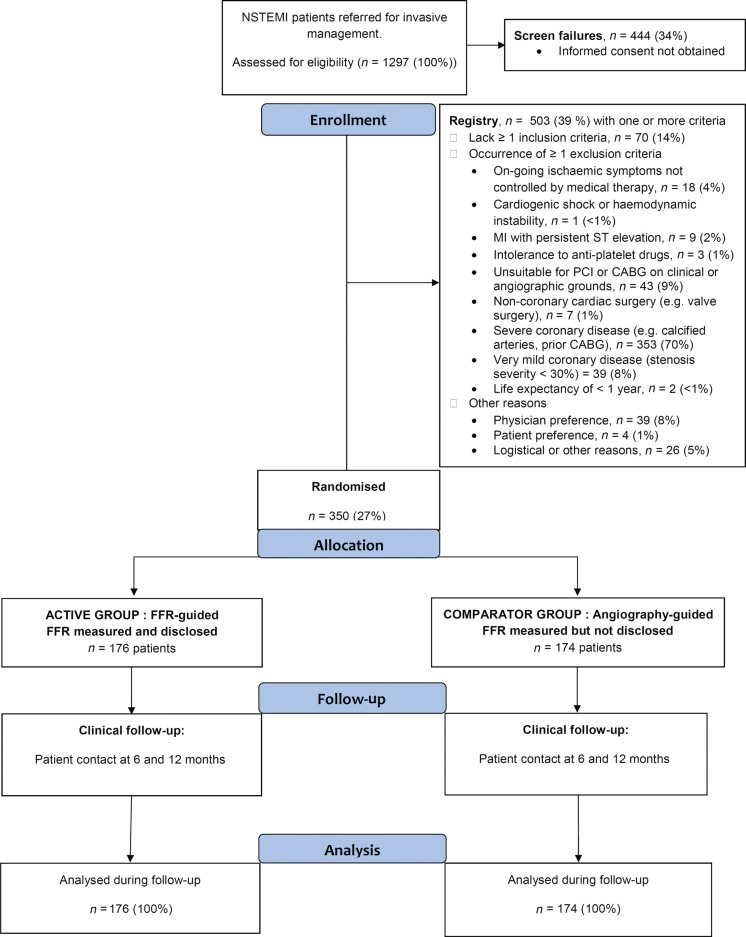
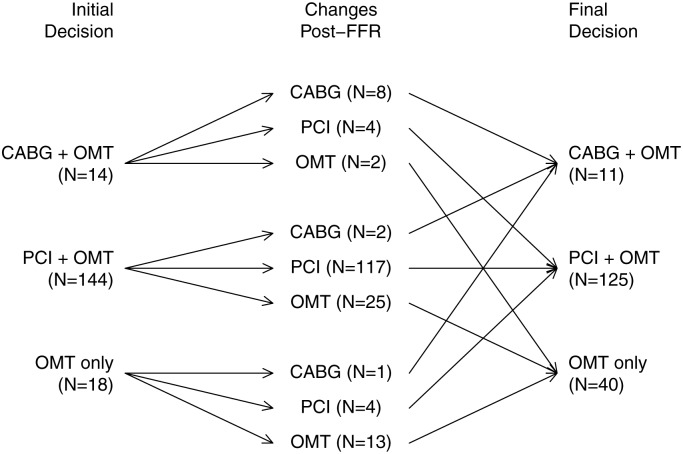
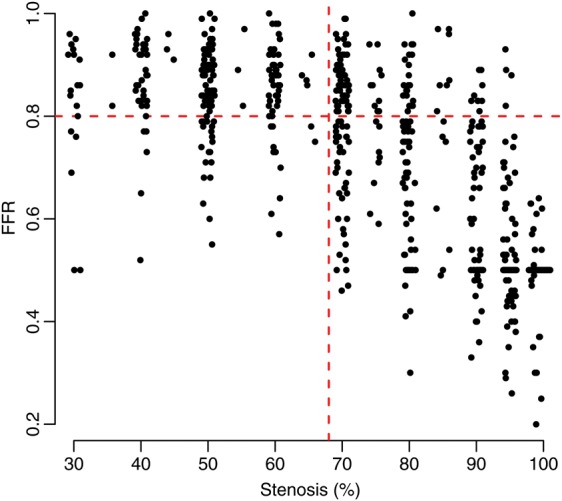
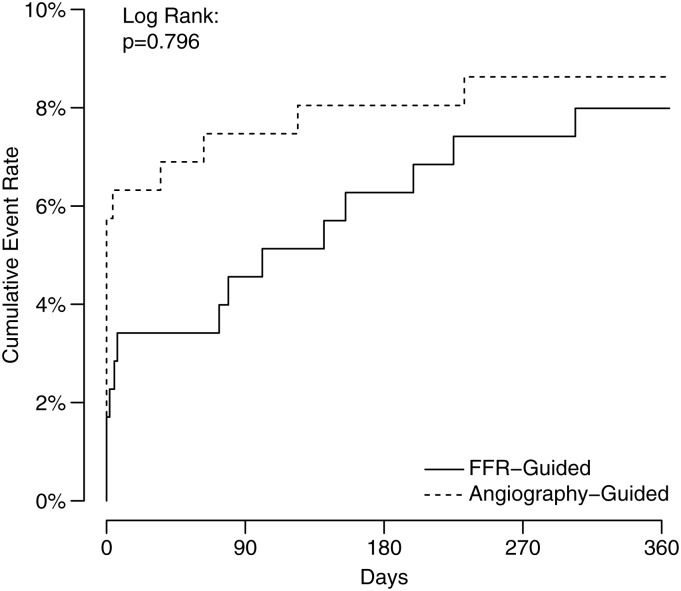
Methods and results: We conducted a prospective, multicentre, parallel group, 1 : 1 randomized, controlled trial in 350 NSTEMI patients with ≥1 coronary stenosis ≥30% of the lumen diameter assessed visually (threshold for FFR measurement) (NCT01764334). Enrolment took place in six UK hospitals from October 2011 to May 2013. Fractional flow reserve was disclosed to the operator in the FFR-guided group (n = 176). Fractional flow reserve was measured but not disclosed in the angiography-guided group (n = 174). Fractional flow reserve ≤0.80 was an indication for revascularization by percutaneous coronary intervention (PCI) or coronary artery bypass surgery (CABG). The median (IQR) time from the index episode of myocardial ischaemia to angiography was 3 (2, 5) days. For the primary outcome, the proportion of patients treated initially by medical therapy was higher in the FFR-guided group than in the angiography-guided group [40 (22.7%) vs. 23 (13.2%), difference 95% (95% CI: 1.4%, 17.7%), P = 0.022]. Fractional flow reserve disclosure resulted in a change in treatment between medical therapy, PCI or CABG in 38 (21.6%) patients. At 12 months, revascularization remained lower in the FFR-guided group [79.0 vs. 86.8%, difference 7.8% (-0.2%, 15.8%), P = 0.054]. There were no statistically significant differences in health outcomes and quality of life between the groups.
Conclusion: In NSTEMI patients, angiography-guided management was associated with higher rates of coronary revascularization compared with FFR-guided management. A larger trial is necessary to assess health outcomes and cost-effectiveness.
Keywords: Acute coronary syndrome; Coronary revascularization; Fractional flow reserve; Medical therapy; Non-ST elevation myocardial infarction.
© The Author 2014. Published by Oxford University Press on behalf of the European Society of Cardiology.
Figures
Comment in
-
Fractional flow reserve in acute coronary syndromes.Eur Heart J. 2015 Jan 7;36(2):75-6. doi: 10.1093/eurheartj/ehu362. Epub 2014 Sep 1. Eur Heart J. 2015. PMID: 25179765 No abstract available.
References
-
- Hamm CW, Bassand JP, Agewall S, Bax J, Boersma E, Bueno H, Caso P, Dudek D, Gielen S, Huber K, Ohman M, Petrie MC, Sonntag F, Uva MS, Storey RF, Wijns W, Zahger D ESC Committee for Practice Guidelines. ESC Guidelines for the management of acute coronary syndromes in patients presenting without persistent ST-segment elevation: The Task Force for the management of acute coronary syndromes (ACS) in patients presenting without persistent ST-segment elevation of the European Society of Cardiology (ESC) Eur Heart J. 2011;32:2999–3054. - PubMed
-
- Wright RS, Anderson JL, Adams CD, Bridges CR, Casey DE, Jr, Ettinger SM, Fesmire FM, Ganiats TG, Jneid H, Lincoff AM, Peterson ED, Philippides GJ, Theroux P, Wenger NK, Zidar JP, Anderson JL, Adams CD, Antman EM, Bridges CR, Califf RM, Casey DE, Jr, Chavey WE, II, Fesmire FM, Hochman JS, Levin TN, Lincoff AM, Peterson ED, Theroux P, Wenger NK, Wright RS. 2011 ACCF/AHA focused update of the Guidelines for the Management of Patients with Unstable Angina/Non-ST-Elevation Myocardial Infarction (updating the 2007 guideline): a report of the American College of Cardiology Foundation/American Heart Association Task Force on Practice Guidelines developed in collaboration with the American College of Emergency Physicians, Society for Cardiovascular Angiography and Interventions, and Society of Thoracic Surgeons. J Am Coll Cardiol. 2011;57:e215–e367. - PubMed
-
- Wijns W, Kolh P, Danchin N, Di Mario C, Falk V, Folliguet T, Garg S, Huber K, James S, Knuuti J, Lopez-Sendon J, Marco J, Menicanti L, Ostojic M, Piepoli MF, Pirlet C, Pomar JL, Reifart N, Ribichini FL, Schalij MJ, Sergeant P, Serruys PW, Silber S, Sousa Uva M, Taggart D Task Force on Myocardial Revascularization of the European Society of Cardiology (ESC) and the European Association for Cardio-Thoracic Surgery (EACTS); European Association for Percutaneous Cardiovascular Interventions (EAPCI) Guidelines on myocardial revascularization. Eur Heart J. 2010;31:2501–2555. - PubMed
-
- White CW, Wright CB, Doty DB, Hiratza LF, Eastham CL, Harrison DG, Marcus ML. Does visual interpretation of the coronary arteriogram predicts the physiologic importance of a coronary stenosis? N Engl J Med. 1984;310:819–824. - PubMed
-
- Tonino PA, Fearon WF, De Bruyne B, Oldroyd KG, Leesar MA, Ver Lee PN, Maccarthy PA, Van't Veer M, Pijls NH. Angiographic versus functional severity of coronary artery stenoses in the FAME study fractional flow reserve versus angiography in multivessel evaluation. J Am Coll Cardiol. 2010;55:2816–2821. - PubMed
Publication types
MeSH terms
Grants and funding
LinkOut - more resources
Full Text Sources
Other Literature Sources
Medical
Miscellaneous
