


Vulnerability risk index profile for elder abuse in a community-dwelling
- PMID: 25180376
- PMCID: PMC4155408
- DOI: 10.1111/jgs.12621
Vulnerability risk index profile for elder abuse in a community-dwelling
Abstract
Objectives: To develop a vulnerability index for elder abuse in a community-dwelling population.
Design: Population-based.
Setting: Geographically defined community in Chicago.
Participants: Community-dwelling older adults (N = 8,157) who participated in the Chicago Health and Aging Project (CHAP); 213 were reported to social services agency for suspected elder abuse.
Measurements: A nine-item vulnerability index for elder abuse was constructed from sociodemographic, health-related, and psychosocial factors. The outcomes of interest were reported and confirmed elder abuse. Logistic regression models were used to determine the accuracy of the index with respect to elder abuse outcomes.
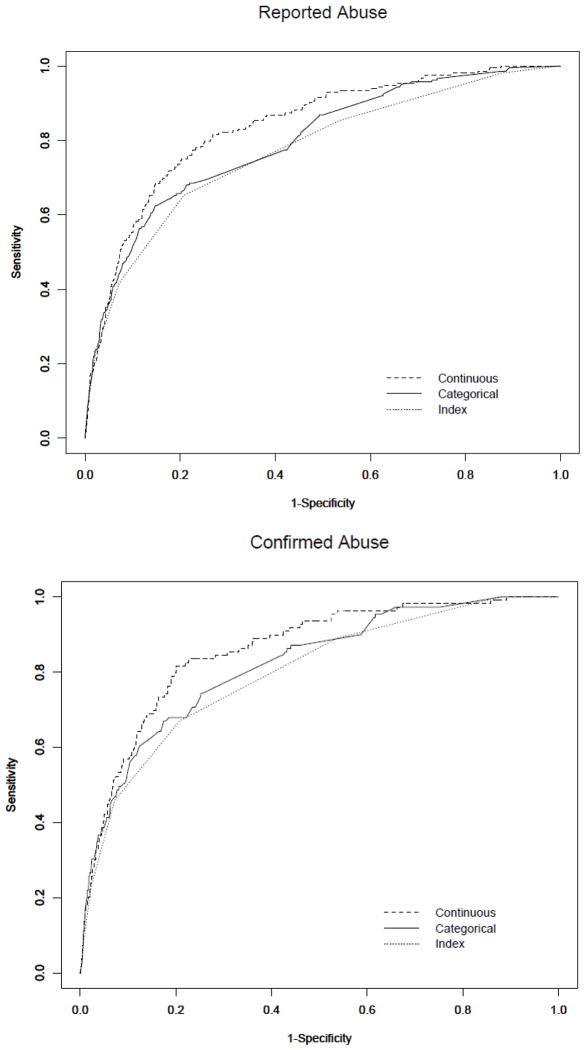
Results: For every 1-point increase in the vulnerability index, there was twice the risk of reported (OR = 2.19,95% confidence interval (CI) = 2.00–2.40) and confirmed(OR = 2.19, 95% CI = 1.94–2.47) elder abuse. Older adults with three to four vulnerability index items had greater risk than the reference group (no elder abuse) of reported (OR = 2.98, 95% CI = 1.98–4.49) and confirmed (OR = 3.90, 95% CI = 2.07–7.36) elder abuse, and the risk of reported (OR = 18.46, 95% CI = 12.15–28.04) and confirmed (OR = 26.79, 95% CI = 14.18–50.61) elder abuse was 18 and 27 times as great, respectively, in older adults with five or more risk index items. Statistically derived receiver operating characteristic (ROC) curves ranged from 0.77 to 0.84 for predicting reported elder abuse and from 0.79 to 0.86 for predicting confirmed elder abuse.
Conclusion: The vulnerability risk index demonstrates value for identifying individuals at risk of elder abuse. Additional studies are needed to validate this index in other community-dwelling populations.
Conflict of interest statement
Drs Dong, Simon declare no conflict of interest.
Figures
References
-
- National Research Council. Elder Mistreatment: Abuse, neglect and exploitation in an Aging America. Washington, D.C: The National Academies Press; 2003. - PubMed
-
- Teaster PB, Dugar T, Mendiondo M, et al. [Accessed April 4th, 2007];The 2004 Survey of Adult Protective Services: Abuse of Adults 60 Years of Age and Older. 2007 www.elderabusecenter.org/pdf/research/apsreport030703.pdf.
-
- Schofield MJ, Powers JR, Loxton D. Mortality and disability outcomes of self-reported elder abuse: A 12-year prospective investigation. J Am Geriatr Soc. 2013;61:679–685. - PubMed
Publication types
MeSH terms
Grants and funding
LinkOut - more resources
Full Text Sources
Other Literature Sources
Medical
