. 2014 Sep 2;9(9):e106232.
doi: 10.1371/journal.pone.0106232. eCollection 2014.

Improved cell-free RNA and protein synthesis system

Affiliations

Improved cell-free RNA and protein synthesis system

Jun Li et al. PLoS One. .

Abstract

Cell-free RNA and protein synthesis (CFPS) is becoming increasingly used for protein production as yields increase and costs decrease. Advances in reconstituted CFPS systems such as the Protein synthesis Using Recombinant Elements (PURE) system offer new opportunities to tailor the reactions for specialized applications including in vitro protein evolution, protein microarrays, isotopic labeling, and incorporating unnatural amino acids. In this study, using firefly luciferase synthesis as a reporter system, we improved PURE system productivity up to 5 fold by adding or adjusting a variety of factors that affect transcription and translation, including Elongation factors (EF-Ts, EF-Tu, EF-G, and EF4), ribosome recycling factor (RRF), release factors (RF1, RF2, RF3), chaperones (GroEL/ES), BSA and tRNAs. The work provides a more efficient defined in vitro transcription and translation system and a deeper understanding of the factors that limit the whole system efficiency.


Conflict of interest statement

Competing Interests: Merck KGaA provided funding for this study. None of the authors are employees of/affiliated with Merck KGaA. There are no patents, products in development or marketed products to declare. This does not alter the authors' adherence to all PLOS ONE policies on sharing data and materials.

Figures

Figure 1
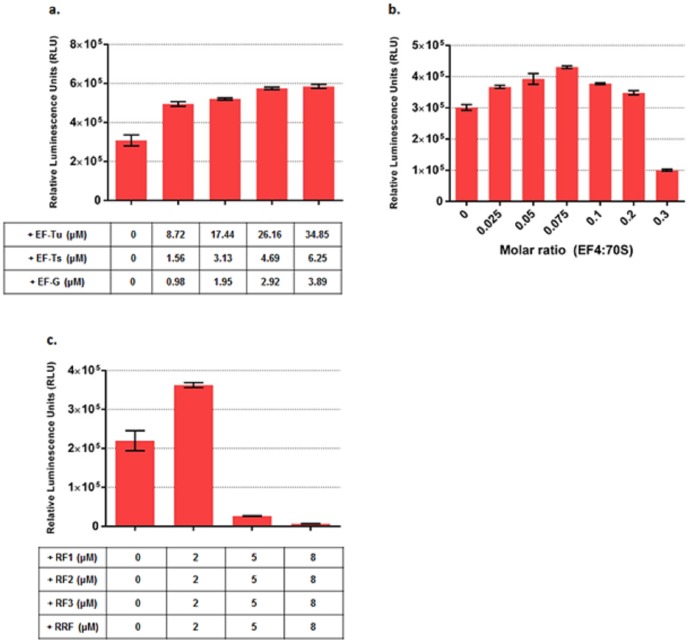
Figure 1. Optimization of PURE system as measured by active Fluc produced by supplementing different concentrations of EF-Tu, Ts, G; EF4; RF1, 2, 3 and RRF.
(a). Active Fluc produced at different EF-Ts, Tu and G concentrations. The table below shows the actual concentration increase of EF-Ts, Tu and G in the PURE system. (b). Active Fluc produced at different EF4 concentrations. (c). Active Fluc produced at different RF1, 2, 3 and RRF concentrations. The table below shows the actual concentration increase of RF1, 2, 3 and RRF in the PURE system. Fluc activities were measured in relative luminescence unit by luciferase assay and PURE system reaction without supplement was set as control. Error bars are ± standard deviations, with n = 3.
Figure 2
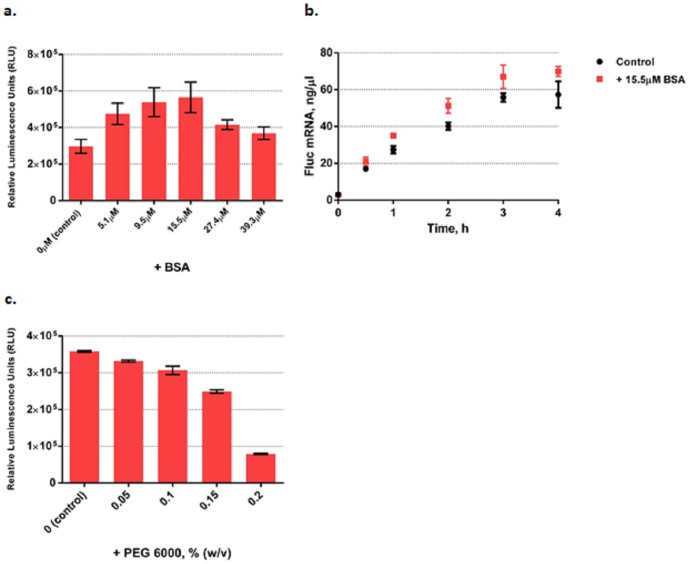
Figure 2. Optimization of PURE system as measured by functional Fluc produced by adding macromolecular crowding agents.
(a). Active Fluc produced in the system at different BSA concentrations. (b). The time course (kinetics) of transcription measured by Fluc mRNA yields with the Quant-iT RiboGreen RNA reagent with and without the presence of 15.5 µM BSA. (c). Active Fluc produced in the system at different PEG-6000 concentrations. In (a) and (c) Fluc activities were measured in relative luminescence units by luciferase assay and PURE system reaction without supplement was set as control. Error bars are ± standard deviations, with n = 3.
Figure 3
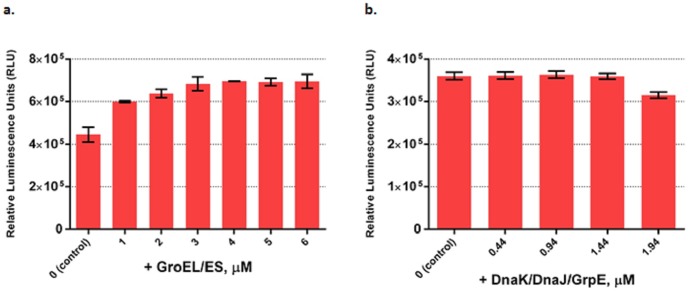
Figure 3. Optimization of PURE system as measured by functional Fluc produced by adding chaperone systems GroEL/ES and DnaK/DnaJ/GrpE.
(a). Active Fluc produced at different GroEL/GroES concentrations. (b). Active Fluc produced at different DnaK/DnaJ/GrpE concentrations. Fluc activities were measured in relative luminescence unit by luciferase assay and PURE system reaction without supplement was set as control. Error bars are ± standard deviations, with n = 3.
Figure 4
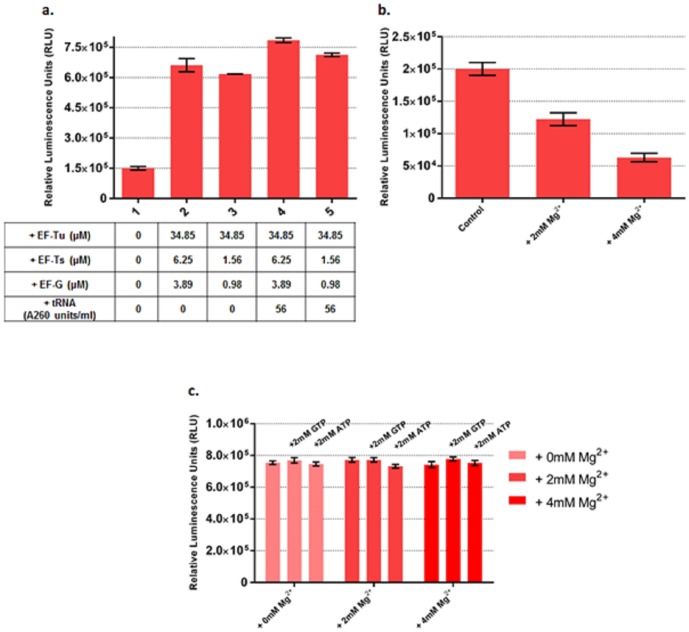
Figure 4. Optimization of PURE system as measured by functional Fluc produced by adjusting tRNA, ATP and GTP concentrations.
(a). Increasing tRNA concentration by 56 A260 units/ml boosts functional Fluc yield by 25%. The table below shows the actual concentration increase of EF-Ts, Tu, G and tRNA in each reaction. Reaction 1 is taken as control. In reaction 2, 3, 4 and 5, EF4; RF 1, 2, 3, RRF; GroEL/GroES and BSA were added at their optimized concentrations. (b). Increasing Mg2+ concentration decreases functional Fluc yield in the original PURE system. (c). Increasing Mg2+, ATP and GTP concentrations has little effect on final yield of functional Fluc in our optimized PURE system with optimized concentrations of EF-Ts, Tu, G; EF4; RF 1, 2, 3, RRF; GroEL/GroES and BSA. Fluc activities were measured in relative luminescence unit by luciferase assay and PURE system reaction without supplement was set as control. Error bars are ± standard deviations, with n = 3.
Figure 5
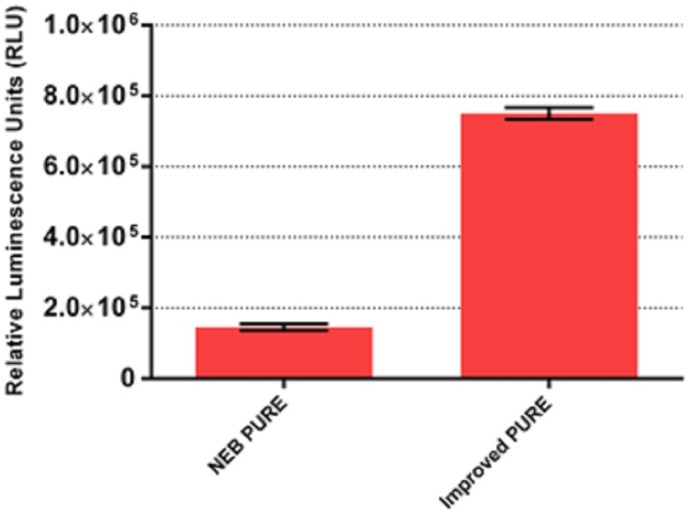
Figure 5. Optimization of PURE system with the best combination of EF-Ts, Tu, G; EF 4; RF 1,2,3, RRF; GroEL/GroES; BSA and tRNA concentrations as measured by functional Fluc produced.
Fluc activities were measured in relative luminescence unit by luciferase assay and PURE system reaction without supplement was set as control. Error bars are ± standard deviations, with n = 3.

References

    1. Noireaux V, Bar-Ziv R, Libchaber A (2003) Principles of cell-free genetic circuit assembly. Proc Natl Acad Sci U S A 100: 12672–12677. - PMC - PubMed
    1. Jewett MC, Calhoun KA, Voloshin A, Wuu JJ, Swartz JR (2008) An integrated cell-free metabolic platform for protein production and synthetic biology. Mol Syst Biol 4: 220. - PMC - PubMed
    1. Cappuccio JA, Blanchette CD, Sulchek TA, Arroyo ES, Kralj JM, et al. (2008) Cell-free co-expression of functional membrane proteins and apolipoprotein, forming soluble nanolipoprotein particles. Mol Cell Proteomics 7: 2246–2253. - PMC - PubMed
    1. Hanes J, Pluckthun A (1997) In vitro selection and evolution of functional proteins by using ribosome display. Proc Natl Acad Sci U S A 94: 4937–4942. - PMC - PubMed
    1. Amstutz P, Forrer P, Zahnd C, Pluckthun A (2001) In vitro display technologies: novel developments and applications. Curr Opin Biotechnol 12: 400–405. - PubMed

Publication types

MeSH terms