. 2014 Sep 2:5:4731.
doi: 10.1038/ncomms5731.

An engineered pathway for the biosynthesis of renewable propane

Affiliations

An engineered pathway for the biosynthesis of renewable propane

Pauli Kallio et al. Nat Commun. .

Abstract

The deployment of next-generation renewable biofuels can be enhanced by improving their compatibility with the current infrastructure for transportation, storage and utilization. Propane, the bulk component of liquid petroleum gas, is an appealing target as it already has a global market. In addition, it is a gas under standard conditions, but can easily be liquefied. This allows the fuel to immediately separate from the biocatalytic process after synthesis, yet does not preclude energy-dense storage as a liquid. Here we report, for the first time, a synthetic metabolic pathway for producing renewable propane. The pathway is based on a thioesterase specific for butyryl-acyl carrier protein (ACP), which allows native fatty acid biosynthesis of the Escherichia coli host to be redirected towards a synthetic alkane pathway. Propane biosynthesis is markedly stimulated by the introduction of an electron-donating module, optimizing the balance of O2 supply and removal of native aldehyde reductases.


Figures
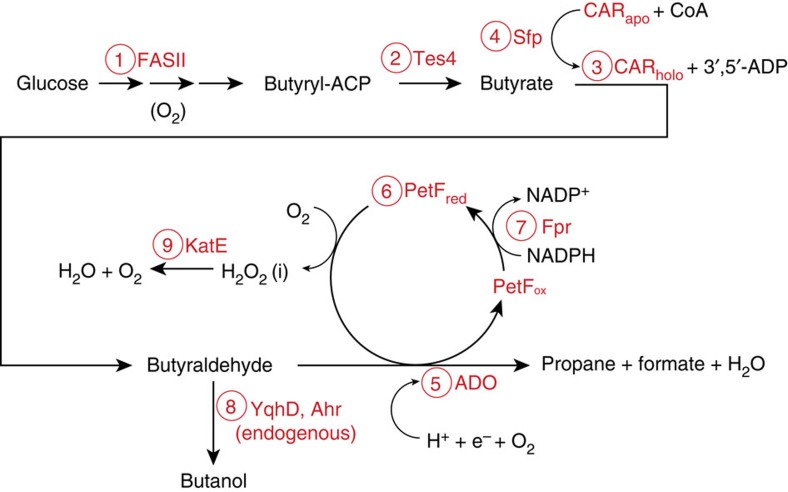
Figure 1
Figure 1. Schematic (non-stoichiometric) representation of the constructed heterologous propane pathway in E. coli BL21 (DE3).
The associated enzyme components are shown in red: (1) butyryl-ACP is generated via the native fatty acid biosynthesis (FASII) pathway, followed by (2) the release of butyrate by thioesterase (Tes4; Bacteroides fragilis). (3) Butyrate is converted into butyraldehyde by carboxylic acid reductase (CAR; Mycobacterium marinum) with the aid of a (4) maturase phosphopantetheinyl transferase (Sfp; Bacillus subtilis). (5) The butyraldehyde intermediate is finally converted to propane by aldehyde deformylating oxygenase (ADO; Prochlorococcus marinus), whereas (6) ferredoxin (PetF; Synechocystis sp. PCC6803) provides electrons for the reaction. (7) Ferredoxin in this pathway is reduced by overexpressed NADPH:ferredoxin/flavodoxin-oxidoreductase (Fpr; E. coli). (8) Endogenous aldehyde reductases (YqhD, Ahr) compete with ADO for the butyraldehyde substrate and reroute the desired pathway towards butanol. (9) Overexpressed catalase (KatE; E. coli) converts inhibitory hydrogen peroxide to oxygen and water.
Figure 2
Figure 2. Propane and metabolite production under various environmental conditions using different strains.
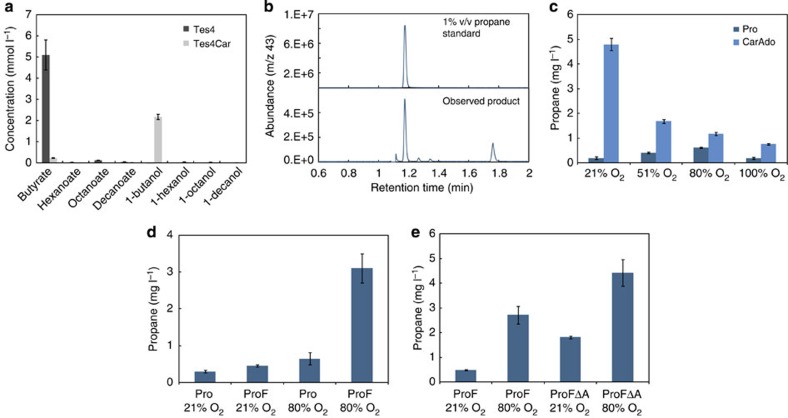
(a) Tes4 and Tes4Car strains were compared for fatty acid and alcohol production in shake flask fermentation under aerobic conditions; metabolites were analysed from culture supernatant after 24 h cultivation. (b) GC–MS chromatogram of a typical sample injected from the headspace of the propane-producing strain ProFΔA and a 1% (v/v) propane standard. (c) Supplementing the reaction culture headspace with oxygen to the final concentration of 51, 80 and 100% (v/v) using Pro strain (generating propane from glucose) and CarAdo strain (fed with butyrate). (d) Co-expression of Fpr and PetF with and without O2 supplementation using strains Pro and ProF. (e) The effect of aldehyde reductase knock-outs with and without O2 supplementation with strains ProFΔA versus ProF. Error bars, mean±s.d. (n=4).
Figure 3
Figure 3. Comparison of the pathways for propane and heptane production.
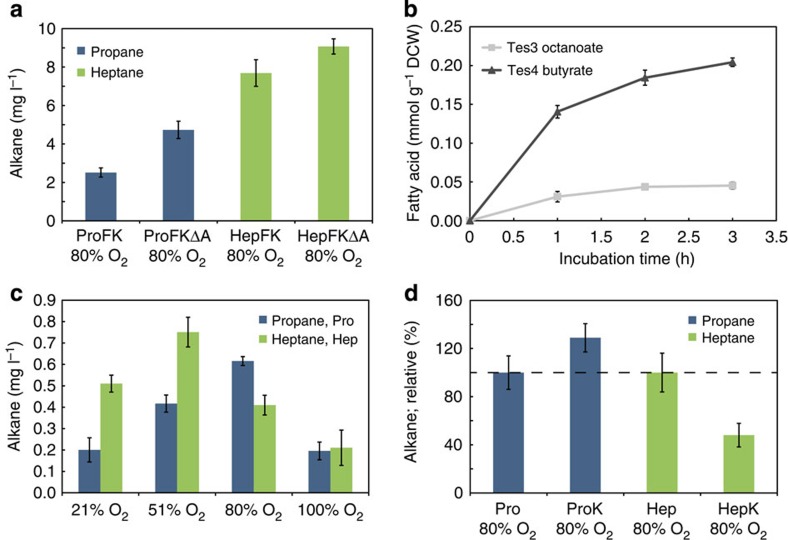
(a) The effect of aldehyde reductase knock-outs in ΔyqhD Δahr strains ProFKΔA and HepFKΔA versus the corresponding strains ProFK and HepFK, respectively, with supplemented oxygen. (b) Octanoate and butyrate production with strains Tes3 and Tes4, respectively, using conditions optimized for propane production (80% v/v oxygen). (c) Supplementing the reaction culture headspace with oxygen to the final concentration of 51, 80 and 100% (v/v) using strains Pro and Hep. (d) Overexpression of KatE in strains ProK and HepK versus Pro and Hep with supplemented oxygen; values are represented as relative % for comparison. Error bars, mean±s.d. (n=4).
Figure 4
Figure 4. Optimization of propane production.
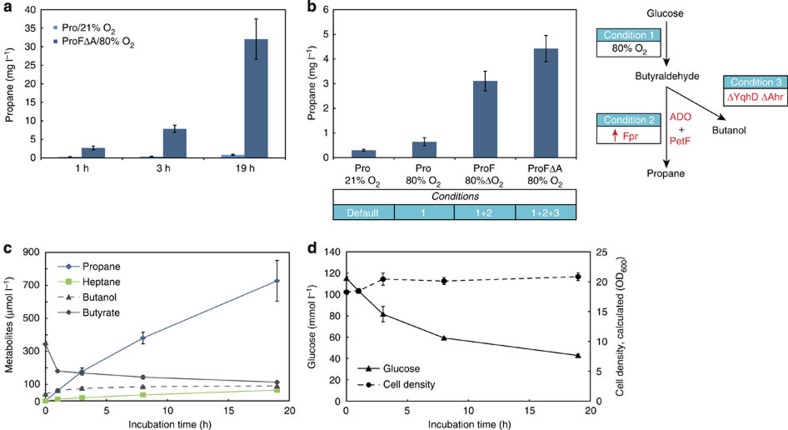
(a) Scale-up of propane production. Cultures of strains Pro and ProFΔA were scaled up from 0.5 ml (2 ml vial) to 20 ml (in 160 ml serum bottles). 80% (v/v) O2 was supplemented to ProFΔA strain. (b) Step-wise improvement of propane production from glucose in E. coli BL21 (DE3) host (Bars from left to right): The default pathway at atmospheric oxygen concentrations (21% (v/v)); supplementing additional oxygen (80% v/v); overexpression of NADPH:ferredoxin/flavodoxin-oxidoreductase (Fpr from E. coli) with 80% (v/v) oxygen; deletion of the two native aldehyde reductase encoding genes, yqhD and ahr, together with fpr and 80% (v/v) oxygen. For detailed information on the metabolic pathway refer to Fig. 1. (c) Metabolite analysis of ProFΔA strain in up-scaled reaction conditions (160 ml serum bottles, 80% v/v O2) over a 19-h cultivation period. The moment of sealing, 4 h after induction, represents the time-point 0 h. The amounts of octanol and octanoate were below detection limit. (d) Glucose consumption and growth rate analysis of the same experiment. Error bars, mean±s.d. (n=4).

References

    1. BP Statistical Review of World Energy June 2012. http://www.bp.com/statisticalreview (Accessed 31, (2013).
    1. US Energy Information Administration. Biofuels Issues and Trends (US Energy Information Administration, October 2012).
    1. Tsukagoshi N. & Aono R. Entry into and release of solvents by Escherichia coli in an organic-aqueous two-liquid-phase system and substrate specificity of the AcrAB-TolC solvent-extruding pump. J. Bacteriol. 182, 4803–4810 (2000). - PMC - PubMed
    1. Dunlop M. J. et al. Engineering microbial biofuel tolerance and export using efflux pumps. Mol. Syst. Biol. 7, 487 (2011). - PMC - PubMed
    1. Salim S., Bosma R., Vermuë M. H. & Wijffels R. H. Harvesting of microalgae by bio-flocculation. J. Appl. Phycol. 23, 849–855 (2011). - PMC - PubMed

Publication types

MeSH terms