


Co-expression of putative stemness and epithelial-to-mesenchymal transition markers on single circulating tumour cells from patients with early and metastatic breast cancer
- PMID: 25182808
- PMCID: PMC4161777
- DOI: 10.1186/1471-2407-14-651
Co-expression of putative stemness and epithelial-to-mesenchymal transition markers on single circulating tumour cells from patients with early and metastatic breast cancer
Abstract
Background: The detection of circulating tumor cells (CTCs) in peripheral blood (PB) of patients with breast cancer predicts poor clinical outcome. Cancer cells with stemness and epithelial-to-mesenchymal transition (EMT) features display enhanced malignant and metastatic potential. A new methodology was developed in order to investigate the co-expression of a stemness and an EMT marker (ALDH1 and TWIST, respectively) on single CTCs of patients with early and metastatic breast cancer.
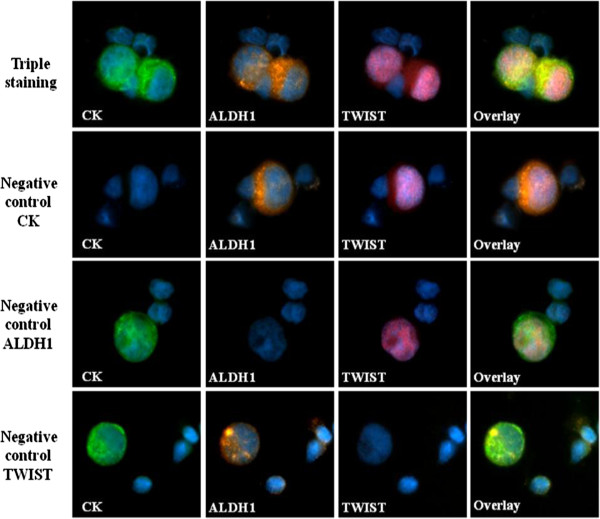
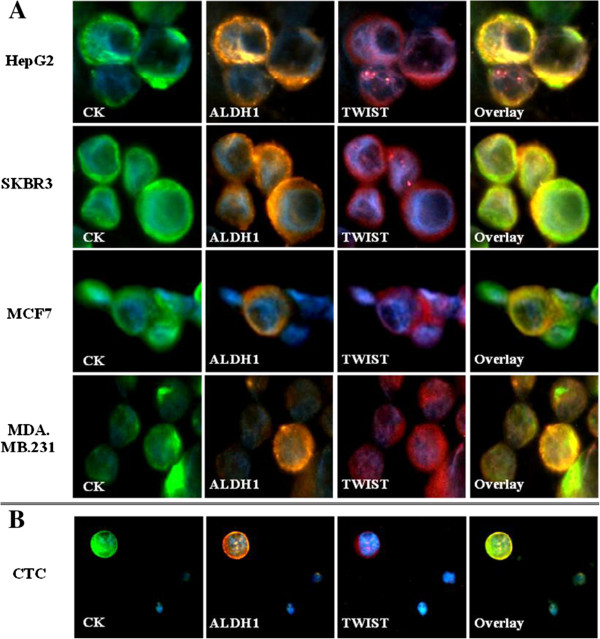
Methods: Triple immunofluorescence using anti-pancytokeratin (A45-B/B3), anti-ALDH1 and anti-TWIST antibodies was performed in cytospins prepared from hepatocellular carcinoma HepG2 cells and SKBR-3, MCF-7 and MDA.MB.231 breast cancer cell lines. Evaluation of ALDH1 expression levels (high, low or absent) and TWIST subcellular localization (nuclear, cytoplasmic or absent) was performed using the ARIOL system. Cytospins prepared from peripheral blood of patients with early (n = 80) and metastatic (n = 50) breast cancer were analyzed for CTC detection (based on pan-cytokeratin expression and cytomorphological criteria) and characterized according to ALDH1 and TWIST.
Results: CTCs were detected in 13 (16%) and 25 (50%) patients with early and metastatic disease, respectively. High ALDH1 expression (ALDH1high) and nuclear TWIST localization (TWISTnuc) on CTCs was confirmed in more patients with metastatic than early breast cancer (80% vs. 30.8%, respectively; p = 0.009). In early disease, ALDH1low/neg CTCs (p = 0.006) and TWISTcyt/neg CTCs (p = 0.040) were mainly observed. Regarding co-expression of these markers, ALDH1high/TWISTnuc CTCs were more frequently evident in the metastatic setting (76% vs. 15.4% of patients, p = 0.001; 61.5% vs. 12.9% of total CTCs), whereas in early disease ALDH1low/neg/TWISTcyt/neg CTCs were mainly detected (61.5% vs. 20% of patients, p = 0.078; 41.9% vs. 7.7% of total CTCs).
Conclusions: A new assay is provided for the evaluation of ALDH1 and TWIST co-expression at the single CTC-level in patients with breast cancer. A differential expression pattern for these markers was observed both in early and metastatic disease. CTCs expressing high ALDH1, along with nuclear TWIST were more frequently detected in patients with metastatic breast cancer, suggesting that these cells may prevail during disease progression.
Figures
References
-
- Cristofanilli M, Broglio KR, Guarneri V, Jackson S, Fritsche HA, Islam R, Dawood S, Reuben JM, Kau SW, Lara JM, Krishnamurthy S, Ueno NT, Hortobagyi GN, Valero V. Circulating tumor cells in metastatic breast cancer: biologic staging beyond tumor burden. Clin Breast Cancer. 2007;7:471–479. doi: 10.3816/CBC.2007.n.004. - DOI - PubMed
-
- Xenidis N, Ignatiadis M, Apostolaki S, Perraki M, Kalbakis K, Agelaki S, Stathopoulos EN, Chlouverakis G, Lianidou E, Kakolyris S, Georgoulias V, Mavroudis D. Cytokeratin-19 mRNA-positive circulating tumor cells after adjuvant chemotherapy in patients with early breast cancer. J Clin Oncol. 2009;27:2177–2184. doi: 10.1200/JCO.2008.18.0497. - DOI - PubMed
-
- Bidard FC, Vincent-Salomon A, Sigal-Zafrani B, Dieras V, Mathiot C, Mignot L, Thiery JP, Sastre-Garau X, Pierga JY. Prognosis of women with stage IV breast cancer depends on detection of circulating tumor cells rather than disseminated tumor cells 11. Ann Oncol. 2008;19:496–500. doi: 10.1093/annonc/mdm507. - DOI - PubMed
-
- Androulakis N, Agelaki S, Perraki M, Apostolaki S, Bozionelou V, Pallis A, Kalbakis K, Xyrafas A, Mavroudis D, Georgoulias V. Clinical relevance of circulating CK-19mRNA-positive tumour cells before front-line treatment in patients with metastatic breast cancer. Br J Cancer. 2012;106:1917–1925. doi: 10.1038/bjc.2012.202. - DOI - PMC - PubMed
Pre-publication history
-
- The pre-publication history for this paper can be accessed here:http://www.biomedcentral.com/1471-2407/14/651/prepub
Publication types
MeSH terms
Substances
LinkOut - more resources
Full Text Sources
Other Literature Sources
Medical
Miscellaneous
